The Sweetness at the Bottom of the Pie, by Alan Bradley

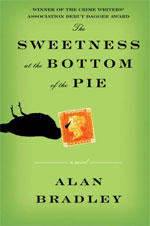
The Sweetness at the Bottom of the Pie, by Alan Bradley

Plucky, precocious 11-year-old Flavia de Luce is the new Nancy Drew. Her inspiring accomplishments aside, the focus on Nancy’s sleuthing prowess left little for character development and made her pretty unassailably a CSI/Detective Barbie. By contrast, Flavia has all Nancy’s investigative chops and some, and combines them with foibles, mischief, intensity and self-deprecation that skew her charmingly into Ellen Page terrain – well, a post World War II, English Ellen Page. She’s a hoot, and you’d want to hang out with her … if, in her independent fashion, she didn’t rebuff you first for some “me time” in her chemistry lab to work on some new poisons or poison antidotes.

Since author Alan Bradley has already published a second installment of Flavia’s adventures (The Weed that Strings the Hangman’s Bag), she obviously survives the scrapes in her first crime solving foray. That doesn’t mean the story is predictable, nor that it doesn’t have its genuinely suspenseful and surprising moments and twists. The supporting cast of characters is colourful, and the dollops of insight into chemistry and philately are intriguing without slowing down plot momentum. There is also an undercurrent of familial angst, tension and depression in the de Luce household that feels authentic because it’s comparatively understated. Bradley would do well to mine that aspect of Flavia’s story in future installments, and he’d be well on the way to crafting a truly unforgettable and fully dimensional young heroine.

So Much For That, by Lionel Shriver

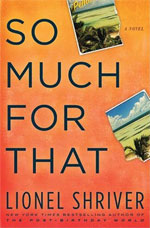
So Much For That, by Lionel Shriver

Lionel Shriver’s So Much For That is a jolting experience, but it’s not a rollercoaster ride. That would suggest moments of ascent and exhilaration as well as gut wrenching downward spirals. So Much For That is more a steady descent into hell for two middle class American families: comparatively modestly living their lives, contending with some challenges, experiencing personal and professional triumphs, making some mistakes and errors in judgement along the way, but nothing that would seemingly warrant the misery that Shriver visits upon them.

What reader would perversely stick around for such a dismal journey, one that dredges up the worst case scenario catastrophes lurking beneath and waiting to be unleashed by everyday occurrences that start out benignly enough: a doctor’s appointment, a credit card debt that is starting to get a bit out of hand, an elderly but still independent parent taking a tumble, a reprimand from a perhaps unreasonable boss about some late office arrivals …?

The reader learns quickly that Shriver doesn’t shy away from a single humiliating detail of those situations run tragically amuck, no matter how intimate or grim it gets. Just as quickly, the reader comes to trust Shriver’s laser precise honesty and the fundamental clarity with which she imbues or finally bestows on her central characters (peripheral characters, not so much – they’re irritating foils, albeit rendered with razor sharp wit). That potent, acerbic honesty means you won’t look away either, no matter how much those scenarios are your own worst nightmares.

As unflinching as Shriver is delineating each character’s folly, self-absorption, selfishness or delusion, she is equally generous showing their resilience, courage and tenderness. The result is a story populated with believable, not always likeable or lovable, fully dimensional characters tackling real situations that might still illustrate our own worst fears, but inspire us to approach them with the same ultimate grace.

Still, is patriarch Shepherd too much a literal rendering of his own name, and perhaps an unrealistic modern Job? After the ragged, searing twists, turns and injustices throughout the novel, is the ending just a bit too neatly sewn up? Perhaps, but after the rough ride Shriver takes her characters and readers on, the ending feels reasonable, compassionate and earned, as Shep captures in a moving and candid moment with his terminally ill and finally fiercely undeluded wife:

“You know, these movies …” He was groping. “Remember how sometimes, in the middle, a movie seems to drag? I get restless, and take a leak, or go for popcorn. But sometimes, the last part, it heats up, and then right before the credits one of us starts to cry – well, then you forget about the crummy middle, don’t you? You don’t care about the fact that it started slow, or had some plot twist along the way that didn’t scan. Because it moved you, because it finally pulled together, you think, when you walk out, that it was a good movie, and you’re glad you went, See, Gnu?” he promised. “We can still end well.”

Chronic City, by Jonathan Lethem

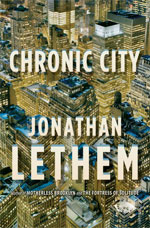
Chronic City, by Jonathan Lethem

Chronic City by Jonathan Lethem feels like an unfettered frolic around an off-kilter and slightly imaginary Manhattan, but it turns out to be tightly and intriguingly choreographed. Tilting back and forth between the probable and the improbable, Lethem follows seemingly bland, naive former child star Chase Insteadman as he becomes enmeshed with a cast of colourful characters involved in the city’s cultural, countercultural and political milieus. Chase absorbs the charms and foibles of an eccentric Lester Bangs-like former rock critic, an attractive but embittered celebrity ghostwriter, a former political radical turned City Hall insider and fixer for the billionaire mayor – and absorbs from afar the wistful missives of a dying astronaut fiancee trapped in the International Space Station.

The increasingly askew city is being menaced by a marauding tiger that can stop traffic and apparently make buildings collapse. The city is further ravaged by peculiar and escalating weather disturbances. As Chase chases his troubled friends around the city and tries his best to give them the different kinds of love and support they demand, he also seems to be chasing some kind of oasis of sanity, safety and predictability in the midst of the maelstrom of a metropolis battered by strange forces. For a time, that safe haven seems to be an apartment building refashioned as a home for abandoned pets. But still, nothing and no one is what it seems to be. In a racing narrative peppered to the end with direct and sly indirect pop references galore, Chase keeps chasing to the last page before he finds sanctuary.

The following quotation is perhaps a bit of a spoiler, but also best sums up what all the storylines and characters converge upon at the end:

“The world was ersatz and actual, forged and faked, by ourselves and unseen others. Daring to attempt to absolutely sort fake from real was a folly that would call down tigers or hiccups to cure us of our recklessness. The effort was doomed, for it too much pointed past the intimate boundaries of our necessary fictions, the West Side Highway of the self, to shattering encounters with the wider real: bears on floes, the indifference and silence of the climate or of outer space. So retreat. Live in a Manhattan of your devising, a bricolage of the right bagel and the right whitefish, even if from rival shops. Walk the dog, dance with her to Some Girls. Why did Perkus have to be killed for his glance outside the frame? But maybe he hadn’t been killed, had only died. And again, maybe absconded. I was sick with ignorance, and my own complicity.”

When he does find sanctuary, the special payoff for the reader is that the tabula rasa central character has in fact absorbed and transmuted all of the confusion and deception (much of it unwitting self-deception) and distilled it into an emotionally authentic finish that will resonate for a long time.

The Last Woman, by John Bemrose

The Last Woman, by John Bemrose

John Bemrose’s The Last Woman focuses on the intertwined lives of an artist, her lawyer husband and her former lover, an Aboriginal community leader in northern Ontario where the artist’s family has had a cottage for many years. The book is thoughtful and carefully crafted. However, Bemrose’s attempt to present all three points in this triangle in as balanced and evenhanded a manner as possible results in the book being overly internal, self-absorbed and ponderous. To one extent or another, each character is emotionally paralyzed at the juncture when Bemrose examines them, and it neither makes for compelling sustained reading nor ultimately rouses much sympathy or empathy for any of them. If in fact the novel is trying to surreptitiously skew towards sympathy for one specific character – as the title and a titular painting might suggest – it doesn’t work.

The book’s descriptions of the natural world and human encroachment on it are very good, even heart tugging in places. I felt much more sympathy for Mother Nature as the “last woman” than for anyone else as the book wound up … and maybe that’s not such a bad thing.

Bemrose’s previous novel, The Island Walkers, was engrossing and engaging. Even with the wider cast of characters compared to his current novel, Bemrose still made each of them authentic and made the reader care about them. Despite some of the weaknesses of The Last Woman, I know I’ll be interested in visiting his explorations of the human and natural world again in future.

Nox, by Anne Carson

Nox, by Anne Carson

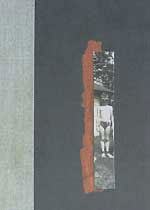
Anne Carson’s Nox is gorgeously crafted, both as poetry and as a book and beautiful object. Carson collaborated with designer Robert Currie to create an extended accordion fold-out of a plump, substantial set of pages that have the feel and heft of a handmade scrapbook. The assembled and folded pages are stored in a sturdy, hinged box, in handsome, muted neutral tones with a family photo album snippet on the lid. The elegance of the outer package seems to be trying to contain the unravelled scope of the pages when they are folded out, just as Carson’s words seem to strive to contain the unfettered life of a loved one she is striving to decode and understand.


(Image courtesy of NYTimes.com)

Nox is Carson’s singular lament for her lost and now deceased brother. Because he left her life early on, and provided and left little for her and her family to reconstruct his life, she approaches understanding and remembering him as she best knows how. She translates him the way she would the fragments of poetry in classical languages, methodically and almost repetitively analyzing every single word down to every possible meaning and variation. She uses as her framework Poem 101 by the Roman poet Catullus, a work that also paid tribute to a dead brother taken before his time. What seems almost monotonous at first grows increasingly moving with every term examined and dissected.

Visually, the jumbled family photos and scraps of handwritten cards and letters are heart clutching. The reproduced textures of torn and crumpled and dog-eared paper and even of the pressure marks of a pen on paper are startling and intimate, compelling you to constantly reach to touch the page.

“Prowling the meanings of a word, prowling the history of a person, no use expecting a flood of light. Human words have no main switch. But all those little kidnaps in the dark. And then the luminous, big, shivering, discandied, unrepentant, barking web of them that hangs in your mind when you turn back to the page you were trying to translate.”

This is a haunting and unforgettable work.

Solar, by Ian McEwan

Solar, Ian McEwan

It’s no coincidence that the epigraph of Solar is a quote from John Updike’s Rabbit, Run. Nobel Prize-winning physicist Michael Beard, the prickly, almost completely unlikable protagonist of Ian McEwan’s latest novel shares the heedless primal energies – and rationalizations for the consequences of those energies – with many of Updike’s retrograde central characters. McEwan attaches this repellent character to the themes of climate change debate and the commoditization of green technologies, and that seems troubling at first. But soldiering through that initially offputting impression, I soon realized that climate change was just one of several sacred cows bulldozed by probably the most cartoonish characters and careening plotline (with a manic quality reminiscent of Don DeLillo’s White Noise) McEwan has ever essayed. And that’s saying a lot. And that’s actually, for the most part, a compliment.

While skewering climate change and environmental discourse through Beard’s blatant opportunism and indifferent scholarship, McEwan also manages to trample everything from marriage to criminal investigations to healthy eating along the way, in rollicking and entertaining fashion. I couldn’t take any of it too seriously because I wasn’t sure McEwan was taking it too seriously himself. I get it, I get it – we have to take a huge grain of salt with the sanctimony of any noble crusade and those espousing same, and climate change is perhaps just as ripe for questioning and comeuppance as anything else. After I’ve been entertained by this book, I didn’t feel there was any longer term message I was supposed to take away other than “wait and see what Ian McEwan will do next.” This book is not going to haunt me the way “The Child in Time” or “Enduring Love” did, and it’s not going to get under my skin the way the somewhat ponderous “Atonement” and the deeply flawed “On Chesil Beach” did. But it was twisted fun while it lasted.

The Children’s Book, by AS Byatt

The Children's Book, by AS Byatt

This vivid, engrossing novel traces the entangled lives of a set of British and German families and friends through the Victorian and Edwardian periods. The book brims with rich description and an almost intimidating amount of social and historical detail, often intermingling the fictional cast of characters with real life figures, including William Morris, Oscar Wilde, JM Barrie and Emmeline Pankhurst. The Victoria and Albert Museum plays a significant role that almost makes it a character unto itself.

The Children’s Book arrestingly captures the collision of different societal, political and cultural forces leading up to the cataclysm of the First World War. With all this potential for both structural and thematic sprawl, the novel still manages to be strikingly emotionally engaging and resonant, to the very last page.

Even when addressing troubling developments and interactions amongst the entwined families, the story always proceeds at a thoughtful and measured pace and takes comfort where it can in the idyllic settings from which the families harken. The country homes of the main families are still havens, even as those places harbour some of the disappointments, secrets, memories and almost literal skeletons in closets that complicate many of their lives. By contrast, the last section of the book seems hurried, but at the same time undoubtedly replicates well the headlong rush into wrenching, unimaginable upheaval that was the First World War. In fact, the jarringly terse tone of some of the final scenes make them that much more affecting.

Byatt weaves myriad recurring images and scenarios throughout – those of flowing water, earth and clay, and puppets, doppelgangers, twins and unwitting siblings (which might be a bit of a spoiler!) are most arresting. On every level, The Children’s Book is a captivating and very memorable read.

Outliers, by Malcolm Gladwell

Outliers, by Malcolm Gladwell

Malcolm Gladwell’s “Outliers” is heartening and gratifying in a general sense, rather than incredibly or specifically edifying. Still, it’s very good, largely due to Gladwell being an accomplished teller of interesting tales rather than a purveyor of startling new theories backed with uniquely, creatively crunched, extensively and exhaustively gathered data. Sure, the hockey player birthday patterns are a bit of an eye-opener, but the snippets of data and trends are not what end up captivating in this book.

Coincidences of birth and being in the right place at the right time might give gifted people an initial and sometimes extraordinary headstart in professional sports, business and industry, arts and popular culture and other walks of life. However, Gladwell contends that those fortuitous elements alone don’t automatically create a Bill Gates, a Lennon and McCartney, a John D. Rockefeller, a Carlos Slim and so on.  A seeming outlier or someone representing by the dictionary definition “an extreme deviation from the mean” in their field of expertise can only become so through hard, hard, ongoing work – at least 10,000 hours of it. (Yes, Gladwell posits the pure embodiment of the old joke, “Pardon me sir, how do I get to Carnegie Hall?”)

But it isn’t just “practice, practice, practice” that completes the formula. Where Gladwell’s book shines and inspires is in its tributes to the sheer, unalloyed passion of the so-called outliers for their so-called work. They were all having so much fun pursuing their love of computer programming or playing the guitar or whatever that the 10,000 plus hours to master their respective crafts probably just flew by, and all of a sudden they were Microsoft and the Beatles and so on.

Gladwell’s forays into cultural aspects that feed into failure or success seem like a distraction from his main thesis, however fascinating. (In fact, the discussion of cultural differences affecting how airplanes pilots do or do not communicate with each other – and the consequences – is riveting.) When Gladwell concludes the book with the heartfelt recounting of his own mother’s story of hard work capitalizing on the particular opportunities that came her family’s way, the real if not intended message of the book emerges. Anyone can be the outlier or the presumed deviation of the norm, by seizing and making the most of the opportunities presented him or her … and everyone can be an outlier if we all work as a society to ensure everyone has opportunities.

The Bishop’s Man, by Linden MacIntyre

The Bishop's Man, by Linden MacIntyre

I enjoyed – yes, genuinely enjoyed reading this book much, much more than I’d anticipated. I’ve always admired Linden MacIntyre as a journalist and assumed he would have an ideally balanced perspective, of both compassion and acuity, for such controversial subject matter as the sexual abuse scandals associated with the Catholic church. That admiration and confidence in the author’s vision still didn’t give me the stomach, though, for a story so closely ripped from the headlines, with the news of more allegations against another Catholic priest hitting right around the time “The Bishop’s Man” was longlisted, then shortlisted for the coveted Giller Prize. Long past the time that the book won the prize, I’ve finally read it, and am glad I did.

The voice of Father Duncan MacAskill is dry at first, blandly and reticently stating the facts of his acknowledged work within the Catholic church, among parishes in the Maritimes, as something of a fixer for the bishop. His more benign moniker is “The Bishop’s Man”, but many of his fellow priests refer to him as the “Exorcist” for his behind-the-scenes work defusing situations and relocating men of the cloth who have strayed into various forms of scandal. He questions his role and his own faith as the job entails not only covering up unsavoury situations, but also increasingly includes running interference with communities, families, the police and media.

Father MacAskill’s words and observations may be spare at first, but they are not unaffecting. As he joins a new parish close to his birthplace and slowly establishes new connections and re-establishes dormant family connections, his is not the voice of someone who doesn’t care, but that of someone who has cared much too much and is shell shocked by what he has seen and experienced. As he gets thrust more and more reluctantly into situations that test his conscience, he learns harshly that things are not what they seem, in what unfolds dramatically before him in the present, but also in pivotal chapters of his own past life.

In the end, the bishop’s man realizes with some relief and humility that he is just a man, but also beholden to neither the bishop and what the bishop represents, nor to anyone else. That realization leaves much unknown for MacAskill at the end of the book, but leaves the reader glad to have seen him along his journey.