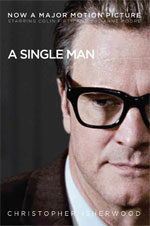
Truth be told, I came to this book by way of the movie (and hence the book cover art which, for sake of accuracy, is the version of the book I read, showing Colin Firth depicting central character George). I love thoughtfully made movies, but they are not my preferred avenue to discover books … but sometimes it works out for the better and this is one such case.
A Single Man, the mid-1960s short novel by Christopher Isherwood, captures the delicate minutiae of one person’s day, along with that person’s welling emotions and surprising spirit. George is a literature professor at a college in Southern California, set in the time in which the book was written and published. He is grappling with the sudden death of his longtime lover, Jim. While going about his day and his usual encounters in his neighbourhood and workplace, he is struggling from moment to moment with, well, how to *get* from moment to moment in the face of pervasive grief. I won’t spoil either the book or the movie by saying that each interprets differently George’s success in this struggle. In both, the end of George’s day is both ironic but oddly life affirming. In both, it’s entrancing to share the protagonist’s 24-hour journey.
Migration Songs by Anna Quon is a most worthy addition to the CanLit mosaic. The book’s own mosaic is a sympathetic and memorable cast of characters of varying pedigrees contending with literal and figurative migrations in their respective personal journeys.
By the dictionary definitions, a migration is the seasonal passage of groups of animals for survival, feeding and breeding, or the movement of a person or persons from one country or locality to another. While one sounds natural, normal, organic and positive, the other sounds possibly artificial, forced or prompted by negative reasons. This dichotomy distinguishes the types of migrations of various characters surrounding the troublingly static main character, who is finally compelled and inspired to set her own migration in motion.
The narrator of Migration Songs is reclusive, rueful Joan, a 30-something variously un- or underemployed loner. She sits at the eye of a storm of swirling and intersecting migration paths that enfold and perhaps protect, but increasingly intimidate, confuse and paralyze her. Joan’s mother Gillian is a fiercely determined Chinese-Canadian immigrant who forged her own migration from her parents’ tradition by resisting an arranged marriage to find her own choice of partner, David, who in turn migrates from England to start a new life with his wife. He had perhaps already set his personal migration in motion before even meeting Gillian by diverging from his British upbringing to become an avid if perhaps naive Maoist. David and Gillian’s transition into marriage and parenthood ultimately separates into divergent personal migrations.
As influential as her parents are to Joan is Edna, a feisty Hungarian immigrant who works as a live-in housekeeper in Joan’s family’s neighbourhood. Edna becomes a de facto parent, mentor and champion for the often fragile Joan. The true extent to which Edna’s own life was a series of daunting migrations – not just from one country to another, but over and through harrowing personal terrain – does not emerge until Edna has aged, has moved to a retirement home and is starting to descend into dementia. When Joan is finally in a position to both repay Edna’s devotion and pay tribute to her personal courage, she is able to set in motion her own migration, unfurl her own migration song and confidently take hold of her own life.
While there is much to recommend this book, Quon particularly excels at capturing the perceptions and wonderment and misapprehensions of a child as she traces Joan’s life and arrested maturity. While fragile, Joan is still extraordinarily faithful and stalwart, and even determined in her fashion. Quon has managed to create an indelible character in Joan who is comparable to young, troubled but striving heroines from Anne Shirley to Madeleine McCarthy of The Way the Crow Flies to Thebes Troutman of The Flying Troutmans.
Is having migrated in one form or another (through parentage, heritage, what one calls home) a self-fulfilling or self-denying construct? Some survive and thrive when they migrate, others allow the fact of having migrated in one form or another – or maybe to have been denied the opportunity to migrate – to always impede them. As frustrating as Joan’s inertia and reticence can be at points throughout the book, the reader is always rooting for her, hoping she’ll ultimately find some direction for her own migration.
Author Anna Quon offers some inspiring insights into her own journey or migration to write this book in the following interview:
Eilean Ni Chuilleanain has apparently been accused by one past reviewer of lacking “killer instinct”, whatever that is supposed to mean when one is crafting poetry. (At any rate, Ni Chuilleanain turns that phrase to striking advantage in one of the most vibrant pieces in this collection.) The poems in The Sun-fish are dense, demand undivided attention and are often understated, sometimes to a fault. However, Ni Chuilleanain’s simultaneously grounded and transcendent verse pays off with fresh, sometimes pointed insights into human resilience.
Deserving winner of the 2010 International Griffin Poetry Prize, The Sun-fish even shades into the acerbic with selections such as the delightfully sly “Vertigo” (“How did such smart women acquire such a mother?”). “The Sister” is a haunting selection, which Ni Chuilleanain read at the Griffin Poetry Prize readings in the spring of 2010:
Reflective reading will reward the patient reader of this deceptively slim but surprisingly rich and deep collection.
The poems in John Glenday’s Grain are unassumingly stoic and plainspoken, ranging from wistful and tender to self-deprecating to harrowing (“Song” and “Grain” have, unfortunately, particularly unforgettable images). Even when he jolts the reader, though, all of the work in this succinct volume has a strong underpinning of humanity and wry compassion.
Grain was recently shortlisted for the 2010 International Griffin Poetry Prize. The judges’ citation captures well the essence of this deservingly nominated work:
“[Glenday] listens carefully to the language he works in. [His poems are] also playful: a tin can, a peculiar fish, invented translations, made-up saints all can suggest poems. It’s refreshing to discover a poet whose work is earthly, full of rivers and hills and islands, but where old ideas like ‘love’ and ‘soul’ have not been banished. Grain is the work of an unhurried craftsman; John Glenday has made poems of understated integrity and humanity.”
“Nothing is simpler than to step through the doors of the universe. First, you switch on your computer. Then rapture begins, when you teeter on the edge with the world at your fingertips, gaping open like a gigantic box of candies that your two hands and your one lifetime could never hope to exhaust.”
This description sounds the first note of genuine passion in the voice of the forlorn narrator of Monique Proulx’s “The Heart is an Involuntary Muscle”. That it follows the emotionally stunted heroine’s last moments with her dying father is very telling. That Proulx is able to sustain the reader’s interest in the misadventures of a cynical, often thoughtless, only sporadically motivated and interpersonally inept narrator illustrates how deceptively accomplished and ultimately winning this book is.
Florence is a Web designer whose only other passion apart from drifting into the online ether is Zeno, the owner of the small Web design firm for which she works, and her on-again, off-again lover. Even the presumably most important and most passionate relationship in her life is intermittent at best. But it’s through the Web design business, which specializes in developing online presence for obscure or underappreciated writers and artists, that Florence finally discovers a subject worth abiding focus, interest and yes, passion. As she becomes entangled with a Thomas Pynchon-esque writer and his wife, Florence begins to confront the life she has lived thus far and assesses why she has not really invested in anyone or anything to that point.
“The Heart is an Involuntary Muscle” bogs down ever-so-slightly about midway, but the murkiness is more likely a reflection of Florence’s inarticulate bewilderment at the new feelings welling up as she becomes more enmeshed with the enigmatic writer than any shortcomings in Proulx’s (and her translators’) precision of expression. Overall, the book is very intriguing and insightful in terms of creating some rich, albeit sometimes frustrating but therefore authentic, characters. Surprisingly, the book’s plot grows increasingly suspenseful as Florence’s involvement with the writer and his wife, and her perhaps on-again relationship with Zeno reach interesting crescendos. The book also offers some intriguing asides about people and their personae and relationships or lack thereof as interactions are conducted online, which sit in striking and instructive contrast to the fumbling interactions of the characters in real life.
The Imperfectionists, by Tom Rachman is not just an exquisitely crafted gem of a book – it’s a series of exquisitely crafted gems that each stand and glimmer gorgeously on their own, but have considerable additional power and depth arranged together in one elegant setting.
The book serves up a connected series of chapters or short stories about the people running and contributing to, with varying degrees of effectiveness and dedication, an international English-language newspaper in Rome. The main stories are set in the near present, but each story concludes with a chronological series of sharp snippets tracing the founding of the paper back in the 1950s. In addition to the particular personal or professional challenges of the central character of each chapter, there is a strong undercurrent of the overall challenges of a news organization contending (or pointedly not contending) with social, cultural and technological changes in news gathering and consumption.
Rachman’s own background as a former foreign correspondent with Associated Press gives The Imperfectionists’ clear and confident industry insights. These are coupled with Rachman’s formidably acute emotional sensitivity, gracefully understated and all the more powerful for it. With just a few brush strokes, Rachman captures the essence of each of his wide range of characters, and makes even the supporting players in each vignette well-rounded and memorable. Gerda Erzberger, the aging feminist writer who appears in obituary writer Arthur Gopal’s poignant sequence, is a standout. With just a few words, she becomes a striking presence who adds resonance to Arthur’s heartwrenching story.
Rachman combines his subtle and unforgettable character portraits – much deeper than just character sketches – with often surprisingly riveting storylines. Resolutions range from the comic to the tragic to even the vaguely menacing, but they all ring true as they are grounded in soundly believable people and circumstances.
The fact that this is Rachman’s first novel (or collection, if you prefer to view it that way) makes this reader both impatient and slightly wary of what will come next from him. The prospect of more finely honed delights like The Imperfectionists is delicious, but has he set the bar impossibly high for himself? I’m certain I’m one of many readers eager to find out.
The poems of The Certainty Dream by Kate Hall all have that clear-eyed, precise and utterly wacky conviction about what is right according to the opaque, hilarious and sometimes terrifying logic of dreams. This conviction (certainty, indeed) permeates almost every poem in this strong first collection, but “This is a Dream Letter” is an especially haunting standout.
Bird and flight imagery also pervades much of the work here, just as the inexplicable but perfectly logical ability to fly often shows up in many dreams. However, Hall’s birds are not always soaring and trilling sweet songs. As well, the bird imagery is sometimes slyly and perhaps menacingly counterbalanced by cat imagery.
The Certainty Dream’s inclusion in the 2010 Griffin Poetry Prize Canadian shortlist was both charmed and deserving. It was charmed in that Hall shared the shortlist with the late PK Page, who was an early mentor as Hall embarked on what will undoubtedly be a notable literary career … and charmed as well because she shared it with Karen Solie, this year’s Canadian winner who previously appeared on the Griffin shortlist with a lauded and memorable debut collection. And yes, the inclusion is deserving, because The Certainty Dream is singular and assured and explores intriguing territory, as summed up in the Griffin judges’ citation:
“As the dream world and the waking world blur, the body and the dimensions it inhabits become a series of overlapping circles, all acting as containers for both knowledge and uncertainty. At times disarmingly plainspoken, at others, singing with lyric possibility, these poems make huge associative leaps.”
Perhaps this snippet from “Suspended in the Space of Reason: A Short Thesis” suggests that Hall intends to hone further her creative acuity and demand much of herself as she embarks on her particular literary journey:
Bats basically scream until they hear their voices echo off bugs and trees. Then they know where they are and exactly what and how large the thing is they are hunting. … Yesterday I yelled at myself and nothing came back at all.
This sweet-natured story of a boy and his dog is distinguished by its authentic-sounding voice of the farming and hunting communities of the Kentucky mountains. Published in the early 1960s, it captures a time, place and people, but avoids being a dated read. The bond between young teenage Caleb and Outcast, the part-Airedale hound who everyone else initially rejects but who proves himself to be a wily and reliable hunting dog, is genuinely and sensitively traced without becoming maudlin. It’s an affecting and timeless tale.
Karen Solie’s poems have a voice that is a potent amalgam of emotions and perspectives. In that voice is the spiritual grit and respect for the natural world of someone raised on a farm. In it, too, is the cynical resilience of someone who has chosen to be an urban dweller, and who manages to celebrate what is harsh and quirky about that environment. It’s all tempered with revelatory sensitivity and tenderness, often prompted by chance collisions of those natural and less natural worlds. “Migration” – movingly dedicated to her aunt when Solie read it at the Griffin Poetry Prize readings in Toronto this spring – is a standout.
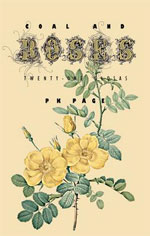
P.K. Page took on the stylistically challenging formal glosa form for each poem in Coal and Roses, which was to become her last poetry collection before her death in January, 2010 at the age of 93. As described at the opening of the book:
The glosa form opens with a quatrain, borrowed from another poet, that is then followed by four ten-line stanzas terminating with the lines of the initial passage in consecutive order. The sixth and ninth lines rhyme with the borrowed tenth. Glosas were popular in the fourteenth and early fifteenth centuries among poets attached to the Spanish court.
That Page would tackle such a labyrinthine approach to poetic expression when others would be long retired from their chosen career or metier attests to her abiding intellectual curiosity and enthusiasm for her craft. That she could apply a form that perhaps sounds fusty and overly complex to fresh subject matter, in varied and lively styles, exploring a range of traditions, is revelatory. That she could take as her inspirations and starting points such diverse poetic voices as Margaret Cavendish, Ted Hughes, Don McKay, Gwendolyn MacEwen, Jorge Luis Borges, Dionne Brand, Anna Akhmatova and more is breathtaking, offering a vibrant primer for those wishing to expand their poetic education and horizons. That this collection could go on to share the Griffin Poetry Prize shortlist with Kate Hall, a young poet who was once mentored by Page, is a gorgeously bittersweet tribute to a respected literary grande dame.
The stunning beautiful Coal and Roses by P.K. Page is a gift to all poetry lovers, a testament to the life of an extraordinary and generous artist, and an essential literary work.