Celebrating Anne Carson Every Day In August

I’m thrilled to introduce Bookgaga blog visitors to a very special guest book reviewer. Amanda Earl is an eloquent and prolific literary supporter, and writer and artist in her own right. I suspect many of you reading this blog already know her and perhaps have met her in person at one of the many arts events in which she takes part. Amanda’s most recent poetry chapbooks and e-books are “Sex First and Then A Sandwich” (above/ground press, Ottawa, Ontario, 2012), “me, Medusa” (the red ceiling press, UK, 2012). Her poems appeared recently or are forthcoming in Rampike, fillingStation and In/Words Magazine. Amanda is the managing editor of Bywords.ca and the Bywords Quarterly Journal, and the (fallen) angel of AngelHousePress. Follow her on Twitter @KikiFolle or Pinterest pinterest.com/kikifolle/. For more information, please visit amandaearl.com.

If I understand correctly, the object of Today’s Poem (#todayspoem) is to expose the general tweeting public (the Tweetosphere) to a daily dose of poetry in 140 characters or less. These poem bits are also posted by ardent poetry enthusiasts or Internet junkies, take your pick, on Pinterest, along with a photo of the author or book cover. Today’s Poem is the brainchild of Vicki Ziegler, who I know as @Bookgaga on Twitter, but haven’t had the pleasure of meeting yet. I am trying to lure her to the Ottawa International Writers Festival this fall for tea and book mayhem.

I began taking part in Today’s Poem this year, most likely in January. At first, I simply opened a book of poems at random and tried to find an excerpt that was compelling and brief enough to post. I had some trepidations about this exercise. What if I wasn’t representing the poet’s work properly by excerpting those 140 characters? I found I often had to exclude parts of lines to fit within the 140-character limit or I could choose to continue in another tweet, thereby breaking the line with the noise from the traffic of other tweets. But the thought of the goal of the exercise, to help people (and myself!) rediscover or discover exciting poetry, motivated me to dive in. I think this is a very creative use of Twitter, which is often just a place for narcissistic self-promotion and the repetition of sweet homilies. I commend @BookGaga for her altruism and initiative.

July 12: “Sweet sweet sweet sweet sweet tea./Susie Asado.” Gertrude Stein
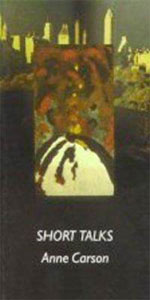
Short Talks, by Anne Carson

My most recent month-long ritual has been to post lines from the work of Anne Carson, not just her poetry, but also her translations of Greek and Latin plays, her essays and her novellas in poem form. I am fascinated by Carson’s exploration of form, the tension between formal elements and the everyday. As a former translator myself, though never a literary translator, I am interested in Carson’s take on the translation, both in the essays she writes about a single word, such as “bittersweet” and the translations themselves in the way in which they enliven and create their own new spaces, much in the way Erín Moure, another literary hero of mine, does with her translations from the Galician or invented personas.

I think of Anne Carson as a model of literary exploration, my older poetic sister. She is eclectic and daring, willing to try anything to explore the limits of her craft, and I respect that, aspire to it for my own writing. Not to mention that she didn’t have her first book published until she was 42 when Brick Books published Short Talks, probably the most treasured of her books on my shelves. While I’m past 42 by many years, Carson demonstrates that there is hope for the spineless.

Starting August 1, 2012, I posted a line from the most recent collection of her work I own, Nox. I don’t have Antigonick yet, Carson’s update of Antigone in a form similar to that of a graphic novel.


My poetry shelves are arranged for the most part alphabetically, and for the most part, according to the order that the work was published, but books have a tendency to unsort themselves for the avid reader. I posted lines from Carson’s work in approximately publishing order with most recent first.

August 1: “The phoenix mourns by shaping, weighing, testing, hollowing, plugging and carrying towards the light.” Nox (New Directions, 2010)

I am intrigued by Carson’s focus on the retelling of myth and the reanimation of Greek and Latin literature to present day. I wasn’t educated in the classics, alas. Carson’s writing is a way to learn about them, a way in.

I love Carson’s wit and sense of humour:

August 8, 2012: “Always planning ahead that’s me, practical as purgatory my mom used to say.” Decreation: Poetry, Essays, Opera (Knopf, 2005)

Am astounded by the beauty of her lines, which aren’t sentimental, but visual and memorable, often with an edge:

August 12, 2012: “A fell dark pink February heaven/Was/Pulling the clouds home, balancing massacre/On the rips.” Men in the Off Hours (Knopf, 2001)
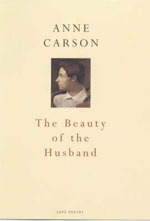
The Beauty of the Husband, by Anne Carson

August 18, 2012: “Hotel gardens at dusk are a place where the laws governing matter/get pulled inside out,/like the black keys and the white keys on Mozart’s piano.” The Beauty of the Husband (Knopf, 2001)

Carson deals with concerns such as death, anger, youth, beauty in ways that resonate and strike a universal chord.

August 23, 2012: “Youth is a dream where I go every night/and wake up with just this little jumping bunch of arteries/in my hand.” Plainwater (Knopf, 1995)

For a very good overview of Carson’s work and insightful interviews, I heartily recommend:

  • the Blaney lecture from October, 2010

I have been gratified by the responses of others on Twitter and Pinterest. Carson’s lines from Today’s Poem have been retweeted and repinned by people from all over Canada and the UK, possibly from the States too. One of the goals of this exercise for me is to spread the good word about poets whose work excites me.

August 31: “Sappho begins with a sweet apple and ends in infinite hunger.” Eros the Bittersweet (Princeton University Press, 1986)
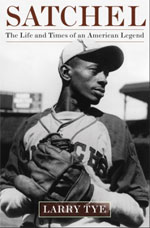
Satchel: The Life and Times of an American Legend, by Larry Tye

Satchel: The Life and Times of an American Legend, by Larry Tye

In one of the sports literature arenas that already boasts many seminal works of great storytelling and rhapsodic prose, Satchel: The Life and Times of an American Legend, by Larry Tye is a distinguished, inviting and elucidating addition. The book captures a pivotal time in the evolution of baseball and of North American society. As if there isn’t already a motherlode of stories and milestones to make that a captivating read, this book is rendered even livelier because it focuses on arguably the sport’s greatest practitioner and groundbreaker on numerous levels: athlete, entertainer, ambassador, philosopher clown prince and African American icon Leroy Robert “Satchel” Paige.

Close to the turn of the last century, Satchel Paige was born in Mobile, Alabama into the brimming, struggling but loving family of gardener Robert and domestic worker Lula Page – “close” because Satchel’s birthdate was long in dispute and frequently subject to scrutiny and confusion, some of it generated by Paige himself. And yes, even the spelling of Paige’s name changed as he embarked on a storied career as a virtually unstoppable baseball pitcher with raw talents evident at an early age that were honed starting with a teenaged stint in reform school.

Paige’s professional journey took him through the Negro leagues, an evolving amalgam of amateur, semi-professional and professional teams and leagues comprised chiefly of African Americans and some Latin Americans. The Negro leagues started in the late 1800s and lasted until the early 1950s, overlapping with Major League baseball for a few years after black players started to be integrated in that white-dominated sporting domain. Paige himself weighed in to the debate about who should have been the very first black player to break the baseball colour line, a role that fell famously to Jackie Robinson. Paige was still one of the first to cross that often treacherous barrier with signature aplomb, and certainly the one to leave the most indelible marks. Those marks were made and cemented before he departed after his last professional game in 1966, just shy of his 60th birthday (assuming we could, by then, trust his purported birth certificate).

If the range and longevity of Paige’s professional accomplishments against a backdrop of racial tension and societal change isn’t riveting enough, there’s also the diverting portrait of a singular man: charmer, trickster, and bon vivant (whether, at any given time, he could afford the cars, clothes, food, drink, companions, appurtenances et al that filled his lively and peripatetic life to overflowing). He was a life force exuding an ebullience that probably intentionally glossed over the pain he contended with maintaining a seemingly effortless physical prowess that was in play, quite literally, year round – from league play to barnstorming and other games and exhibitions across the United States, Canada, Mexico and the Caribbean. That pain surely extended to the emotional challenges of being separated from loved ones, not to mention being socially separated, even when that was supposedly a thing of the past. Paige’s almost unstoppable and at times inexplicable joie de vivre only seemed to fray around the edges in his final years, when he was out of the game and probably felt freer to give vent to some of the injustices with which he’d contended and had seemed to dance over, around and through at the time.

Author Larry Tye’s skills at distilling a complex story with layers of themes, towering mountains of data and gaping valleys of omissions in the data (for a sport deeply fascinated with and rich in statistics, recordkeeping in the early days and outside of the then exclusively white major leagues was sketchy at best) are breathtakingly impressive. That the themes and data are digestibly interwoven with infectious storytelling – true or tinted delightfully rose-coloured, all told with gusto – is more impressive still. That this daunting assignment was further complicated by a central figure who contributed as much to his own mystique as he did to his rightful legend makes the whole package, with astutely marshalled sources and research, extraordinary.

Some knowledge of baseball is useful to follow the terminology and have some frame of reference for the excellence of the accomplishments of Paige, his contemporaries and those who came after. Still, the reader will not be intimidated by an overly technical examination of the game. Tye frames well and accessibly where Paige stood in the context of the sport and its evolution, along with where he stood in the context of social changes external to but internalized by and affecting the sports world in which he operated and often but didn’t always thrive. Finally, Tye paints a vivid but also clear, honest picture of Paige, where there are wide and vibrant swaths of impressionistic versions of Paige out there (with some brushstrokes by Paige himself), but bringing the man into the sharpest focus possible to date, and possibly ever.

Satchel: The Life and Times of an American Legend is, by the way, a great read aloud book – that’s how my husband and I read this entire book. That’s tribute to Tye’s crisp, pleasant style which matches Paige’s argot in note perfect tandem … and of course, to the treasure trove of witticisms and repartee either on the record or legendarily associated with Paige and his contemporaries. (Yes, you can easily and abundantly google them.)

#thursdayreviews to help with your #fridayreads

We all know about the storied and powerful #fridayreads hashtag and tradition, whereby folks tweet what they’re reading on Friday. It’s a way to shout out and celebrate reading, good books and hard working writers, publishers and booksellers.

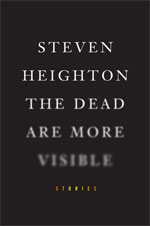
The Dead Are More Visible, by Steven Heighton

While touting the virtues of one of writer Angie Abdou’s great book reviews today (The Dead Are More Visible, by Steven Heighton), a fellow book tweep (@davideburga) declared that the review had inspired him to make the book his #fridayreads selection. Ah, the instantaneous, twinkling magic of Twitter!

So, OK then … What if we pointed folks to great reviews before Friday, so that they can make some good and informed reading decisions for Friday and the weekend?

Thus is born #thursdayreviews … let’s see how it goes:

  • For #thursdayreviews, on a Thursday, tweet a link to a good review of a book that you think someone should make his/her #fridayreads.

  • The #thursdayreviews link can be to your own review, or a review that you like and/or that inspired you to pick up a specific book.

  • In the spirit of the week that was (start here), #thursdayreviews can also be a negative review of something that shouldn’t be one’s #fridayreads. Ahem. Be nice, or at least be constructive, OK?

Are you in?

See also:

#thursdayreviews contributors on Twitter

Six months of #todayspoem

Poets Linda Besner, Robin Blaser, Lavinia Greenlaw, Ko Un, P.K. Page and Ian Williams

or 147 poets in 184 days (or so)

Did I have any idea I’d be this far along a journey through poetry when a bunch of us bookish Twitter friends had the first #todayspoem discussion back in late 2011? What I did know is that I felt very committed from the outset to giving it a concerted try. I would do my best to read and share via Twitter every single day an excerpt from a poem to which I’d given some consideration and reflection. So far, so good. I was still enthusiastic when I checked in after two months, and six months in, I’m still interested, motivated, intrigued, jazzed … and have yet to miss a day.

What I didn’t know when I sent my first #todayspoem tweet on December 25, 2011 was where my poetry explorations would take me. What I also didn’t realize is how many others would be along for the adventure, and how their contributions, comments and insights would send me off on new side trips along the way.

Overall, the exercise (which has never felt like an exercise, actually) has compelled me to revisit and go deeper in my own library. It has also inspired me to go further afield in print and online, with poets with whom I was already familiar, but also very excitingly with poets old and new I was encountering for the first time.

And what of the daily poetry excerpts and selections themselves – my own and those of other #todayspoem contributors? Well, every day is a fresh intersection with where I am and how I’m feeling and what that day’s poem provokes, evinces or confirms. Not a day goes by that those simple tweets and where they lead have amused, amazed, surprised, touched, agitated, intrigued and more. Try it for yourself.

So, without (much) further ado, here is a list of the poets whose work I’ve read and incorporated in #todayspoem tweets since December 25, 2011. For each name, I’m going to link to a biography, article, interview, review or some other resource that might inspire you to go off on a few poetry side trips yourself. Thank you to the poets, publishers, #todayspoem contributors and poetry lovers in general who have filled and enriched the first six months of this venture, and are likely to help me turn this into a lifelong habit.

“How often I look back
for the moment my footprints
fade from sight

the dew undisturbed and the moss – “
Emily McGiffin, As Air from Between Dusk and Night (2012, Brick Books)

“To crow
would have been
out of place;
and besides
this rooster
wanted to be different.”
Irving Layton, The Laughing Rooster (1964, McClelland and Stewart)

“The paper’s still empty, the poem unwritten.
You would have done better to have talked to your mother.”
PK Page, How to Write a Poem from Coal and Roses (2009, Porcupines Quill)

“For he is tenacious of his point.
For he is a mixture of gravity and waggery.”
Christopher Smart, from Jubilate Agno (written 1759-1763)

“Kevin Costner stayed in this hotel
Babe Ruth and Calvin Coolidge too
This is a sacred place”
August Kleinzahler, Sleeping It Off in Rapid City (2008, Farrar, Straus and Giroux)

“I started spelling my name backwards,
retreating from the space a name makes.”
Rosemary Sullivan, Sisters from The Space a Name Makes (1986, Black Moss Press)

“and the wind began to blow and all the trees began to bend
and the world in its cold way started coming alive.”
John Darnielle, Woke Up New from Get Lonely (2006)

“It’s the spot where the dogs
always stop overlong, then look at me as if to say,
Explain this, please.”
Chase Twichell, The Park From Above (2012, Plume Poetry)

“And when Peace here does house
He comes with work to do, he does not come to coo,
He comes to brood and sit.”
Gerard Manley Hopkins, Peace from Poems (1918)

“It was the last conversation I ever had with her.
I told her I liked baseball, to make her happy.”
Dave McGimpsey, What Was That Poem? (2011, Walrus Magazine)

“Outside there are sirens.
Someone’s been run over.
The century grinds on.”
Margaret Atwood, Secular Night from Morning in the Burned House (1995, McClelland and Stewart)


See also:


2012 reading list (so far)

Selected 2012 reading so far

Here are the books I’ve read so far in 2012, with links where they exist to books that I’ve reviewed (either here on this blog or briefly on Goodreads). As I’ve remarked before, it’s a competition with no one but myself, but it is always interesting to reflect halfway through the year where one is at with one’s reading, both quantitatively and qualitatively. This has been another good year. How is your reading going so far in 2012?

    canlit

  1. The Game
    by Ken Dryden (reread)

  2. The Money Tree
    by Sarah Stewart and David Small

  3. canlit

  4. The Antagonist
    by Lynn Coady (reread)

  5. The Marriage Plot
    by Jeffrey Eugenides

  6. canlit

  7. Something Fierce – Memoirs of a Revolutionary Daughter
    by Carmen Aguirre

  8. canlit

  9. Expressway
    by Sina Queyras

  10. canlit

  11. Algoma
    by Dani Couture

  12. canlit

  13. Autobiography of Childhood
    by Sina Queyras

  14. canlit

  15. I’m Starved For You
    by Margaret Atwood

  16. Inside of a Dog – What Dogs See, Smell and Know
    by Alexandra Horowitz

  17. canlit

  18. On a Cold Road
    by Dave Bidini (reread)

  19. canlit

  20. Believing Cedric
    by Mark Lavorato

  21. Audio Obscura
    by Lavinia Greenlaw, photographs by Julian Abrams

  22. canlit

  23. Why Men Lie
    by Linden MacIntyre

  24. canlit

  25. Methodist Hatchet
    by Ken Babstock

  26. canlit

  27. The Love Monster
    by Missy Marston

  28. Detroit Disassembled
    by Andrew Moore, essay by Philip Levine

  29. canlit

  30. The Sisters Brothers
    by Patrick DeWitt
    (guest review by Barbara McVeigh)

  31. canlit

  32. Night Street
    by Kristel Thornell

  33. canlit

  34. The Juliet Stories
    by Carrie Snyder

  35. canlit

  36. Killdeer
    Phil Hall

Currently in progress:

  • The Blue Book, by A.L. Kennedy
  • The Collected Short Stories of Lydia Davis
  • Satchel: The Life and Times of an American Legend, by Larry Tye

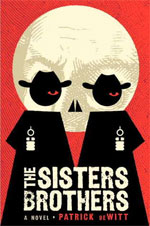
The Sisters Brothers, by Patrick DeWitt

I’m delighted to introduce Bookgaga blog visitors to another splendid guest book reviewer. Barbara McVeigh is a dedicated and enthusiastic teacher-librarian working in Southwestern Ontario. She’s a writer and avid, omnivorous reader who combines her own interests, such as cycling, with particular emphasis in her reading and book curating on the area of sport literature. Barbara is active on Goodreads, and you’re guaranteed a lively discussion when you converse with her via Twitter – @barbaramcveigh.

The Sisters Brothers: A Defense

The Sisters Brothers, by Patrick DeWitt

I was reluctant to read The Sisters Brothers for a long time. It was getting mixed reviews and being nominated for so many damn awards. Not a good sign. However, I bought (and read) the book because I was attending the Stephen Leacock Medal presentation, which The Sisters Brothers had won.

The book has been criticized as not having a story, for having too much senseless violence, and for its weird, anachronistic language and characters. Because of all these reasons, I loved the book.

In terms of plot, The Sisters Brothers moves along in short chapters. Each chapter left me breathless and wondering where the characters were going to next. We do not expect what happens to happen. For example, after being treated for a tooth infection and then robbing the dentist of his novocaine, the narrator defies a witch’s curse in order to save a horse he doesn’t want from a grizzly bear. These short chapters allow the brothers to quickly move from place to place and interact with the best the Wild West has to offer.

The novel also delivers emotional sucker-punches and subverts the expectations of the Western genre. In a typical Western, you’d have two cowboys in white hats who come to save the day. Instead, we have the brothers Charlie and Eli Sisters whose job it is to mercilessly kill Hermann Kermit Warm, and dispose of anybody who gets in their way. When hatching a plot, Charlie says: “Morals come later. I asked if [the plan] would make sense” (DeWitt 222). As they head towards their mission and move from misadventure to misadventure, we cheer them on.

The strength of the subversion lies in the empathy the reader feels for Eli Sisters. I read this book out loud to a student and was immediately struck by the strength of the voice: gravelly, rolling and soaked with whiskey. Now Eli isn’t just your run-of-the-mill heartless killer. He’s looking for true love and personal improvement. He is also loyal to his bloodthirsty brother. Yet, Charlie (whom is often described as a psychopath in reviews) doesn’t always come across as the baddest of the bad, either. At one point Charlie tells Eli the story of how Eli got his freckles. The story demonstrates their brotherly bond, as well as revealing Charlie’s protective spirit.

Still, these aren’t men in white hats. When the brothers are in situations where they could behave as if they were good guys, they defy our expectations. On their way to California to find Warm, Eli and Charlie come across a 15-year-old boy alone in the wild. They give him food and listen to his life story. Apparently, everyone who meets this boy hits him on the head. In the usual Western script, the reader would expect that the two heroes would adopt the boy and care for him. But Charlie and Eli can’t: They’re assassins. They hit the boy on the head to disarm him and then abandon him (not once, but twice) on their journey.

The reality of scenes like this would be horrible if played straight. Patrick DeWitt at the Stephen Leacock presentations spoke about using comedy as a weapon. The humour deflects the bite of reality. This is the Wild West “where life ha[s] no value” (Fisher). The boy evokes every sense of pathos: no mother, a missing father, unrequited love, and a naive optimism that the brothers will take him under their wing. Their interaction is touching and funny, and then the boy disappears from the book. Like all the minor characters in the novel, whether it be the intermissions girl, the dirt coffee prospector, or the weeping man, these characters appear “for no real reason” (Edwards). In an interview, DeWitt says that these characters have no symbolic value; they are just “semi-humorous vaudevillian prop[s] wandering into someone else’s scene” (Edwards). What these characters do provide is the quirkiness and atmosphere for this great rollicking story.

The action quickly continues to California and comes to an unexpected conclusion. There’s a moment when the elastic seems to snap backwards and fortunes are reversed, much like Martin Amis’s Time’s Arrow.

Initially, I felt the ending wasn’t satisfactory. There’s a reversal of position for Eli and Charlie, but I wanted them to get some sort of reward. A few readers (and definitely some characters) might say that, in the end, Charlie and Eli got their “just desserts”. Still, I felt that since we’ve grown to like these two anti-heroes, something good should’ve happened to them. But then I found, on second thought, that something good does happen; it’s just not in terms of a monetary prize.

Comedy as a weapon not only deflects the harshness of reality. If the humour is sharp, it also reveals a message or truth. And what does the humour of The Sisters Brothers reveal? That despite “the difficulties of family [and] how crazy and crooked the stories of a bloodline can be” (DeWitt 11), it is only family you can trust. In a world that changes in the blink of an eye and where life has no value, it is only with family you can find safety and home.

So should you read The Sisters Brothers, especially since there’s a danger you may hate it rather than love it? Here’s the warning I like best: “If the characters and briskly paced events don’t appeal to [you] early, it is unlikely it will get better” (Trembley). If you can preview the book, do. I strongly recommend that you saddle up and go on a wild ride with Eli and Charlie Sisters.

Works Cited

DeWitt, Patrick. The Sisters Brothers. Toronto: House of Anansi Press, 2011. Print.

Edwards, Art. “An Interview with The Sisters Brothers Author Patrick deWitt.” The Nervous Breakdown. 13 July 2011. Web. 13 June 2012.

Fisher, Austin. “Chapter II: A Fistful of Lire.” Dissertation. Sergio Leone and the Western Myth: Reading the Ritual. 50Webs.com. 2000-2001. Web. 15 June 2012.

Trembley, Dave. Comment on Goodreads. 25 January 2012. Web. 13 June 2012.

Summer reading aspirations … and inspirations

The Little Shadows, by Marina Endicott

The cottage dock is beckoning. When I wander down to it for a lazy afternoon of refreshing beverages, relaxing and reading, I aim to have some of these books in my tote bag. These are all titles that have been calling to me from the tbr pile for some time:

  • Tell It to the Trees, by Anita Rau Badami
  • The Chemistry of Tears, by Peter Carey
  • The Little Shadows, by Marina Endicott
  • Canada, by Richard Ford
  • Killdeer, by Phil Hall  ✔
  • Monoceros, by Suzette Mayr
  • How to Read the Air, by Dinaw Mengestu
  • Magnified World, by Grace O’Connell
  • The Juliet Stories, by Carrie Snyder  ✔
  • Night Street, by Kristel Thornell  ✔

These ones aren’t dock books, but ones I want to enjoy on my porch in Toronto … and with a TTC pass nearby so I can leap up, inspired, to go exploring:

  • Stroll, Psychogeographic Walking Tours of Toronto, by Shawn Micallef
  • Seen Reading, by Julie Wilson  ✔

Of course, it’s all subject to change, whim, fancy and recommendations from my erudite and persuasive book friends. What are your summer reading aspirations … and inspirations?

(As I read them, I’m ticking them off my list …   ✔)

Believing Cedric, by Mark Lavorato

Believing Cedric, by Mark Lavorato

Writer Mark Lavorato sets several daunting challenges for himself with the ambitious Being Cedric. His title character Cedric Johnson, middle-aged insurance broker, variously estranged from family, friends and former associates, isn’t particularly sympathetic – which is fine and true to life and all, but then perhaps something else might be needed to draw readers in. There are other characters with which one can establish some interest or understanding, but none of those characters are involved and sustained throughout the story.

Then there’s the matter of Cedric’s rather unique problem: the readers is to believe he is having physical flashbacks to key moments in his past, going back as far as childhood. He can’t change the outcome of those events, but he can view and assess them in the moment with full knowledge of their impact and the presumed wisdom of age. Can this problem come to attain some symbolic heft, transcend gimmickry to achieve something more profound? Early on this strange journey, the reader might be piqued but not entirely certain.

So, Lavorato’s writerly dilemmas in turn create some considerable challenges for his readers. Those challenges freight the book with vaguely discordant notes well into the first several segments, each consisting of a few stanzas of poetry and two prose pieces set in different time frames. However, readers who persevere with this somewhat cumbersome structure and at times thorny novel/linked short stories hybrid will be rewarded with the book’s surprising emotional payoff.

Is it a spoiler of sorts to suggest that with each successive chapter or segment, it becomes increasingly likely that while he’s the title character, Cedric isn’t the protagonist? It’s an interpretation that does help to remove the distraction of Cedric and his predicament and get to the heart of some more interesting character studies, such as his third-grade teacher, a former landlady, a disgruntled ex-business partner, an emergency room physician and most poignantly, his estranged daughter. Those character studies, while uneven, offer some absorbing and satisfying moments in this book.

While they’re meant to be part of the connective tissue of the book, the poetry sequences in each chapter suffer from unwieldy structure and phrasing in places, not really deepening our understanding of the related prose sections. Interestingly, the most stirring poetry in the book isn’t in these sequences, but in a discussion about human connection and poetry towards the end of the book, which includes this soaring evocation:

“Poetry is being deaf to the extravagant choir that is behind you, below you, above you. But singing anyway. It is the collective and soundless cacophony of our solitary melodies, which is humming, even now, ringing in our ears with its almost perfect silence.”

Perhaps that’s the clue. Whether intentional or not, the awkward poetry sequences end up being a lovely illustration of what a spiritual panacea writing poetry can be. Writing poetry seems to have been comforting and clarifying for at least one of the characters brushed by Cedric in his earthly and unearthly travels. By the same token, whether intentional or not, the at best glancing connections from chapter to chapter are a form of mourning for connections lost or never really made. It makes it worth forging to the end of this uneven but intriguing and at times touching book.

Thank you to Brindle & Glass and the author for providing a review copy of Believing Cedric, by Mark Lavorato.

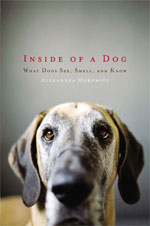
Inside of a Dog, by Alexandra Horowitz

Inside of a Dog, by Alexandra Horowitz

In learning to slow down to better appreciate my dogs’ perception of our shared world, Alexandra Horowitz has also taught me to slow down for my own benefit. It’s no longer too cold, I’m no longer too tired, I’m no longer in a roaring hurry to get home to watch the “At Issue” panel (and probably raise my blood pressure anyhow), if my dogs need to take measure of the world through their own gauges, via some good, long, ruminative sniffs.

In its absorbing and entertaining examination of the unique human-canine bond, Horowitz’s Inside of a Dog charmingly balances the scholarly and scientific with the personal and whimsical. This is one of my favourite explorations of how dogs and people can so effectively, happily and affectionately co-exist.

Human and animal cognition expert Horowitz spells out in down to earth fashion a practical and enlightening approach to optimally and respectfully sharing our lives with another species. Her science/technical examination of differences between wild and domesticated species and their perceptions of their lives and the lives of those with whom they share their existence is accessible without feeling oversimplified or condescending. She couples it with a sweet, wistful personal recounting of the dogs in her life, which serves to illustrate and underpin the scientific themes without ever feeling forced or cloying.

Horowitz tackles concepts that are certainly thought provoking for dog owners and lovers, but I’m guessing (because I can’t be other than a dog lover) are also instructive to other animal lovers or others just interested in our relationship to the species with whom our paths cross. Most elucidating is the discussion about umwelt as distinct from the dangers of anthromorphizing, where we attribute human characteristics and reactions to animal behaviour, and allow that interpretation to inform how we train, interact with and attempt to understand our pets. Umwelt, on the other hand, accounts for different creatures with different physiology, sensibilities, experiences and more processing and reacting to the same environment in very divergent ways.

Umwelt is an important concept in The Tiger, the acclaimed non-fiction bestseller by John Vaillant. Vaillant uses the concept to pointedly avoid characterizing the behaviours of the tiger in the story as having human motivations, such as the urge for revenge, and weaves that appreciation of different interpretations of the same world and circumstances into a compelling tale and environmental paean.

Horowitz dials down the application of umwelt to the small, the domestic, the practical, but still with a profundity surprisingly comparable to Vaillant’s.

The parcel of scientific facts we have collected allows us to take an informed imaginative leap inside of a dog – to see what it is like to be a dog; what the world is like from a dog’s point of view.

We have already seen that it is smelly; that it is well peopled with people. On further consideration, we can add: it is close to the ground; it is lickable. It either fits in the mouth or it doesn’t. It is in the moment. It is full of details, fleeting, and fast. It is written all over their faces. It is probably nothing like what it is like to be us.

Horowitz literally illustrates how warmly approachable Inside of a Dog is. While making notes of scientific observations of dog behaviour, she was often inclined to doodle and the results depicted her subjects. She incorporates many of those whimsical line drawings throughout the book, forging a heartwarming connection with every reader and fellow dog lover.

Inside of a Dog, by Alexandra Horowitz

See also:

Treasuring my Book of Books (BOB)

“With no small amount of trepidation, I lay open here the first page of my diary ­ high-­schoolish stabs at intellectualism, fleeting girlish obsessions, deliberately obscure annotations and all. After many failed adolescent attempts at keeping a journal, the summer after my junior year in high school, I finally found a format I could adhere to: Never mind describing the back-and-lack-of-forths of unrequited crushes and falling-outs with friends. I decided to list the books I read instead.”

Pamela Paul
Essay, My Life With Bob
Keeping Track of Reading Habits With a ‘Book of Books’

New York Times
April 13, 2012


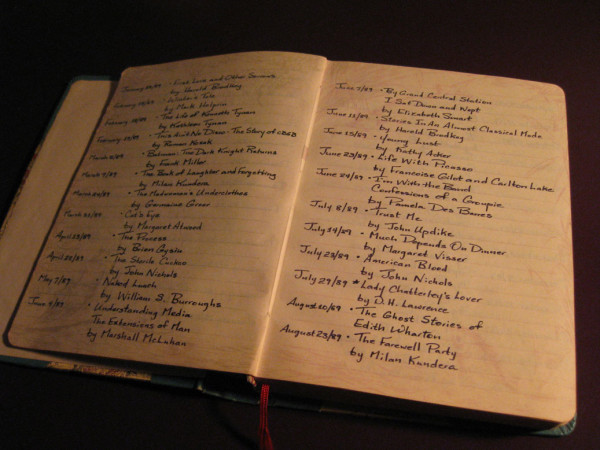
Here's a page of my "Book of Books", which I started when I graduated from university in 1983 ...

Pamela Paul’s essay warms my heart. When our ways of engaging with and keeping track of books is becoming increasingly digital – even “in the cloud”, not tangibly or physically connected to us – how lovely is it to see a paper diary with handwritten entries capturing someone’s life in reading? As soon as I saw this picture in my paper copy of the New York Times Sunday Book Review. I immediately connected with the picture and the essay because I’ve been doing the same thing as Pamela for close to 30 years (gulp).

I have a battered little bound diary in which I have been recording my reading since I graduated in 1983 from the University of Waterloo with a BA in Honors English (co-op). Surprisingly, I was not at all weary of all the reading I did as a student, and continued merrily along right after graduation. My first few entries in my Book of Books are:

April 28, 1983
Lolita by Vladimir Nabokov (reread)

May 6, 1983
Brideshead Revisited by Evelyn Waugh

May 20, 1983
Jude the Obscure by Thomas Hardy

… and on it goes from there. (Click on the picture accompanying this post to glimpse a couple of pages from 1989.) My only regret is that I didn’t start keeping a Book of Books sooner.

The spine on my Book of Books has come unglued on one side in all that time, but it still holds a place of honour on the shelf over my home office desk. I take it down and record my latest book completed as part of the beloved ritual of adding another book to one of my fondest memory banks of all.

Twitter, Goodreads, Bibliocommons and their ilk allow me to connect with other readers, for which I’m immensely grateful. My Book of Books allows me to connect with my own personal history as a reader, which is priceless.

See also:

Book of Books (BOB) Pinterest board
I’ve started capturing pictures of people’s gorgeous, textured, much loved book diaries. If you would like me to pin your book diary to this collection, leave a comment here with a link.