Flaubert’s Parrot, by Julian Barnes

Flaubert's Parrot, by Julian Barnes

This is the 63rd of a series of titles selected by writer Yann Martel to provide to Canadian Prime Minister Stephen Harper, to encourage an appreciation of the arts and literature in particular in the PM, and to also help him (Harper, that is) with his stillness and thoughtfulness. Martel has regularly sent books from a wide range of literary traditions to Harper. Martel has devoted a Web site to the reading list and his kind and considered covering letters with each volume. (All of his letters can be read at http://www.whatisstephenharperreading.ca/.) Martel’s thoughtful persistence in this quest, started in April 2007, is both heartwrenching and highly commendable. He has never received a direct acknowledgement from Harper, and only recently some fairly form-letter responses from Harper’s staff. He has, however, received a response (although not directly related to one of his book selections for Harper) from Industry Minister Tony Clement.

Will this quirky, challenging literary novel by the always intriguing and stylistically shape-shifting Barnes finally inspire Harper, to take up Martel’s recommendation, to read, to respond? We shall see.

Cal, by Bernard MacLaverty

Cal, by Bernard MacLaverty

Both lyrical and bleak, this story captures the protagonist’s hopeless choices in the harsh and divisive world of Northern Ireland. The narrative voice has the flat affect of a person who is both shell shocked and cannot believe he is really capable of or deserving of love or even respect. Yet even with that flatness, that voice is still very moving. When Cal does find love, it is complicated by layers of seemingly unsolvable circumstances that leave the reader wondering and hoping to the last sentence …

“Sometimes in her presence he felt like Quasimodo – as if the ugliness of what he had done showed in his face. The brand in the middle of his forehead would never disappear and seemed to throb when she was near. Alone, now, he relaxed into his ugliness. To hell, why not? If he could not take her like Sleeping Beauty then he could ravish the things which surrounded her. His impotence was something he could smell and touch.”

Object of My Affection, by Stephen McCauley

Object of My Affection, by Stephen McCauley

Stephen McCauley crafts a sweet and impossible pas de deux between two characters, George and Nina, with sufficient warts and foibles to be believable. He surrounds them with a wry and witty cast of supporting characters and melds it all with charming, infectious, Friends-like dialogue (predating Friends by about 10 years). It’s interesting that Jennifer Aniston went on to portray Nina in the movie version of the book.

The Gift: Imagination and the Erotic Life of Property, by Lewis Hyde

The Gift: Imagination and the Erotic Life of Property, by Lewis Hyde

This is the 55th of a series of titles selected by writer Yann Martel to provide to Canadian Prime Minister Stephen Harper, to encourage an appreciation of the arts and literature in particular in the PM, and to also help him with his stillness and thoughtfulness. Martel has regularly sent books from a wide range of literary traditions to Harper, and has devoted a Web site to the book list and his kind and considered covering letters with each volume. (See http://www.whatisstephenharperreading.com.)

While the subtitle suggests that this book examines creativity and artistry, it really focuses on how the giving of one’s creativity as a gift informs societies, cultures and economies. In a lot of respects, Hyde’s book predicted the current download/open source culture.

Gilead, by Marilynn Robinson

Gilead, by Marilynne Robinson

Gilead is poetically introspective, an elderly man’s meditation on how fatherhood came to him late in life, and how he regrets that he won’t likely see his young son to adulthood.

This book was the 48th of a series of titles selected by writer Yann Martel to provide to Canadian Prime Minister Stephen Harper, to encourage an appreciation of the arts and literature in particular in the PM, and to also help him with his stillness and thoughtfulness. Martel has regularly sent books from a wide range of literary traditions to Harper, and has devoted a Web site to the book list and his kind and considered covering letters with each volume. For more on Martel’s noble venture, go to http://www.whatisstephenharperreading.com.

Good to a Fault, by Marina Endicott

Good to a Fault, by Marina Endicott

This absorbing novel recounts in lively, touching and suspenseful detail the aftermath of worlds literally colliding. Lonely, middle-aged and middle-class Clara’s car connects fatefully with that of the gypsy-like Gage family. While hospitalized after the crash, mother Lorraine learns that her bruises are actually an indication of late-stage cancer. Clara suddenly finds new meaning in her life as she takes charge of Lorraine’s three children, elementary school age Dolly and Trevor and infant Pearce, and elderly, cantankerous mother-in-law. As Lorraine battles cancer, Clara raises Lorraine’s family after L’s husband Clayton flees the situation. Clara’s friends and family rally round, and everyone learns about their capacity for patience, compassion and love. This novel offers probing reflections on selflessness versus selfishness, on charity, on all forms and types of love and caring for one’s fellow human beings.

An aspect of this novel that I initially found distracting was Endicott’s propensity for changing the narrator’s perspective so frequently, sometimes in mid-paragraph. By the end of the novel, however, I appreciated how much richer an overall experience the novel was for its interwoven voices. The novel mimics how voices naturally intermingle in normal group conversations, as if all of the characters are trying to describe the story to the reader at the same time.

Another striking aspect of this novel is its simple but arresting cover artwork. I’m not sure how often this sort of thing is remarked upon in reviews, but this book’s cover haunted me throughout. It’s a very simple picture of the end of an interior wall or doorway, upon which you can see the marks of someone measuring the heights of children. There are only a few marks, however, whereas in a home and a family where this is a tradition, there would be lots of marks. It said to me that Clara yearned to have a family and simple traditions like that, but that she only got to enjoy them for a short while. It turns out that this was the reasoning behind the image, as explained in these lovely and moving insights from the designer, which includes comments from author Marina Endicott:

http://daviddrummond.blogspot.com/2008/10/good-to-fault.html

This quotation from the Bible, which is mentioned in the novel, seems to sum it up well:

“Be not forgetful to entertain strangers: for thereby some have entertained angels unawares.” (Hebrews 13)


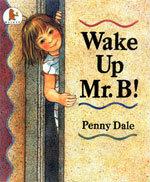
Wake Up Mr B! by Penny Dale

Wake Up Mr B! by Penny Dale

This sweet, low-key tale offers some of the loveliest illustrations for a children’s book that I’ve ever seen. The pictures capture the rumpled intimacy of a young child at absorbed play with her faithful dog. Illustrator Penny Dale has particularly captured the patient expressions of little Rosie’s loving Airedale Mr. B very well.

Letting Go of the Words: Writing Web Content that Works, by Janice (Ginny) Redish

Letting Go of the Words: Writing Web Content that Works, by Janice (Ginny) Redish

This common sense book walks the walk and talks the talk. As it promotes clear, instructional, active voice writing on the Web, coupled with clean, logical page layout and navigation, the book itself admirably follows its own advice. Author Ginny Redish provides plenty of good examples and before and after case studies to illustrate and drive home her points.

Ironically, Redish offers instances where “letting go of the words” actually means employing a few more words to make particular subject matter abundantly clear. She illustrates repeatedly how complementary choices in page layout, colour, typefaces and more also contribute to the overall effect, and allow people to locate and absorb key information. “Letting go of the words” often means simply letting go of your own perspective and knowledge of a subject when you put it online, and trying to adopt the perspectives of your potential Web audience, which is often very different.