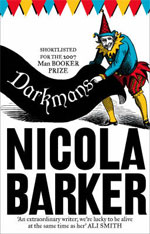
Darkmans, by Nicola Barker

Darkmans, by Nicola Barker

Deservedly shortlisted for the 2007 Man Booker Prize, Nicola Barker’s Darkmans pivots on the various forms of upheaval wrought by the construction of the Channel Tunnel between England and France in the late 1980s to early 1990s. The Chunnel churned up lands and historic buildings, sundered communities and families, and both destroyed and created new employment and ways of life. The colourful, rambling cast of Darkmans is touched in numerous fashions by this disruptive force.

While the new housing developments and roadways literally pave over the history of the area, forces from the past still seem to bubble to the surface and manifest themselves in disturbing ways. Is the young boy Fleet autistic, brilliantly gifted, or is he possessed by the ghost of an evil court jester who was at one time banished to France from England? Is Fleet’s father, Dory, clinically schizoprenic or also possessed by the same devious spirit? Elen, Dory’s long-suffering wife and Fleet’s bewildered but ever patient mother, seems like a put-upon heroine who also captivates hospital worker and amateur historian Beede and Beede’s easygoing drug dealer son Kane … but then might be a malevolent temptress as the many tendrils of plot and character swirl to a dizzying conclusion.

Even the more peripheral characters in Darkmans are vivid and intriguing. Barker orchestrates some clever use of typography to convey the idea of people speaking and conversing in multiple languages at once. Yet while so much going on at once would seem to defeat or exhaust even the most dedicated readers, you’re left wanting more after a breathtaking 840 page sprint.

This bit from near the beginning of the book lays some of the foundation for the disruptive force of the Chunnel development:

“It went without saying that the Chunnel (now a source of such unalloyed national complacency and pride) had caused huge headaches – and terrible heartache – in East Kent …

When the developer’s plans for the new Folkestone Terminal were initially proposed, however, it quickly became apparent that all this was soon about to change. Several farms and properties (not least, the many charming, if ramshackle homes in the idiosyncratic Kentish hamlet of Danton Pinch) were to be sacrificed to the terminal approach and concourse, not to mention over 500 acres of prime farmland and woodland, as well as all remaining evidence of the old Elham Valley Railway (built in 1884, disused since 1947). But worse still, the access road from the terminal to the M20 was due to cut a wide path straight between Newington and Peene, thereby cruelly separating them, forever.”
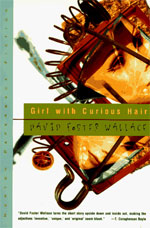
Girl With Curious Hair, by David Foster Wallace

Girl With Curious Hair, by David Foster Wallace

The title story features a chilling, amoral, American Psycho-esque narrator whose account of his outing to a jazz concert with his drug addled punk friends is by turns horrifying, perversely comic and, momentarily, shockingly touching. Each story in this collection is a daring exploration of voice, perspective and form. When such real life figures such Alex Trebek, Merv Griffin and David Letterman appear in secondary or peripheral roles, it adds intriguing dimensions rather than gimmickry to those stories. The portrait of Lyndon B. Johnson in “Lyndon” is moving and revelatory. “Westward the Course of Empire Takes Its Way” is a dense, intricate journey and pop culture pastiche featuring, amongst others, former child stars of McDonald’s commercials. Somehow, the topical references feel like they will accrue historical heft rather than feeling dated as time goes on.

David Foster Wallace was a fearless experimentalist and humanist, and is so dearly and immensely missed.

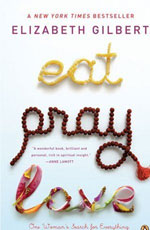
Eat, Pray, Love, by Elizabeth Gilbert

Eat, Pray, Love by Elizabeth Gilbert

Halfway through India, Elizabeth starts to shed her self-absorption and the book becomes a fairly tolerable read. By the end, she’d more or less won me over, and I admired her quest to learn to live more effectively, for herself and others around her.

At the same time, her premeditated and well-financed ability to have such an adventure in the first place makes it largely out of the realm of possibility for most people experiencing similar personal crises. It bewilders me a bit that so many readers felt a connection to this rather rarified story.

Mister Pip, by Lloyd Jones

Mister Pip, by Lloyd Jones

Deservedly shortlisted for the 2007 Man Booker Prize and winner of the 2007 Commonwealth Writers’ Prize, Lloyd Jones’ Mister Pip is a memorable tribute to the power of words to give people focus, hope and courage. When a remote village on a Pacific island is blockaded during a civil war, the island’s only white man, Mr Watts, reopens the school and bolsters the spirits of the children and eventually of the entire community by taking them by memory through Dickens’ Great Expectations. For many, the life of Pip becomes more real to them than the surreal and increasingly frightening and shocking events occurring around them. The story is told from the point of view of Matilda, one of the children, and her journey to pay her respects to Mr Watts and find closure many years later meanders a bit and makes the end of this novel feel a bit ragged, but this is otherwise a stunning and beautiful work.

This is one of the titles selected by writer Yann Martel to provide to Canadian Prime Minister Stephen Harper, to encourage an appreciation of the arts and literature in particular in the PM, and to also help him with his stillness and thoughtfulness. Martel has regularly sent books from a wide range of literary traditions to Harper, and has devoted a Web site to the book list and his kind and considered covering letters with each volume.

“You cannot pretend to read a book. Your eyes will give you away. So will your breathing. A person entranced by a book simply forgets to breathe. The house can catch alight and a reader deep in a book will not look up until the wallpaper is in flames.”

Changing Woman, by Jay Scott

Changing Woman, by Jay Scott

Helen Hardin was a Native American artist who created vibrant, ornate paintings, murals and etchings that gained increasing interest and critical acclaim from the late 1960s to the early 1980s. This book is a gorgeous showcase of the work of an innovative artist, an absorbing critical study of her diverse influences, and an intriguing, moving and respectful glimpse at her personal challenges. Sadly, Hardin died of breast cancer in 1984 at the age of 41. Late works right up until the year of her death are featured in this volume, showing the determination and ferocity with which she worked until she could work no more.

This comes from a description of Hardin’s 1981 work Metamorphosis:

“The Warrior Mother, the Sun Kachina, pre-Columbian design elements, a sophisticated technique in which layout after layer of acrylic paint is applied laboriously to the surface, sometimes with an atomizer, occasionally with a brush, frequently with an airbrush, often with a pen, less often with a mundane household sponge: Metamorphosis could stand as a definitive example of Hardin’s art in the early eighties, an art of anger and elegance, of aggressive precision and passionate passivity (the latter a peculiarly Indian trait, paradoxical to the Western mind), an art that seamlessly merged the archeo9logical and the tribal with the contemporary and the personal, an art that sought invariably to return to ancient realms by modern means. “You have noticed that everything an Indian does is in a circle,” the Lakota Sioux wiseman Black Elk said, “and that is because the Power of the World always works in circles, and everything tries to be round.”

When asked what Metamorphosis was, Helen Hardin said, “It’s a self-portrait.””

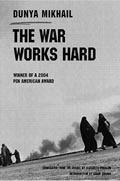
The War Works Hard, by Dunya Mikhail, translated by Elizabeth Winslow

The War Works Hard, by Dunya Mikhail, translated by Elizabeth Winslow

Winner of a 2004 PEN Translation Fund Award and shortlisted for the Griffin Poetry Prize, “The War Works Hard” brings the Arabic poetry of Iraqi expatriate Dunya Mikhail into English in stunning, heartbreaking form by the translation alchemy of Elizabeth Winslow. Many of the poems have short, clipped line scans, suggesting that the speaker or narrator is in a hurry (in fact, one poem is entitled “I Was In a Hurry”) – perhaps escaping pursuers or bombs – or is shell shocked. At the same time, what emerges from the poems collectively is a sense of a person or persons finding the way to survive, get through horrific circumstances, retain dignity for themselves and lost loved ones, and eventually to build new lives out of the ruins.

From the poem “Bag of Bones”:

What good luck!
She has found his bones.
The skull is also in the bag
the bag in her hand
like all other bags
in all other trembling hands.
His bones, like thousands of bones
in the mass graveyard,
his skull, not like any other skull.

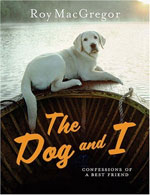
The Dog and I, by Roy MacGregor

The Dog and I, by Roy MacGregor

Roy MacGregor’s amiable tribute to the dogs whose companionship he enjoyed at different stages in his life, and continues to enjoy to date, is like the anti “Marley and Me.” That is, rather than the presumed trials and tribulations of failing to bend the will of a bright canine to that of a self-absorbed human being, MacGregor reflects in a moving and self-effacing way on how dogs have taught *him* important lessons throughout his life.

The Grandmothers, by Doris Lessing

The Grandmothers, by Doris Lessing

This collection of four novellas has the signature Lessing elegance and stateliness of expression on the surface, but all are surprising and edgy under the surface. In the case of the title characters of the novella that gives the collection its title, under the surface lies a perhaps improbable, perhaps disturbing but still compelling sexiness, too. While somewhat uneven in terms engaging the reader (particularly the dystopic “The Reason for It”), there is something to satisfy in plot and character in each novella. Published in 2003 when she was into her 80s, this collection shows that the Nobel Prize winner’s sharp, ironic wit has yet to dull.