Category Archives: Reviews

Rosina, the Midwife, by Jessica Kluthe

Rosina, the Midwife, by Jessica Kluthe

Jessica Kluthe reaches a hand – at first tentative and trembling – across oceans and generations from her life in Canada to that of her ancestors in Italy in her captivating family memoir, Rosina, the Midwife. Those ancestors were part of a 26-million-strong exodus of Italians from 1870 to 1970, departing Italy for other parts of Europe and further afield, to North America. Kluthe’s particular focus, however, is the stalwart and enigmatic figure of a family member who chose to stay behind: her great-great-grandmother, Rosina, respected matriarch and, as a practising midwife, essential keeper of community tradition, secrets, and life.

Kluthe imagines poignantly and strikingly Rosina’s determination to see her family succeed and thrive, even if and when it means separating from loved ones permanently:

“She didn’t have a picture of her husband, but she could see him when she looked into her son’s face: everyone could. And, as her family would resettle, she would be left to remember this day of goodbyes and their faces – Giovanni’s and Generoso’s. And their eyes so dark that she couldn’t see their pupils – so dark that she could see her face reflected in Generoso’s as she stepped back, her hands still on his shoulders, and smiled as she wished him safe travels.”

Kluthe’s passion for the intricacies of heritage and the enduring love of family and how they inform both social fabric and individuals make Rosina an absorbing read. Kluthe’s pursuit of answers, interwoven with her own life’s joys and sorrows, rounds out the emotional satisfaction quotient of the book, making Rosina a “can’t put down” book for any season.

It was a pleasure to offer a version of this review to 49th Shelf for their Summer 2013 “Couldn’t Put It Down” feature, which includes great summer reading recommendations by noted Canadian reviewers, bloggers, publishers, authors, editors, and publicists with whom I was delighted to have my name and recommendation included. Read the feature here.

2013 reading list (so far)

The Alice Poems by Leon Rooke

Here are the books I’ve read so far in 2013, with links where they exist to books that I’ve reviewed (either here on this blog or briefly on Goodreads). As I’ve remarked before, it’s a competition with no one but myself, but it is always interesting to reflect halfway through the year where one is at with one’s reading, both quantitatively and qualitatively.

This has been another fine and interesting year in reading so far. I see I need to invest some more time in getting some more reviews on this blog, although I think that has been supplanted a bit by #todayspoem activities and reflections on beautiful book-shaped objects. I’ve been trying to balance my reading so that I always have prose and poetry on the go at the same time. I’m also pleased to see that 16 of the 21 books I’ve read so far this year are Canadian, and 8 of that total are poetry collections.

    canlit

  1. The Age of Hope
    by David Bergen (a Canada Reads selection)

  2. May We Be Forgiven
    by A.M. Homes

  3. CivilWarLand in Bad Decline
    by George Saunders

  4. Pastoralia
    by George Saunders

  5. canlit

  6. Red Doc>
    by Anne Carson

  7. Tenth of December
    by George Saunders

  8. canlit

  9. Traveling Light
    by Peter Behrens

  10. canlit

  11. Stories About Storytellers
    by Douglas Gibson

  12. canlit

  13. How Should A Person Be?
    by Sheila Heti

  14. canlit

  15. Seldom Seen Road
    by Jenna Butler

  16. canlit

  17. The April Poems
    by Leon Rooke

  18. canlit

  19. The Shore Girl
    by Fran Kimmel

  20. canlit

  21. Li’l Bastard
    by David McGimpsey

  22. canlit

  23. 1996
    by Sara Peters

  24. canlit

  25. One Bird’s Choice
    by Iain Reid

  26. Clear
    by Nicola Barker

  27. canlit

  28. Under the Keel
    by Michael Crummey

  29. canlit

  30. Coping with Emotions and Otters
    by Dina Del Bucchia

  31. canlit

  32. The Miracles of Ordinary Men
    by Amanda Leduc

  33. canlit

  34. What’s the Score?
    by David W. McFadden

  35. canlit

  36. Bone & Bread
    by Saleema Nawaz

Currently in progress:

  • Journey with No Maps: A Life of P.K. Page
    by Sandra Djwa

  • Big Day Coming: Yo La Tengo and the Rise of Indie Rock
    by Jesse Jarnow

  • Lyrics and Poems 1997-2012
    by John K. Samson

How is your reading going so far in 2013?

The Miracles of Ordinary Men, by Amanda Leduc

The Miracles of Ordinary Men, by Amanda Leduc

Among its many bittersweet delights, Amanda Leduc’s The Miracles of Ordinary Men makes me miss Peter Falk. One of Falk’s most unforgettable roles was playing himself – but that self as a lapsed angel – in the haunting 1987 film Wings of Desire. While they take different approaches, both the film and the book turn the tables on a spiritual concept that we perhaps all take for granted: that angels are benevolent celestial beings that look out for us, perhaps intercede between us and our higher being of choice … and are happy to do so, with no troubles, desires, anguish or emotions of their own.

The angels in Wings of Desire feel, but what they feel most is absence, because they observe human beings experiencing frustration, loneliness, pain and love, tasting food and life … and wonder what it would be like to experience that figurative and literal palette of sensations themselves. They have the choice to do that, but only by becoming mortal.

The Miracles of Ordinary Men reverses that process. Mortals become angels, and it is an increasingly excruciating process that Leduc renders with a psychological and physical detail and believability balanced with just enough ambiguity that a reader can perceive it as literally, clinically or symbolically as suits one’s perspective. Like Peter Falk, only a chosen few in The Miracles of Ordinary Men can see and even begin to comprehend the angels or angels-in-the-making before them.

Leduc is never heavy handed about what anyone’s form of belief or source of hope might be. She wisely posits that even the most doubtful or agnostic want something to turn to, and it is brave to acknowledge that desire, even if succumbing to it won’t necessarily achieve anything. This exchange captures it aptly and beautifully:

“People always want to pray when they’re down. It’s the easiest thing in the world.”

“I don’t think so. I think it’s the hardest thing anyone can do. Because there’s a part of you that always knows nothing might happen, that you might just be speaking words into air. And people do it anyway.”

The dual protagonists in the midst of this making of angels are English teacher Sam and executive assistant Lilah, both struggling, fresh from or in the process of suffering personal loss, estrangements and deaths. They are depressed, distraught and punishing themselves for those losses in different and some cases very overt fashion. It isn’t really a spoiler to note that their stories are quietly, elegantly constructed to intersect.

Even at its most troubling, the tone of The Miracles of Ordinary Men is almost determinedly evenhanded. Even at its most violent, the story and how it is told is essentially, if inexplicably gentle, always reaching for comfort and solace. As their stories accelerate and inevitably tilt towards each other and some kind of conclusion, Sam and Lilah both experience a falling away, a dispensing with, a distillation that holds the reader’s attention to the very last page. Is it the flat affect of shell shocked survivors, or the preternatural serenity of those who know something better is coming?

The Miracles of Ordinary Men is a book you’ll want to revisit and from which you could derive an entirely different but equally rich, redeeming and satisfying interpretation each time.

May We Be Forgiven, by A.M. Homes

May We Be Forgiven, by A.M. HOmes

That May We Be Forgiven by A.M. Homes hits the ground hard and running from the opening pages will let you know quickly if you have the intestinal fortitude and heart to continue. The book launches immediately into the first and most visceral of a series of insanely horrible things that happen to a family in less than a year. The sequence of woe is so over the top at times that it seems like a macabre, Tarantinoesque cartoon of violence and perversity. Running parallel to the gutwrenching but – it must be said – often darkly hilarious mayhem, parts of May We Be Forgiven are also lyrically wonderful testaments to spirit, optimism, resilience and forging new family structures out of the ashes of old ones.

For professor, Nixon scholar and nebbish Harold Silver, the old family structure consisted chiefly of his childless marriage with Claire. Rapid-fire tragedy rips asunder the lives of Harry’s brother George, a prominent TV executive, George’s wife Jane and their pre-teen children Nate and Ashley. It falls to profoundly traumatized, reluctant and harried Harry to reconstitute a new and viable life for his niece and nephew. Along the way, he falls sweetly and deeply in love with the children, and learns to appreciate and respect a cast of eccentrics this newly minted family draws to itself along the way.

Homes has a love for her flawed, battered, prickly characters reminiscent of Nicola Barker (whose singular novels I’ve rhapsodized about here and here). Homes also wields bracing social commentary in a fashion reminiscent of Tom Wolfe at his best. At the same time that she’s pointedly criticizing everything from Internet sex to consumer culture to the correctional system, Homes also casts a sympathetic gaze (albeit with a gently skeptical cocked eyebrow) at caring for prematurely overly mature children and aging parents. She poignantly captures the conundrum that nowadays, we seem most “connected” with strangers, and most estranged when we’re with our ostensible loved ones:

“There is a world out there, so new, so random and disassociated that it puts us all in danger. We talk online, we ‘friend’ each other when we don’t know who we are really talking to – we fuck strangers. We mistake almost anything for a relationship, a community of sorts, and yet, when we are with our families, in our communities, we are clueless, we short-circuit and immediately dive back into the digitized version – it is easier, because we can be both our truer selves and our fantasy selves all at once, with each carrying equal weight.”

In an interview in late 2012, Homes explained with fervour what was clearly her aim in May We Be Forgiven, not to mention the riveting journey of Harry and his evolving family and sense of family:

“I want to push back against the pessimism. I can’t bear to accept that everything is basically going to shit. And everything is: the economy, the family, the social structures, the class divide, the political process in this country, global warming, random violence from terrorism. Unless you want to live in denial, I feel that you have to train yourself to find hope. The logical response is to get incredibly depressed, but what’s the point of that? Especially if you’ve got children.”(1)

May We Be Forgiven will rattle and possibly repel the more faint of heart reader. If one can ride out the rollercoaster dips in what feels like a century’s rather than a year’s worth of trauma, it’s well worth it. Even at its most horrific, May We Be Forgiven is satisfyingly redemptive as well as an irresistible read.

Notes:

1. AM Homes on her new novel May We Be Forgiven
The acclaimed novelist AM Homes talks about her latest dark satire of 21st-century America
by Richard Grant, The Telegraph

See also:

May We Be Forgiven by A.M. Homes – review
by Harvey Freedenberg in Bookreporter.com

What I read in 2012

The Yips, by Nicola Barker

Here are the books I read in 2012, with links to reviews (here on this blog or on Goodreads) where I have them. As I’ve done in previous years, this is an exhaustive, “all of” list, not a “best of” list.

In addition to the interesting and often challenging complement of books I enjoyed this year, 2012 was the year I committed to a daily devotion to at least one poem … and usually more, as more and more friends on Twitter began to generously share their poem choices and reflections via the #todayspoem hashtag. It’s been a truly revelatory experience. In a little over a year, I’ve pondered the works of over 260 unique poets, writers, songsmiths and wordsmiths I’ve revisited or unearthed myself, and countless more via others wielding that often surprising hashtag. I’m continuing with my #todayspoem habit every day heading into 2013, and I hope many will continue or join anew.

I also celebrated some beautifully built books, including:

That list, then …

  1. The Game
    by Ken Dryden (reread)
  2. The Money Tree
    by Sarah Stewart and David Small
  3. The Antagonist
    by Lynn Coady (reread)
  4. The Marriage Plot
    by Jeffrey Eugenides
  5. Something Fierce – Memoirs of a Revolutionary Daughter
    by Carmen Aguirre
  6. Expressway
    by Sina Queyras
  7. Algoma
    by Dani Couture
  8. Autobiography of Childhood
    by Sina Queyras
  9. I’m Starved For You
    by Margaret Atwood
  10. Inside of a Dog – What Dogs See, Smell and Know
    by Alexandra Horowitz (read aloud)
  11. On a Cold Road
    by Dave Bidini (reread)
  12. Believing Cedric
    by Mark Lavorato
  13. Audio Obscura
    by Lavinia Greenlaw, photographs by Julian Abrams
  14. Why Men Lie
    by Linden MacIntyre
  15. Methodist Hatchet
    by Ken Babstock
  16. The Love Monster
    by Missy Marston
  17. Detroit Disassembled
    by Andrew Moore, essay by Philip Levine
  18. The Sisters Brothers
    by Patrick DeWitt
    (guest review by Barbara McVeigh)
  19. Night Street
    by Kristel Thornell
  20. The Juliet Stories
    by Carrie Snyder
  21. Killdeer
    by Phil Hall
  22. The Blue Book
    by A.L. Kennedy
  23. Whiteout
    by George Murray
  24. The Forrests
    by Emily Perkins
  25. Seen Reading
    by Julie Wilson
  26. Satchel: The Life and Times of an American Legend
    by Larry Tye (read aloud)
  27. Personals
    by Ian Williams
  28. The Art of Fielding
    by Chad Harbach
  29. The Yips
    by Nicola Barker
  30. Swallow
    by Theanna Bischoff
  31. Everything, now
    by Jessica Moore
  32. A Ride in the Sun, or Gasoline Gypsy
    by Peggy Iris Thomas (read aloud)
  33. The Deleted World
    by Tomas Transtromer, versions by Robin Robertson
  34. Swimming Home
    by Deborah Levy
  35. The Essential Tom Marshall
    selected by David Helwig and Michael Ondaatje
  36. Autobiography of Red
    by Anne Carson
  37. The Little Shadows
    by Marina Endicott
  38. Inside
    by Alix Ohlin
  39. NW
    by Zadie Smith
  40. Dear Life
    by Alice Munro
  41. Copernicus Avenue
    by Andrew J. Borkowski
  42. Two Solitudes
    by Hugh MacLennan (reread)
  43. Indian Horse
    by Richard Wagamese

Currently in progress, heading into 2013:

  • The Collected Short Stories of Lydia Davis
  • Big Day Coming: Yo La Tengo and the Rise of Indie Rock, by Jesse Jarnow (read aloud)
  • The Age of Hope, by David Bergen

Looking back fondly on my 2012 reading, looking forward eagerly to my 2013 reading, I’ll simply conclude …

It’s not how many you read that counts. It’s that you read that counts.

Book of Books, page from 2012

A Ride in the Sun, or Gasoline Gypsy, by Peggy Iris Thomas

A Ride in the Sun, or Gasoline Gypsy, by Peggy Iris Thomas

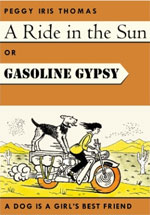
I’ve mentioned before that my husband Jason and I have combined our love of books with our love of dogs (Airedale terriers in particular) by building a library of books in which Airedales have starring or supporting roles, or at least appear in all their handsome splendour on book covers. Jason and I also, by the way, regularly enjoy sharing our books by reading aloud to each other. We combined all of these pleasures when we read together A Ride in the Sun, or Gasoline Gypsy, by Peggy Iris Thomas, earlier this year.

This book has many charms. The author recounts the myriad adventures she and her Airedale, Matelot, enjoyed as they embarked on a 14,000-mile motorcycle trek through Canada, the United States and Mexico from 1950 to 1952. As an unassuming paean to a considerably more innocent time, it’s a delight. At every hairpin turn along the way, Peggy miraculously finds a trucker who will pick up her woefully underpowered and overloaded motorcycle and transport it to the next garage. With only one or two comically villainous exceptions, those garages are staffed by resourceful mechanics willing to figure out the vagaries of her unusual model of bike and get her back on the road again – often no charge. At times fearless and self-sufficient, at times naively hapless, Peggy is always captivating, and Matelot is the epitome of canine patience and fidelity.

We relished all of these charms and they seemed to shine through most brilliantly when we were sharing the book together, reading it aloud, laughing, pausing to comment on Peggy’s misadventures, close calls and feisty spirit, and to stray into our own stories. When we paused to stumble just a bit over yet another repetition of Peggy’s stock phrases or stilted prose, the fact that we were reading it all aloud helped us to compensate, laugh it off and carry on. The few times we tried to read portions of the books to ourselves, the story fell calamitously flat, freighted under the words of someone more comfortable riding a motorcycle or training dogs than capturing any of it in sentences. And hence the glory of reading aloud to redeem great stories somewhat awkwardly told.

See also:

60th anniversary edition of A Ride in the Sun, or Gasoline Gypsy, by Peggy Iris Thomas

Benefits of reading aloud
(While there is much to be said about children reading aloud, adults reading aloud to children, and adults reading their own prose aloud to remedy problems in expression, it’s hard to find much about the joys of adults reading aloud to adults. Leave a comment on this post if you find anything, OK?)

Dear Life, by Alice Munro

Dear Life, by Alice Munro

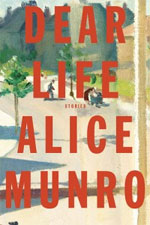
Dear Life, like every new Alice Munro collection, is like returning for what will be a wonderful visit with a cherished, wise and quietly wicked good friend. Does it feel that way even if you are discovering Munro for the first time? I suspect it does, although for this reader, that firsthand feeling is now many books ago. This renewed visit with Munro is possibly my most cherished of all.

For good reason, it’s rare when an Alice Munro book gets something resembling an indifferent, much less a bad review. One smartypants sentence perhaps doesn’t count as a review of any ilk, but yes, trains and train schedules do appear a lot in this collection, and they literally and symbolically link the stories. Much of Dear Life is about arrivals and departures of all kinds and, with gentle perversity that characters often stoically withstand, how life’s moments and milestones don’t always materialize to an expected schedule.

Once again, with crisp but not heartless precision, Munro cultivates a rich undercurrent beneath every seemingly benign exterior. Sometimes, that undercurrent is more perceptible to the reader than the protagonist. However, that doesn’t make us love or admire any less the oblivious but resilient bride-to-be or the cheerfully determined woman who doesn’t know she’s succumbing to Alzheimer’s but acknowledges that others might be fighting it and should be accommodated accordingly and compassionately.

“She likes how the lattice provides a touch of fantasy. Public buildings have been changing in the past few years, just as private houses have. The relentless, charmless look – the only one permitted in her youth – has disappeared. Here she parks in front of a bright dome that has a look of welcome, of cheerful excess. Some people would find it fakey, she supposes, but isn’t it the very thing you would want? All that glass must cheer the spirits of the old people, or even, perhaps, of some people not so old but just off kilter.”

Leave it to Munro to save the most powerful impact for almost the last page. Whether you were convinced already or not, the eponymous story “Dear Life” (part of a “finale” sequence that Munro suggests is autobiographical) proves that those very words form not a placid, sentimental phrase, but are fused into something utterly urgent, even harsh, often hard won, always vital. Based on what might have been a misunderstanding, filtered and interpreted through the fog of years, mutual unstated grievances, tenuous memories, Munro believes that her mother once rescued her from strange but real danger:

“Perhaps that daughter, grown and distant, was the one she was looking for in the baby carriage. Just after my mother had grabbed me up, as she said, for dear life.”

Again, Munro’s deceptive economy of expression leaves a potent, moving, unforgettable impression. Let’s hope it’s not her last, but treasure it if it is.

See also:

Canada Reads 2013 virtual book club

The Canada Reads web site gives you everything you need to know about the recently announced finalist books for Canada Reads 2013, the debaters, what everyone else thinks about the books and the debaters and what their strategies should be … all ramping up to the actual debates, which will take place from February 11th to 14th, 2013.

Between now and February, many of us will be avidly reading and re-reading these fine books in preparation for some lively and passionate discussions. To help everyone get up to speed on the books, we’re offering this compendium of reviews and articles. If you have or know of any pieces that should be part of this collection, contact me via @bookgaga or add a comment below to get the relevant link added. Thanks!

Canada Reads Twitter book club

Starting January 3, 2013, CBC Books will be hosting a weekly Twitter chat to discuss each of the Canada Reads finalist books. Learn more here … and hope to see you there.


Indian Horse by Richard Wagamese

Indian Horse
by Richard Wagamese
(Douglas & McIntyre)
representing the BC & Yukon region championed by Carol Huynh (@HuynhCarol)

Reviews and articles:

CBC books trailer for Indian Horse by Richard Wagamese:


The Age of Hope by David Bergen

The Age of Hope
by David Bergen
(Harper Collins Canada)
representing the Prairies & The North region
championed by Ron Maclean

Reviews and articles:

CBC books trailer for The Age of Hope by David Bergen:


Away by Jane Urquhart

Away
by Jane Urquhart
(McClelland and Stewart)
representing the Ontario region
championed by Charlotte Gray

Reviews and articles:

CBC books trailer for Away by Jane Urquhart:


Two Solitudes by Hugh MacLennan

Two Solitudes
by Hugh MacLennan
representing the Quebec region
championed by Jay Baruchel (@BaruchelNDG)

Reviews and articles:

CBC books trailer for Two Solitudes by Hugh MacLennan:


February by Lisa Moore

February
by Lisa Moore
(House of Anansi Press)
representing the Atlantic Provinces region
championed by Trent McClellan (@Trent_McClellan)

Reviews and articles:

CBC books trailer for February by Lisa Moore:

Swimming Home, by Deborah Levy

Swimming Home, by Deborah Levy

Deborah Levy’s Swimming Home opens with a careering, hands-off-the-steering-wheel plunge down a perilous road. You’re given little opportunity from the outset to catch your breath from there to the framing repetitions of this same ride towards the end of this slender, gripping novel.

The story’s chronology commences with the startling arrival of an interloper and the even more startling invitation to the interloper to stay, amidst a group of vividly unhappy vacationers sharing a villa on the French Riviera. That intruder, Kitty Finch, makes her entrance as a mistaken dead body in the villa swimming pool. She proceeds via wiles combining Edie Sedgwick, Sylvia Plath and a mermaid to seduce or unsettle all of poet Joe Jacobs, his war correspondent wife Isabel, their teenaged daughter Nina, the Jacobs’ guests Mitchell and Laura, villa house staff Jurgen and elderly villa neighbour Dr. Madeleine Sheridan.

That Kitty claims to be, among many things, a botanist – albeit one with a particular fascination for beautiful, poisonous plants – fits perversely well with the hothouse confluence of characters with relationship, financial, emotional and psychological problems, and problems relative in some cases to lack or excess of age and experience. She also claims to be a poet, obsessed with getting Jacobs to read one poem of hers that could hold something potent and revelatory for both of them – and how that is or isn’t revealed is also perverse.

For a book so lush in imagery – veering from plants and foliage to weaponry to water to real and toy animals – the overall effect of the book is still spare and spacious. There is much room to wonder what just happened and what will happen next between various troubled couplings and encounters, most of them provoked directly or indirectly by that maybe uninvited, maybe dangerously desired guest with the name combining predator and prey.

You won’t know until the very end if any of this largely unsympathetic but still fascinating cast of characters manage to swim home safely. As the story and voices linger long after you’ve finished this slim novel, you’ll continue to wonder if, in fact, you assessed correctly who did swim home … and even what is home, and if perhaps some found it instead by letting go and slipping under the surface.

Thank you to House of Anansi Press for providing an advance copy of Swimming Home, by Deborah Levy.

See also:

September 20, 2012
Deborah Levy: ‘It’s a page-turner about sorrow’
Booker-nominated writer Deborah Levy talks to Kate Kellaway about her dazzling novel and why repression is more interesting than depression

Deborah Levy speaks to a Waterstones interviewer at Waterstones Piccadilly bookstore about her story, Black Vodka, and novel, Swimming Home.

NW, by Zadie Smith

NW, by Zadie Smith

NW is not Zadie Smith’s best. However, it shows a writer at her finest and bravest exploring diverse terrain and experimenting with different methods and vocabularies with which to present those explorations. That makes Smith’s examination of intersecting worlds and lives in the northwest corner of contemporary London a still fascinating if sometimes frustrating read.

NW focuses – as much as the intentionally disjointed storytelling and multiple narrative voices overlaid with a range of stylistic syncopations can be said to focus – on the lives of two women who have known each other since a fateful childhood encounter: red-haired Leah Hanwell, a charitable lottery administrator of Irish descent and Natalie Blake (who selectively abandons her birth name of Keisha), a lawyer of Jamaican descent. Both struggle and flirt with ambition, identity and personal reinvention against a backdrop of societal and economic changes happening, at times very literally, on their doorsteps.

Smith propels the story with varying degrees of success via a carousel of styles and formats from stream of consciousness narration to numbered and labelled lists and paragraphs to even a touch of concrete poetry. In the end, plotlines dangle or simply deflate. What endures for this reader is that the two central characters seem able to pick up their sometimes suspended conversations and relationship, and continue caring for each other through revelations, attempted transformations and missteps. The foundation of their friendship is grounded on a recognition of the essential persons under the layers of time and circumstance. Likewise, this reader will wait for and seek out this author’s future literary transformations, recognizing the essential craft and character at the foundation of whatever she attempts next.

See also:

NW by Zadie Smith – review
Adam Mars-Jones finds himself stumbling on the cracks in Zadie Smith’s new novel
The Guardian

Zadie Smith’s new novel is filled with voices from everywhere
by Lisa Moore
The Globe and Mail