Author Archives: Vicki Ziegler

A quick(ish) look at my 2025 reading

… and it will be quick(ish) in large part because, well, I want to get back to my reading as we head on into 2026!

My 2025 year in reading ended beautifully just last night – New Year’s Eve – when my husband and I finished a book we were reading aloud together: Flight Paths – How a Passionate and Quirky Group of Pioneering Scientists Solved the Mystery of Bird Migration by Rebecca Heisman.
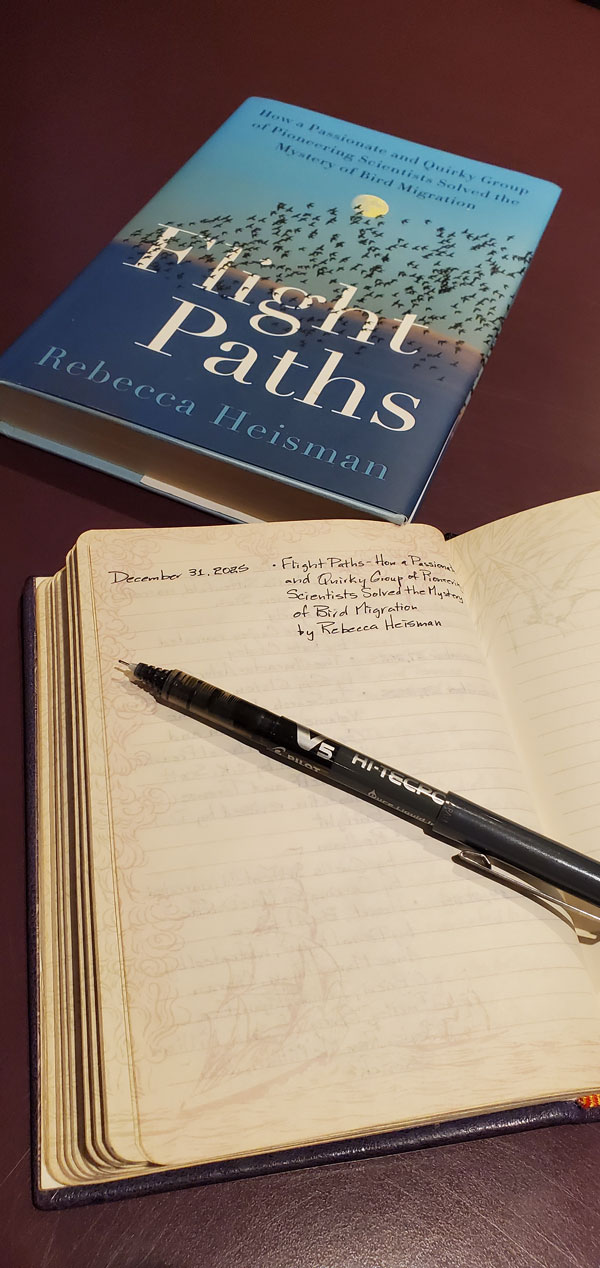
The book Flight Paths by Rebecca Heisman sits next to a notebook in which the book title is written.

With that, I finished 69 books in 2025. I’ve always contended that it’s not a competition, but confess that I do compete a bit with myself from year to year. In 2023, I read 83 books and in 2024, I read 100. Contributing to those numbers in recent years has been my participation in the poetry Sealey Challenge, which means I read 31 works of poetry in the month of August. But this year, I decided in July (the month before the Sealey Challenge) to challenge myself to read In Search of Lost Time, and realized very quickly that that commitment meant I couldn’t juggle that and 31 works of poetry in a month.

Still, 69 books in one year is just fine. That breaks down as follows:

  • works of poetry: 20
  • works of fiction: 35
  • works of non-fiction: 14
  • rereads: 4
  • works by Canadian authors: 33
  • works in translation: 9
  • read aloud: 2
  • audiobooks: 26

The one sub-category of reading I regret neglecting this past year was graphic novels. I’ll do my best to correct that omission in 2026!

Here is my 2025 reading, in all its glory!

January, 2025

February, 2025

March, 2025

April, 2025

May, 2025

June, 2025

July, 2025

August, 2025

September, 2025

October, 2025

November, 2025

December, 2025

In years past, I concluded my reflections on and list of the past year’s reading with observations that I still find very applicable again this year:

  • It’s not how many books or works you read (in whatever form) that counts. It’s that you read that counts – and it counts so very much.
  • If you can read in good company, be it a partner, a four-legged reading companion and/or a group of trusted bookish friends, your reading will always be imbued with a special, warm glow.

Wishing you comforting, clarifying, entertaining, challenging and all round good reading in 2026!
I missed the silent book club meeting … but I didn’t miss it … and you didn’t, either!

As I’ve said before, not everyone makes it to every book club meeting, every month. But the book beat goes on, and individual members and the group as a whole keeps it going, pretty much every month of the year – now going on eight years straight!

Without further ado, here are some images from our group’s July gatherings, followed by another gorgeous combined reading list from the group.

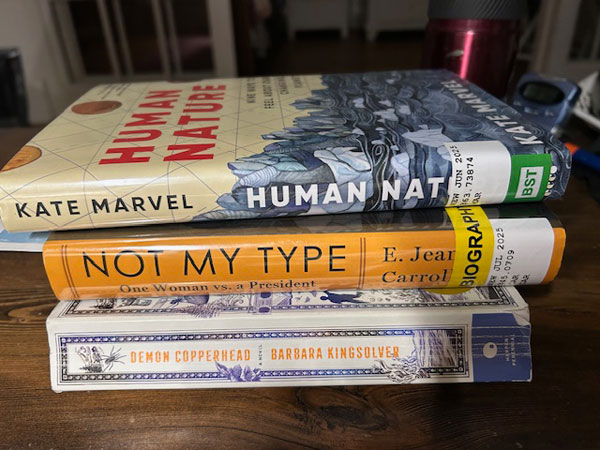
Silent book club member Jess' book pile: Not My Type by E. Jean Carroll, Human Nature by Kate Marvel and Demon Copperhead by Barbara Kingsolver - Photo by Jess Bootsma

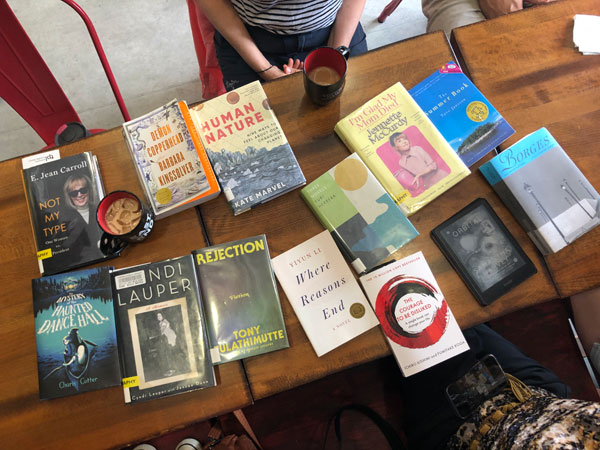
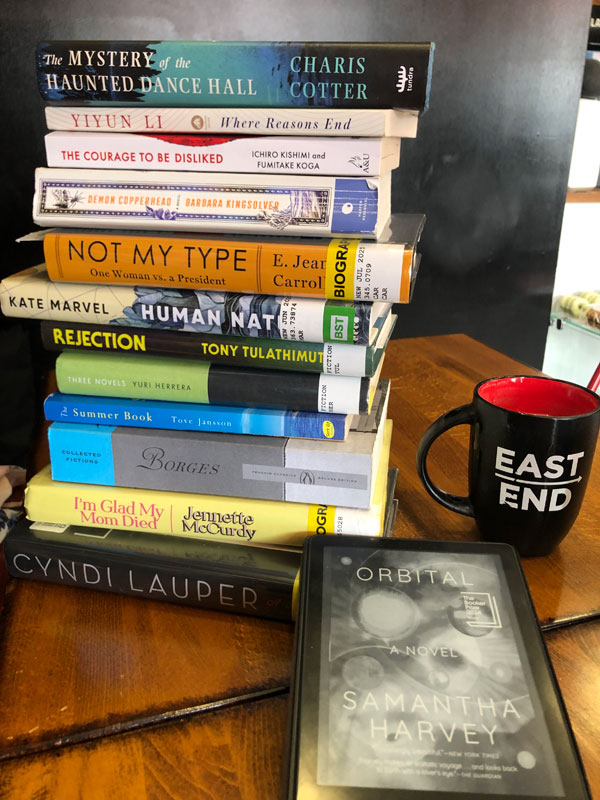
Group book pile at East Toronto Coffee Co, accompanied by coffee - titles include Not My Type by E. Jean Carroll, I’m Glad My Mom Died by Jennette McCurdy, Rejection by Tony Tulathimutte, The Courage to Be Disliked by Ichiro Kishimi and Fumitake Koga + more - Photo by Jennifer D. Foster

Books and hot beverages and pastries on the table at East Toronto Coffee Co, just before the start of the silent book club meeting - titles include Where Reasons End by Yiyun Li, Cyndi Lauper: A Memoir by Cyndi Lauper with Jancee Dunn, Rejection by Tony Tulathimutte + more - Photo by Jennifer D. Foster

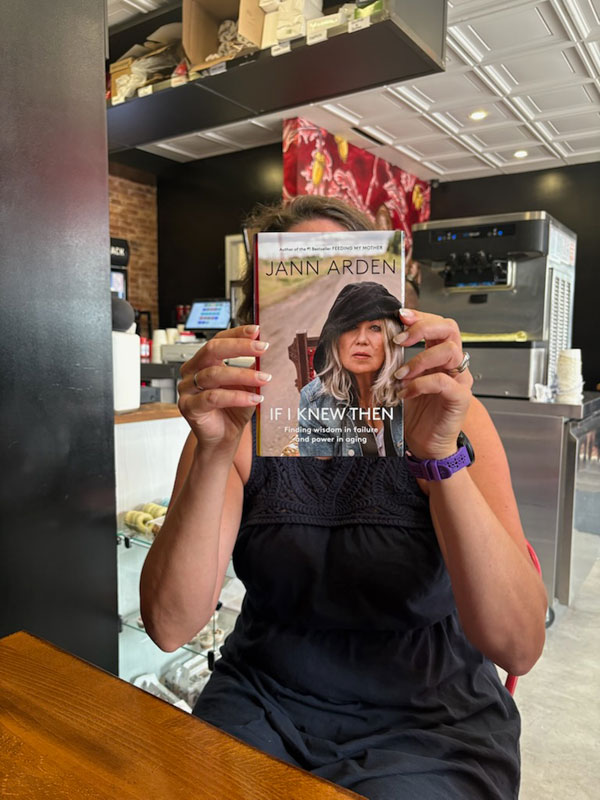
Book club member holds up the book If I Knew Then: Finding Wisdom in Failure and Power in Aging by Jann Arden - Photo by Jennifer D. Foster

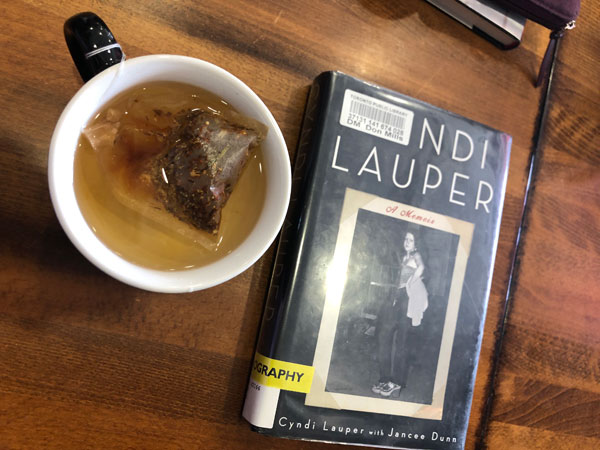
The book Cyndi Lauper: A Memoir by Cyndi Lauper with Jancee Dunn sits on a table at East Toronto Coffee Co with a cup of tea. - Photo by Jennifer D. Foster

Vibrant painting of a fox on the wall of the East Toronto Coffee Co coffee shop - Photo by Jennifer D. Foster

Photo credits: Jess Bootsma, Jennifer D. Foster

Every title on our group’s generous lists means that at least one (but usually more) readers have given that title considered attention. That doesn’t mean that every work on our lists is expressly recommended, of course. Inclusion on this list always means that our readers have devoted time and thought to a title – and that counts for so very much.

Our group’s previous reports and book lists never take the month off, either – they’re always available right here!

You can also check out links to articles, interviews and more here – some with San Francisco-based Silent Book Club founders Guinevere de La Mare and Laura Gluhanich, and some with us here in east end Toronto.

Learn more about the worldwide phenomenon of silent book clubs via Guinevere and Laura’s Silent Book Club web site. In fall 2023, they welcomed their 500th chapter … and with continuing, breathtaking momentum, they now boast closer and closer to 2,000 chapters … (There were around 60 chapters when we joined as the first Toronto chapter in 2017.) And oh, SBC will be celebrating its 10th anniversary this fall!

You can find information on meetings happening around the world and close to where you live. Every club is different in size, format (in-person, virtual or combinations) and vibe, so contact a club’s organizers beforehand if you have any questions or preferences. Please feel free to contact me for more information about our club and its offerings.

Happy reading till next we meet … or don’t, but that’s OK, too.

The special trust you derive from a very good silent book club

This month, our east end Toronto silent book club chapter celebrates its 7th anniversary, thank you very much! Here’s how our first meeting went.

Our latest meetings, online and in-person, were just yesterday. Not every meeting is like this, but some like yesterday’s are an interesting balance of our fellow readers’ enthusiasms and delights and … disappointments or cautions. I actually really appreciate that our readers have so grown to trust each other that our discussions and reviews are not just about what we enjoyed reading, but what we didn’t. When the review is not necessarily glowing, we can also trust that the assessments will be measured or readers acknowledge when maybe it just wasn’t the right time for one to be challenged by a particular subject or author. It’s still constructive and informative.

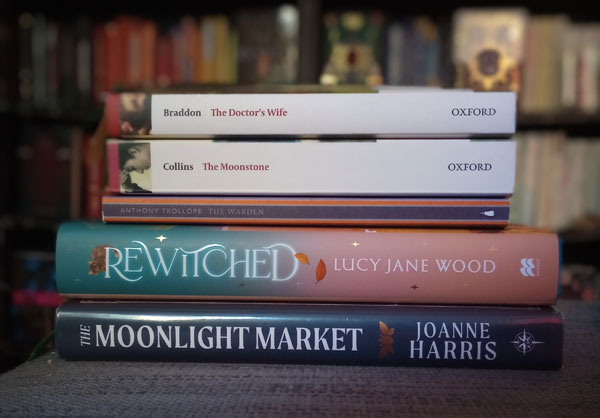
Silent book club member Kath's recent reading, including The Doctor’s Wife by Mary Elizabeth Braddon, The Moonstone by Wilkie Collins, Rewitched by Lucy Jane Wood and The Moonlight Market by Joanne Harris

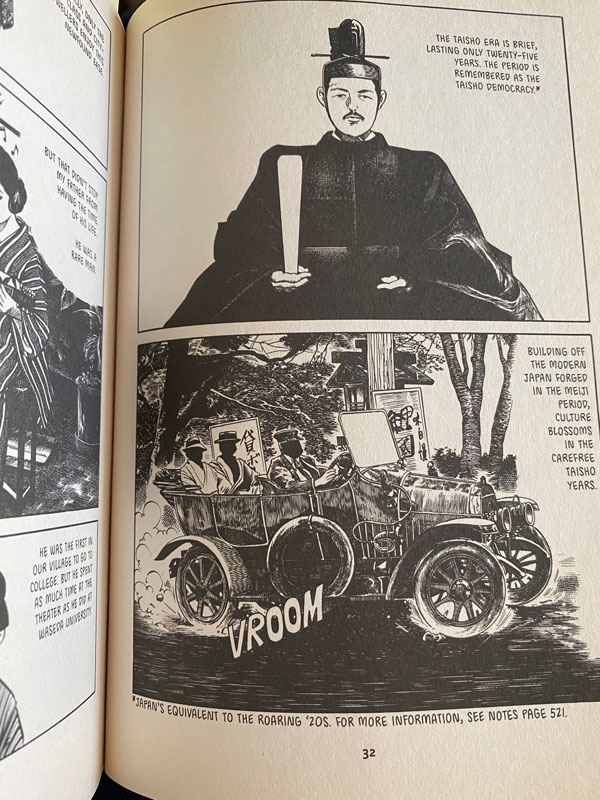
Cover of Showa 1926-1939 A History of Japan by Shigeru Mizuki

Page of graphic novel Showa 1926-1939 A History of Japan by Shigeru Mizuki

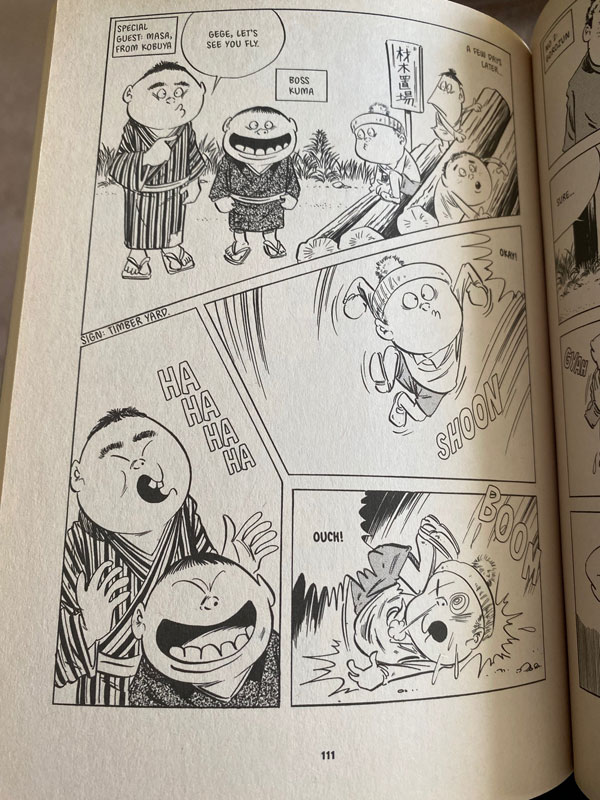
Page of graphic novel Showa 1926-1939 A History of Japan by Shigeru Mizuki

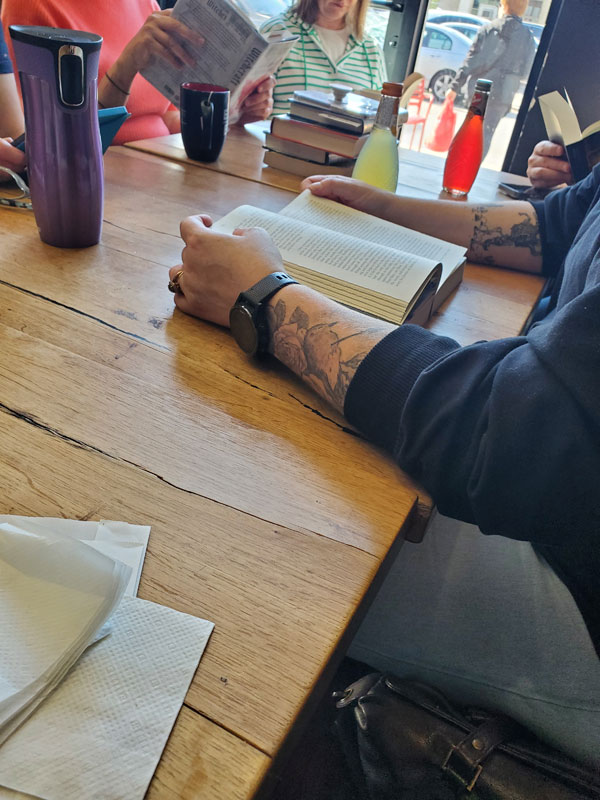
Silent book club members gathered, reading silently, at a table at East Toronto Coffee Co

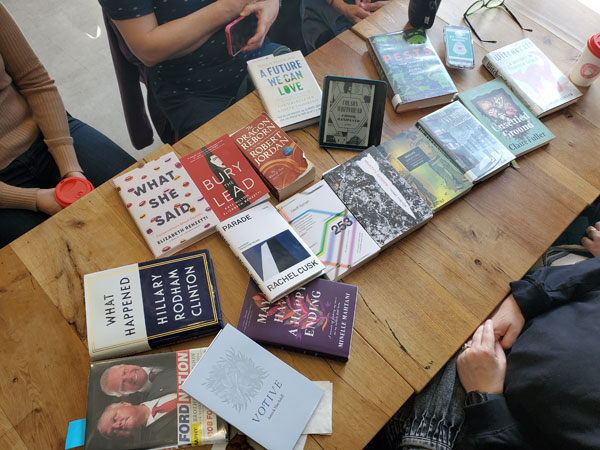
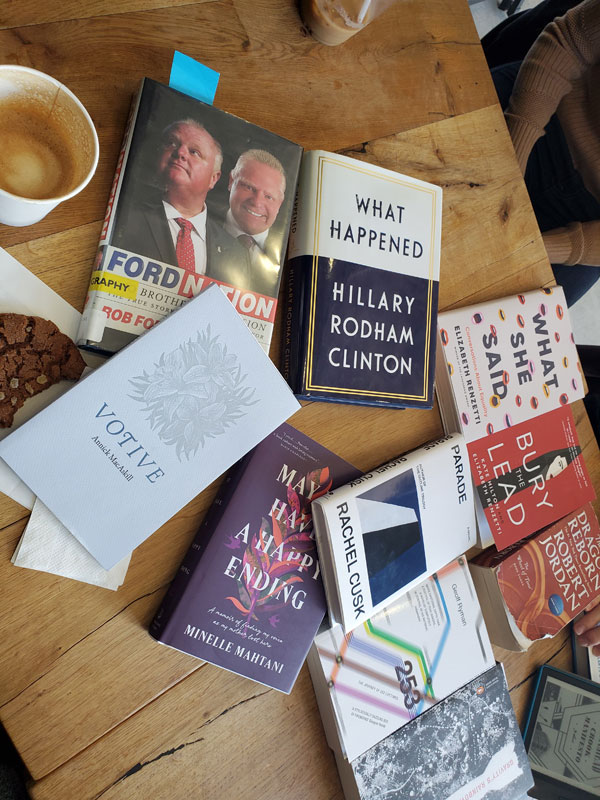
Silent book club meeting at the East Toronto Coffee Co, with the group's book selections spread out on the table along with beverages and pastries. The books include works by Rob Ford and Doug Ford, Hillary Rodham Clinton, Annick MacAskill, Rachel Cusk, Elizabeth Renzetti, Thomas Pynchon, Claire Fuller + more

Silent book club meeting at the East Toronto Coffee Co, with some of the group's book selections spread out on the table along with beverages and pastries. The books include works by Rob Ford and Doug Ford, Hillary Rodham Clinton, Annick MacAskill, Rachel Cusk, Elizabeth Renzetti, Geoff Ryman, Robert Jordan + more

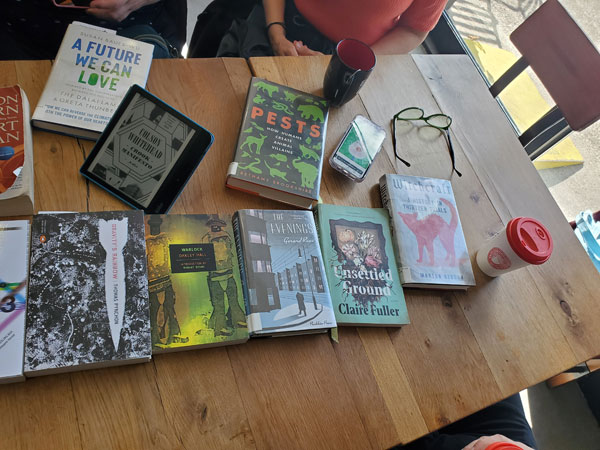
Silent book club meeting at the East Toronto Coffee Co, with some of the group's book selections spread out on the table along with beverages and pastries. The books include works by Thomas Pynchon, Oakley Hall, Claire Fuller, Gerard Reve + more

As always, every title on our group’s lists means that at least one (but usually more) readers have given that title thoughtful consideration. That doesn’t mean that every work on our lists is expressly recommended (as I just suggested) – but that’s still more than OK, we think. Inclusion on this list always means that our readers have devoted time and attention to a title – and that, dear readers, means a lot.


Here are some extra book-related articles, resources, news and recommendations, items and tidbits that are often companions to books on the list, or are inspired or offered by our members and/or come up during our discussions and chat.

  • In case you missed it … yes, we’re that book club from TV!
  • One of the creatures chronicled in Pests – How Humans Create Animal Villains by Bethany Brookshire is the cane toad. If that story sparks your interest, you might also enjoy the 1988 documentary Cane Toads: An Unnatural History.

Our group’s previous reports and book lists – all eminently trustworthy – areright here!

You can also check out links to articles, interviews and more here – some with San Francisco-based Silent Book Club founders Guinevere de La Mare and Laura Gluhanich, and some with us here in east end Toronto.

Learn more about the worldwide phenomenon of silent book clubs via Guinevere and Laura’s Silent Book Club web site. In fall 2023, they welcomed their 500th chapter … and with continuing and astonishing momentum, they are now boasting over 1,000 chapters!!! (There were around 60 chapters when we joined as the first Toronto chapter in 2017.) You can find information on meetings happening around the world and close to where you live. Every club is a different size, format (in-person, virtual or combinations) and vibe, so contact a club’s organizers beforehand if you have any questions or preferences. Please feel free to contact me for more information about our club and its offerings.

Happy, happy reading (or even sad, or challenging, or frustrating reading … but keep going!) until next we meet!

52 Adventures #32: Silent Together

This blog post originally appeared in Todd Tyrtle’s Go Outside Today blog by Todd Tyrtle blog on February 29, 2020. I’ve gratefully reproduced it here with Todd’s permission.

In the late 1970’s, a new item was added to our elementary school’s daily schedule. “Sustained Silent Reading” or simply “Silent Reading” as the teachers called it. Classes would pause mid-afternoon and the entire class would read silently together – whatever books we liked. The idea was to encourage a love of reading – something I already had a great deal of. So for me, being given 30-40 minutes of my school day several times a week was like a dream come true. The class would become silent save for the occasional sound of a page turning as we all dove in to separate worlds. Some of us would read books from the Weekly Reader Book Club, others books we’d found at the library in the classroom. After some time, our teacher would quietly inform us time was up. Slowly the students would come back. Stuart Little would drive Kathy back to our school in his little car, Mike would wave goodbye to Harriet and Sport and catch a New York subway that mysteriously had a stop in our classroom, and Sam Gamgee and I would finish our second lunch and I’d say goodbye. For the rest of the afternoon, my mood would be influenced by having spent time reading a book I loved.

Decades passed, and during that time my reading waxed and waned with how busy my life was, and lately, how compelling the Internet, my smart phone, and social media were.

Ironically, one day last October my smartphone gave me a notification about a news story. With all of the data Google had, it knew I was heading for India soon and told me that something called a Silent Book Club was now regularly happening in Delhi. The idea was intriguing. Participants meet in a cafe and then, just as I remember doing in 1978, they sit together and silently read. Unlike many book clubs, there is no expectation that everyone will read the same book and discuss it. There is time set aside for optional discussion of books that everyone is reading and of course before or after the event itself, participants can socialize freely.

I did not find time to visit the club in Delhi, however I was very excited to read more about it. The idea, described on their website as “Introvert Happy Hour”, started in San Francisco 2012 and has since spread to dozens of cities in thirty countries.

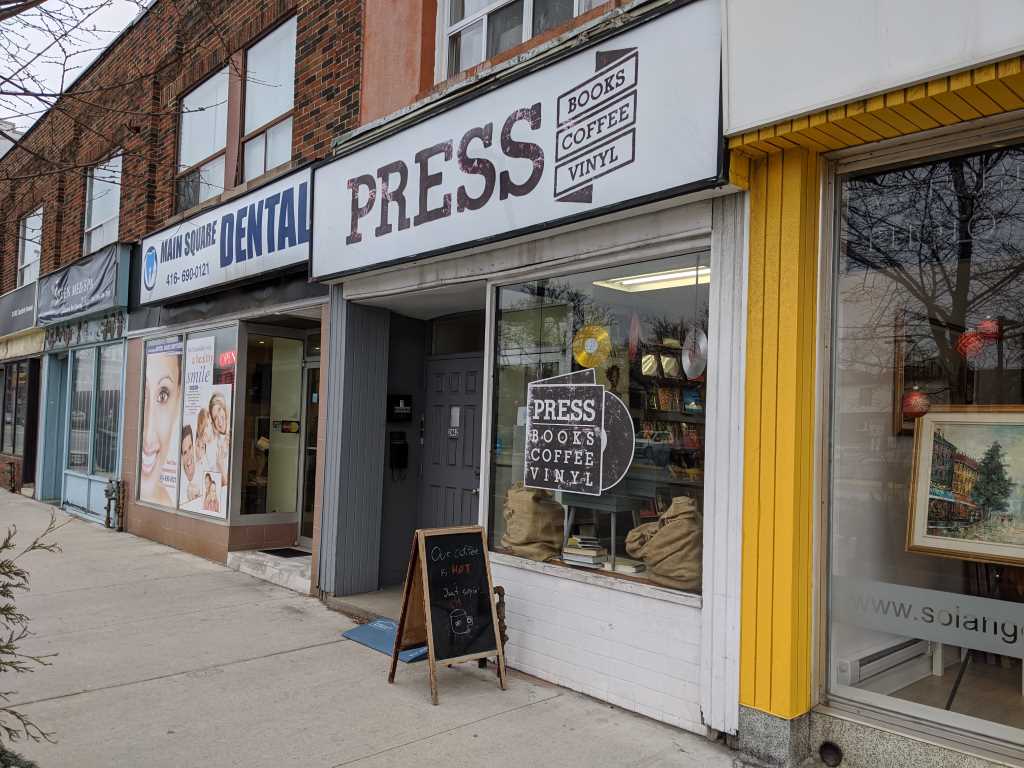
In January I meet up with the Toronto chapter which meets at a bookstore / cafe / record store called Press Books, Coffee, and Vinyl, a cozy spot smelling of a delicious combination of used books and coffee. Several tables are pushed together with space for about a dozen people. I’m warmly welcomed by Vicki, the organizer, and introduced to several of the other participants. I grab a coffee and a scone and take a seat.

Press on the Danforth, Toronto (Photo by Todd Tyrtle)

Though I’d read some time ago about the Toronto chapter’s activities, I’d forgotten the agenda and was a bit taken off guard by the format. Every meeting starts by going around the table. Each participant introduces themselves and then has 2-3 minutes to talk about what they’ve read recently and what they are planning on reading today. I quickly make a few notes about what I had read earlier in the month and in December and then listen in to everyone else’s impressions of what they’d read recently. The diversity of books was so interesting and inspiring. (You can see a full list at the Silent Book Club’s entry for my first visit here). Up until now I haven’t had a chance to talk to many other people about what they’re reading and so I’ve relied on following my own whims as to what I generally enjoy. This has meant reading so many travel memoirs, a little self-improvement non-fiction, a tiny bit of history, and the occasional fiction piece. Hearing about the great reads everyone else was enjoying is doing an excellent job of getting me out of the literary echo chamber I’d put myself in.

After everyone has had their chance to talk about the books they’d recently been spending time inside, it is time to read. We all go silent and I notice that Joni Mitchell has been playing on the cafe’s turntable. The atmosphere is lovely. It isn’t just reminding me of childhood Sustained Silent Reading time at school, I am noticing it is something that I rarely get to experience these days: the experience of sharing comfortable silence with others. Very often with friends and family there’s a sense that if we’re together there must be a conversation happening. This is most definitely not the case here. I’m happy to be in the room with others but I’m also happy to simply be able to read and share space with them.

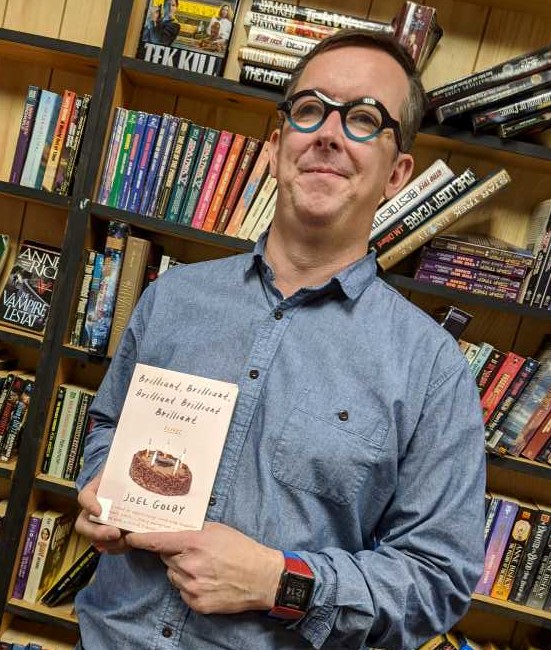
Fifty-five minutes in to the reading, Vicki gently raps on the table signaling that we have five minutes left before our hour of reading together is up. I appreciate this little bit of notice as it allows me to gently return from my read. The five minutes pass quickly and we end the session with a series of photos of us with our books for sharing on the Toronto Silent Book Club blog – anonymized to preserve everyone’s privacy. I’m less concerned about my own privacy so I have a second photo taken that clearly shows me with my read.

Todd Tyrtle and book at February 2020 silent book club meeting

For the curious – that book was hit and miss. There were some fantastic stories – and others that left me cold.
I have been to one more Silent Book Club meeting since then – this time with Sage who enjoyed it tremendously. The biggest thing I notice after this experience is how much I have enjoyed rediscovering reading. Over the past several weeks since the first meeting, I have read literally hundreds of pages more than I was regularly reading. And the more I spend reading, the more I notice others doing the same. A few mornings ago I had an impromptu “silent book club” experience at 6:00 AM on the bus as I joined a line of three other people all in a row reading our books together.

This experience, along with my visit back to 1987, has created ripples throughout my life well beyond this – watch for an entry on this subject in the very near future.

If you’re inspired to find a Silent Book Club chapter in your own area, check out the Silent Book Club map. And if there isn’t one, learn how to start your own here. To my friends in India: take note – there aren’t many chapters there yet, but I have readers in both Delhi and Bangalore (including HSR Layout and Whitefield) who may enjoy visiting those events. If you do, please share what it’s like – I’m very curious to hear how the chapters differ).

Where to find Canadian poetry online

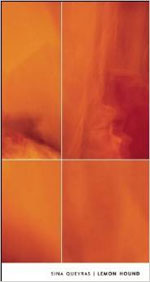
bookcover-lemonhoundPoet Jacob McArthur Mooney recently sparked a discussion on Facebook about online publications with a mandate to publish new work by Canadian poets. With his go-ahead, I’m moving the list that resulted from the discussion here. Where I can find them, I’ve added links and Twitter handles. Broadening the definition just a bit, there are some publications on this list that have a print counterpart. I’ve also added a few web sites that go back a bit in terms of Canadian poetry history and archives, and some that might be now defunct in terms of publishing new material, but still offer interesting selections and back issues (and hey, you never know – sometimes these things come back to life!)

The intent here is to give people a starting point to explore and discover poetry created and published by Canadians. Are there any sites or resources that should be included? Let me know via the comments here or by email at vicki@bookgagabooks.ca.

Celebrating the beautiful book object – The Children Act, by Ian McEwan

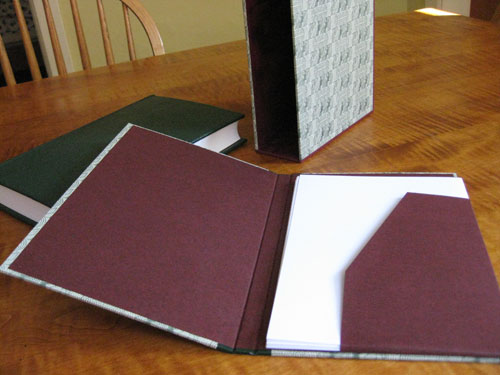
The special limited first edition of Ian McEwan’s latest novel, The Children Act, is not only a beautiful book object, but it offers some striking visual insights into the author’s creative and editing processes.

This edition charms right from the slipcover …

mcewan-childrenact004

… which contains not one, but two pieces …

mcewan-childrenact005

… the leatherbound edition of the book, plus an additional treat exclusive to the first 25 of the 100 copies of this specially crafted version.

mcewan-childrenact006

mcewan-childrenact007

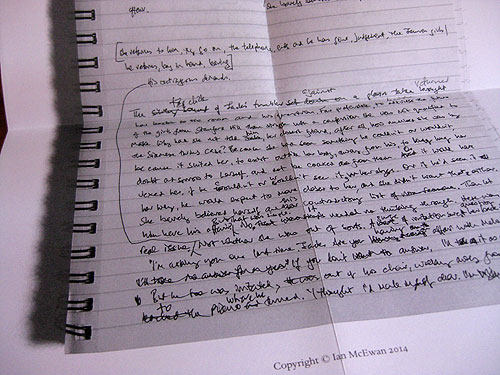
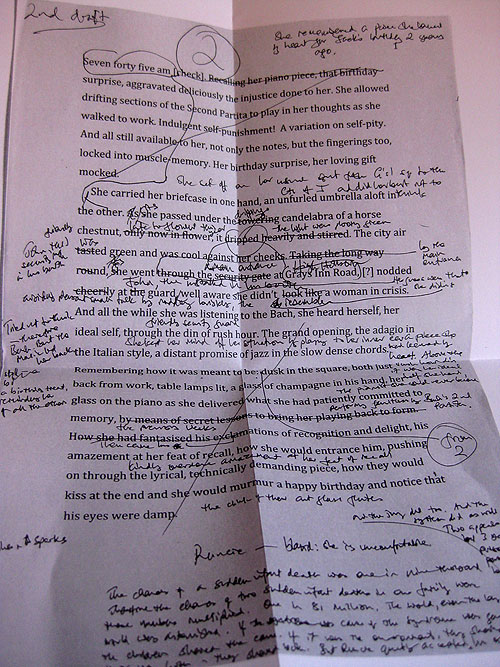
The unique addition is a selection of facsimile pages of notebook manuscript and one page of hand-corrected typescript from an early draft of the novel, all supplied by the author – an intimate look into the author’s work and fascinating pieces to pore over and scrutinize.

mcewan-childrenact008

mcewan-childrenact009

See also:

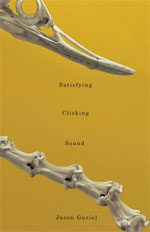
Satisfying Clicking Sound, by Jason Guriel

“Avoid writing if you can. If you can’t, avoid cliché, and be precise. Don’t try to ‘express yourself’; self-expression usually amounts to expulsion. Try, rather, to connect with another: picture a smart but demanding reader, and try to hold her attention.”
– Jason Guriel … on hoarding and keeping your best lines off Twitter

I’m pleased to welcome back guest book reviewer Rebecca Hansford, who previously reviewed Margaret Atwood’s The Year of the Flood here on the the Bookgaga blog. Rebecca recently graduated from Queen’s University, where she studied Biology and Psychology. As she previously observed, “Majoring in science instead of English was a tough choice for me as I have an electric passion for reading. I particularly enjoy fiction that integrates scientific facts, environmental issues and dystopian societies.”

bookcover-satisfying-clicking-sound

In Jason Guriel’s Satisfying Clicking Sound, the poet explores the contrasting elements of nature and technology currently existing in our society. Guriel’s style is of writing demands the reader’s attention in a profound yet disturbing way. For instance, Two Girls Splitting a Set of Earbuds describes two girls as flesh conjoined by an iPod, illustrating our dependence on our newfound technology and our inability to communicate without it. This brutal yet honest style of poetry is seen throughout his work, causing any reader to pause and ponder his thought, even possibly becoming repulsed at times. In his poem Poetry is Barbarous, Guriel fully exposes the vulgarity of his writing, as he compares a snowfall burying plastic swans and rabbits to real animals being buried to the throat. This vicious, yet captivating style of writing is seen throughout most of Satisfying Clicking Sound.

Although most of Guriel’s poems are blunt and difficult to digest, there was some free verse poetry with a more flowing style. In the Washbasin, Guriel compares painting and watery reflections to emphasize how the narrator feels he can live up to his father’s shadow. This poem was genuine, and the painting metaphor was beautifully tied into the poem. Dead on Arrival was another poem that appealed to me. Guriel remarks that stars are not aware of the fact that they burned out light years ago and therefore, they may not be aware of who they are themselves. Similarly, since we live our lives with the knowledge that we will die, is life futile? Will we ever know who we truly are?

In short, Jason Guriel’s Satisfying Clicking Sound is a fantastic read if you are interested in a more modern style of poetry. However, the last half of his work does bring forth some beautiful poetry with a less hard-hitting and vulgar style. Nonetheless, Guriel uses imagery in an astounding manner as he broadcasts his ideas regarding technology and society in a brutally honest manner. He will almost certainly hold your attention throughout his work.

Thank you to Véhicule Press for providing a review copy of Satisfying Clicking Sound by Jason Guriel.

Book traffic report #6 – an especially giving month

carrying-stack-books

This household continues to brim with books – but is maybe starting to offer just a wee bit of breathing space – as we continue to take a year-long look at how books make their way into (and out of) this place. This report reflects the month of August, which even though it included a cottage week during which all we did was read books, we still somehow managed to have a record month in the “outgoing” column.

At the end of August, the two columns on my home office whiteboard tallied up as follows:

Incoming: 4

  • All incoming books were paper.
  • 2 of the books were fiction, 2 were poetry collections.
  • 3 of the incoming books were purchased in bookstores (Book City and Sunworks in Red Deer, Alberta).
  • 1 book was purchased online, directly from an independent bookseller in the UK.

Outgoing: 48

  • 32 outgoing books were contributed to three local Little Free Library boxes.
  • 7 books were given to friends.
  • 5 books (mostly technical references) were donated to a workplace.
  • 4 books that were damaged or grievously outdated references were consigned to the recycling bin.

It pains me to have to put a book in the recycling bin, but on occasion, that seems like the only sensible thing to do … that really, it’s just going to take up precious space in a Little Free Library box and really, no one is going to take that wrinkled, discoloured Windows 98 technical reference manual.

2014 to date: 74 books incoming, 138 books outgoing

The ratio of read to unread book incoming or outgoing is still pretty much 1 to 1, with slightly more outgoing books leaving here read rather than unread. As I mentioned before, this makes me feel like we’re sending mostly loved or at least acknowledged books back out into the world, versus having more books pass through our home to which we haven’t given any attention.

So far this year, 38 fiction, 15 non-fiction and 21 poetry books have arrived, and 61 fiction, 53 non-fiction and 24 poetry books have departed. One further observation to one I made in our last report: many of the departing non-fiction books are admittedly out-of-date technology or topical content that perhaps doesn’t have great historical value. We are consciously adjusting so that if we are going to read non-fiction or reference that might have a “best before” date, we more likely to borrow that from the library now rather than purchase it. Perhaps that’s a “well, duh” realization, but anyhow …

Our outgoing numbers continue to confirm that we have an abiding affection for our local Little Free Library boxes. If those didn’t exist, I wonder if we’d be carting more boxes of books to garage/yard sales and the like. Somehow, Little Free Library boxes seem more thoughtful, don’t they? (Do many books still make their way through Freecycle, I wonder?)

The whiteboard is erased and ready for another month as we head into the home stretch of our year of flying books …

Carrying a stack of books. Photograph: Thomas Barwick/Getty Images (via The Times)
(http://www.thetimes.co.uk/tto/arts/books/article3307489.ece)

With each social media milestone, a continued commitment to literacy causes

I’ve mused in previous blog posts about the importance of literacy. From those musings, coupled with wise advice and support from book and publishing friends and acquaintances in real life and online, I’ve made a commitment to supporting literacy initiatives and programs … every time I hit a followership milestone on Twitter.

This time, I’ve made my donation as follows:

copian-logo
For 25 years, non-profit organization Copian (previously known as the National Adult Literacy Database) built Canada’s largest and most comprehensive digital collection of Literacy and Essential Skills tools and resources. This database/collection was a vital resource to numerous grassroots literacy organizations, libraries and individuals, not only providing materials but also comprehensive online training.

Earlier this summer, the Government of Canada withdrew vital funding, forcing the closure of Copian. The following coverage and reactions capture the dismay, confusion and disappointment:

Mainstay of Canada’s literacy movement topples: Goar
Literacy workers distraught as Ottawa eliminates their national database and resource centre.
by Carol Goar
Toronto Star
July 3, 2014

Update: On September 24, 2014, Copian announced that they have been able to restore a streamlined version of their online library. While the content is not maintained as regularly as before, Copian hopes this will tide over everyone depending on this information until the organization can devise an ongoing sustainable business model.

As I’ve mentioned previously on this subject, much more important than numbers of followers or influence scores or whatever is that we are in this social milieu reading and writing and talking … about books and literature and print and digital formats and reading devices, and on to bookstores and libraries and the vital reading and writing experiences in all their forms. I value those who follow me and converse with me, those that I follow and learn from, and those that I come across even fleetingly in this vibrant tweeting, retweeting, chattering, enthusiastic and engaged environment. It’s not the numbers of them (although that there are an endless potential for book friends out there continues to take my breath away), but the quality of the discourse and the spirit, dealing with fundamental issues, not to mention myriad delights.

Numbers are just numbers. But then again, we can use those numbers in creative ways to challenge ourselves to remember, to recognize, to give back. Through this exercise, I’ve learned about other organizations and institutions supporting literacy, literary causes and books that I’d like to recognize in future, so I’m going to set a goal to do just that whenever I hit one of those “number” milestones. I challenge other book tweeters and bloggers to do the same.

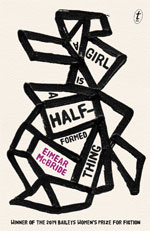
A Girl is a Half-Formed Thing, by Eimear McBride

A Girl is a Half-Formed Thing, by Eimear McBride

In A Girl is a Half-Formed Thing, Eimear McBride takes you inside a young woman’s mind teeming so violently, body pained so volcanically, soul torn so profoundly that you’re left shaking by the last page … if you last to that point. You might not. As McBride inhabits this character at the cellular level, the effect is scorchingly intimate, uncomfortable, unbearable and possibly unreadable for some at times. The rewards and insights are great, though, for the reader that can persevere with this thorny, brilliant debut novel.

This young woman gives vivid voice to her troubled upbringing, her sexual abuse at the hands of a manipulative family member, and the self-abuse she plunges into to simultaneously feel and not feel what has happened to her. That voice is only tempered with tenderness and sweet, wry humour when she speaks of and to her brother, set back in his own life’s progress by early childhood illness that comes back to afflict him and unravel their already fractured family.

While always defiant and spirited, that vivid voice is not entirely discernible, however. Spewing a churning wellspring of language that is somehow both dense and fragmented, this unforgettable narrator’s words regularly tumble into inarticulate ranting, but can just as easily take exuberant flight as she wields her unique form of black humour. Even as strict meaning is sometimes blurred, though, you will somehow manage to feel, sometimes be strangely charmed and almost constantly be rendered uncomfortable but still compelled by this woman’s intensity, however desperate, misguided and destructive she is, to herself and those she loves.

Through her voice, you also gain a powerful sense of her physical presence. As striking and verging on impossible it is to take in the indignities visited upon her and that she seeks out, it is a comparatively minor impertinence with her deceased grandfather that oddly but most affectingly connects with the physical intimacy, sympathy and even empathy of the final days with her brother. Even if some of her capacity for fearless physical connection has been made in the most horrific ways, you can’t help but feel a breathless, twisted admiration at her perverse determination to survive.

Her particular ability to understand her brother’s confusion and humiliation is both disquieting and profoundly moving to witness – and still, miraculously, leavened with that feisty dark humour – even when her beloved sibling’s existence has ground down to the miserably mundane. Somehow, she alchemizes that misery into something expiatory and transcendent:

“Something. Words words. I’ll go on my own. Your temper that’s the devil up. Normal almost sight again. Pull the bed but melt like water. Gone to hell. All your muscles. You’d give me a hit but can’t. I. There. Lie back. Lie back. You have to. Don’t do this you say.

“Don’t. You have to. And I turn away. I say. Just go don’t worry it’s. Normal now. It’s fine. You. Strapped up in your body. You don’t live there. I. Don’t look. I hear you. Crying.

“Going in the nappy. Rage. Not fair. Not fair. You wait til I’m well. You can definitely kill me then I say.

“Quiet.

“Turn and you are back asleep. I. Know I life the cover. Clean up. And now you’re gone fast far. Breathing. Don’t see me. Don’t know I do. New one. Clean you. Put it in the bin. See. My one act. I might be a person. Beneath the. Where horrible can be a good act of contrition. Shush there. You there sleeping. My boy. My brother. Wish my eye for yours tooth for your tooth. You’re a better. No. It’s all fuck gone. Gone to the gone to the wrong wrong wrong. Be shush for you. I can.”

A Girl is a Half-Formed Thing is perhaps best read in as few sittings as possible to stay with the narrator’s linguistic and emotional rhythms. Ironically, maintaining that sustained attention is like gazing into the sun. You have to stop. You have to look away. You have to take a breath before resuming. In particular, the book’s last 50 pages (pretty much the entirety of Part V, The Stolen Child, an at least two-pronged title) are suffocatingly intense and emotionally lacerating as the heroine’s – yes, she is heroic – anguish reaches a crescendo.

A Girl is a Half-Formed Thing joins admirably other works known for distinctive if fractious voices that veritably leap off the page. The comparisons to Joyce are plentiful and warranted. More titles that come to mind include Pigeon English by Stephen Kelman and How late it was, how late by James Kelman.

Eimear McBride’s admiration of James Joyce and Edna O’Brien is immense and unabashed, as she reveals in this Guardian essay. Her tribute to Joyce can also be well applied to the rewards to the reader who stays with A Girl is a Half-Formed Thing to the end:

Difficulty is subjective: the demands a writer makes on a reader can be perceived as a compliment, and Joyce certainly compliments his readers in what he asks of them.

See also:

Thank you to Simon and Schuster Canada for providing a review copy of A Girl is a Half-Formed Thing, by Eimear McBride.