This is an engrossing and sensitive depiction of the complexities of human lives lived during the German occupation of France during the Second World War. It’s made all the more poignant by the fate of the author, who was arrested and died at Auschwitz in 1942. Her notes accompanying the manuscript reveal that she had envisioned an even more sweeping and ambitious work, but that she sensed that her time was running out. The novel’s appendices, detailing her notes and the correspondence of her last days and that of her family and colleagues as they tried to find and rescue her, are as riveting as the novel.
Well crafted but depressing, sometimes verging on sinister … but when you hear Wright read his work aloud (which I’m glad I had the opportunity to do), the poems come across as wry and almost self-effacing.
This examination of different mother-son relationships – some intimate, some estranged, some just strange – is movingly rendered in language that is simultaneously rich and plain-spoken. This is an absorbing read that I think would touch everyone in some way, even if you aren’t a mother or a son.
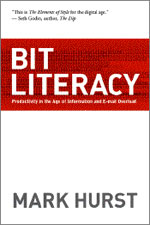
Mark Hurst waxes exuberantly optimistic on the promise of simple bit literate habits to make every computer user more productive and savvy. I think he underestimates how ingrained people’s habits are, coupled with their fear of the “mystique” of technology and their dependence on specific applications. His contention, though, that bits should be independent of a given company’s software or platforms makes very good sense. Even if you just develop a few of his suggested habits, you’ll be more in control of your digital world … and, whether we admit it or not, we all *do* have a digital world nowadays.
I am loving Kleinzahler’s jaunty juxtaposition of high-falutin’ references with down-to-earth commentary. Having heard him read and give speeches, it’s great to hear his voice in my head as I’m reading his words. I go back to this wonderful, funny, moving speech of his all the time:
One of my favourite poems from “Rapid City” is thematically similar to Kleinzahler’s “The Strange Hours Travellers Keep”, about the disorientation that travellers feel in places like indistinguishable hotel rooms:
On waking in a room and not knowing where one is
There is a bureau and there is a wall and no one is beside you. Beyond the curtains only silence, broken now and again by a car or truck. And if you are very still an occasional drip from the faucet. Such are the room’s acoustics it is difficult to place exactly where from. Also, the tick of the clock. It is very dark. There exist all manner of blacks, lampblack, for instance, much favored by the ancients, so deep and so dense and free of any shade of gray or brown. But this, this dark is of another order, compounded of innumerable shadows, a weave of them. One is able to make out shapes. It is not restful, to be like this, here, nor is it a fearful place. In a moment or two you will know exactly where you are, on which side of the door, your wallet, your shoes, and what today you’ll have to do.
Cities each have a kind of light, a color even, or set of undertones determined by the river or hills as well as by the stone or their countless buildings. I cannot yet recall what city this is I’m in. It must be close to dawn.
This book is sweet, funny and insightful. Winter unerringly dissects the intimate minutiae of relationships with friends and lovers, while simultaneously maintaining a wry distance, and also looking out at the bigger world. His dialogue is at times devastatingly hilarious and moving.
This plainspoken book is riveting, emotionally stunning, a marvel. Its rapid-fire juxtaposition of harsh, abrupt violence, unexpected thoughtfulness, enduring tenderness and wry wit is unforgettable. Its themes have Biblical majesty. That one of the strongest ethical statements comes from the most twisted, perverse characters is a haunting conundrum. Equally haunting is the Bells’ love story, which underpins the entire story.
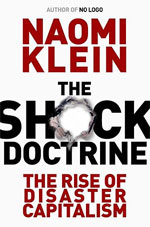
Overall, I feel like I learned a lot, as I did with “No Logo”. I’m also filled with even more admiration for Klein’s intellect and tenacity with complex, thorny, overwhelming subject matter. Unlike “No Logo”, however, “Shock Doctrine” left me feeling pretty bleak, hopeless and powerless. It wasn’t until mere pages from the end that Klein starts to give examples of people rising up against and finding ways to resist being shocked into accepting the Freidmanesque privatization of government and social services – almost as if she is pretty weary and despairing of the subject, too.