NW is not Zadie Smith’s best. However, it shows a writer at her finest and bravest exploring diverse terrain and experimenting with different methods and vocabularies with which to present those explorations. That makes Smith’s examination of intersecting worlds and lives in the northwest corner of contemporary London a still fascinating if sometimes frustrating read.
NW focuses – as much as the intentionally disjointed storytelling and multiple narrative voices overlaid with a range of stylistic syncopations can be said to focus – on the lives of two women who have known each other since a fateful childhood encounter: red-haired Leah Hanwell, a charitable lottery administrator of Irish descent and Natalie Blake (who selectively abandons her birth name of Keisha), a lawyer of Jamaican descent. Both struggle and flirt with ambition, identity and personal reinvention against a backdrop of societal and economic changes happening, at times very literally, on their doorsteps.
Smith propels the story with varying degrees of success via a carousel of styles and formats from stream of consciousness narration to numbered and labelled lists and paragraphs to even a touch of concrete poetry. In the end, plotlines dangle or simply deflate. What endures for this reader is that the two central characters seem able to pick up their sometimes suspended conversations and relationship, and continue caring for each other through revelations, attempted transformations and missteps. The foundation of their friendship is grounded on a recognition of the essential persons under the layers of time and circumstance. Likewise, this reader will wait for and seek out this author’s future literary transformations, recognizing the essential craft and character at the foundation of whatever she attempts next.
See also:
NW by Zadie Smith – review Adam Mars-Jones finds himself stumbling on the cracks in Zadie Smith’s new novel The Guardian
Yes, I have another lovely book object about which I’d like to rhapsodize … as I’ve done recently here, here and here. As I mentioned, I’m going to try from time to time to showcase and celebrate the physical books I’ve read, reviewed, and/or from which I’ve gathered #todayspoem snippets of inspiration. Today’s treasure is At Marsport Drugstore, by Al Purdy, published in 1977 by the storied Paget Press.
While it’s a zesty good read, Al Purdy’s At Marsport Drugstore is also emblematic of two great literary collaborations. This collection of largely love poems was the first publishing venture of Paget Press(1) of Sutton West, Ontario, lovingly operated by Peter Sibbald Brown as a distributor for California’s iconic Black Sparrow Press(2). Brown’s literary tastes and sense of book aesthetics and production values were very simpatico with those of Black Sparrow founder John Martin. As well, the collection boasts an appreciation by legendary US poet Charles Bukowski, with whom Purdy conducted a lively correspondence in the 1960s and 70s.(3) (The two never met, but their warmth and respect for each other is palpable, not only in Bukowski’s tribute here, but in a subsequent collection of their letters, also published by Paget Press.)
Each poem is preceded by a woodcut-style illustration by artist Hugh Leroy. The edition shown here is part of a limited run of 75 that includes a tipped-in print by Leroy, and is autographed by both Purdy and Leroy.
Wielding deceptively simple, straightforward prose, Alix Ohlin draws us into the labyrinthine lives and emotions of a set of connected characters who spiral out and back on their own journeys in Inside. The book’s opening scene, where a woman skiing alone literally stumbles across a man who has failed to commit suicide in snowy seclusion, draws the reader in as swiftly and intimately as the characters’ unusual collision.
From that breathtaking start, Ohlin takes the reader through the complicated lives of Grace, a perhaps overly dedicated therapist; John, a traumatized former international aid worker; Annie, a troubled teenager turned aspiring actress; and Mitch, Grace’s ex-husband and a therapist himself who has worked in Canada’s Far North. As the overall story moves back and forth in time and from Montreal to Iqaluit to New York City to Hollywood to Rwanda, Ohlin maintains a steady hold on the characters and their intersecting paths, to offer the reader an enticingly, compulsively readable experience.
At the recent International Festival of Authors, Ohlin took part in a combined reading and group discussion with her fellow Scotiabank Giller Prize shortlist nominees. (In this season of literary awards, Inside is also shortlisted for the Rogers Writers’ Trust Fiction Prize.) In an elucidating exchange with discussion moderator Carol Off, Ohlin observed that Inside connects its characters through unanticipated acts of kindness. It’s a touching and potent way of encapsulating the entire book. Inside strikingly balances the precious gift of strangers reaching out to help strangers against the bittersweet conundrum of those nearest us and most beloved often being the greatest strangers and enigmas of all. This reader suspects that beautiful dilemma will continue to haunt and intrigue the most.
Thank you to House of Anansi Press for providing a review copy of Inside, by Alix Ohlin.
Well, I’m closing in on 10 months (211 poets in 288 days, to be exact) of #todayspoem. Yep, and so far, I haven’t missed a day. As I’ve mused before, did I have any idea I’d be this far along a journey through poetry when a bunch of us bookish Twitter friends had the first #todayspoem discussion back in late 2011? I knew I would commit to it, and I did. What I didn’t know was how far-ranging a journey it would be, and how much I’d learn from both my own explorations, and from the discoveries I’d make through the generosity and creativity of other #todayspoem contributors (who I hope I’ve accurately captured in this Twitter list).
As far afield as I’ve gone at times with #todayspoem, I notice from keeping track of my choices that there are poets I’ve returned to more than once. The following is a list of the poets I’ve visited and revisited for #todayspoem inspiration, with links (where available) to some of their poems that I’ve chosen, read, enjoyed and derived inspiration or solace from early in the morning.
As I mentioned recently – here and here – I’m going to try from time to time to showcase and celebrate the physical books I’ve read, reviewed, and/or from which I’ve gathered #todayspoem snippets of inspiration. Today’s treasure is Bottle, by Margaret Atwood, published in 2004 by Hay Festival Press.
The frontispiece of Bottle includes a lovely, whimsical illustration by Margaret Atwood.
The Hay Festival started in Wales and now runs literary and cultural festivals under the Hay name around the world. As described on the festival’s web site:
For 25 years Hay Festival has brought together writers from around the world to debate and share stories at its festival in the staggering beauty of the Welsh Borders. Hay celebrates great writing from poets and scientists, lyricists and comedians, novelists and environmentalists, and the power of great ideas to transform our way of thinking. We believe the exchange of views and meeting of minds that our festivals create inspire revelations personal, political and educational. Hay is, in Bill Clinton’s phrase, ‘The Woodstock of the mind’.
Hay now runs 15 festivals across five continents at which current political thought and the re-imaginings of international writers gathered together cross cultural and genre boundaries and foster the exchange of understanding, mutual respect and ideas.
In conjunction with author appearances at the Hay Festival, excerpted and original works premiered at the event are also published in wee, attractive, gem-coloured Hay Festival Press original and limited editions. Learn more here.
As I mentioned recently, I’m going to try from time to time to showcase and celebrate the physical books I’ve read, reviewed, and/or from which I’ve gathered #todayspoem snippets of inspiration. Today’s treasure is A Saving Grace, by Lorna Crozier, published in 1996 by McClelland & Stewart.
The book’s dust jacket has a cutout window which reveals a prairie farmland picture underneath.
Separating the book’s dust jacket with the cutout window from the rest of the book reveals that the prairie farmland picture is embossed directly onto the hardcover book board.
Lorna Crozier’s signature appears on the book’s front cover. When you can recall the moment when you received the signature from the author, doesn’t it lend the book object a special glow forever after? Even if a book is pre-signed, doesn’t it lend the book an additional bit of warmth?
As part of my daily #todayspoem tweeting routine, I recently accompanied my selection of an excerpt from Margaret Atwood’s poem “Spelling” with some pictures of the treasured limited edition chapbook from which the poem came, entitled Notes Towards a Poem That Can Never Be Written (published in 1981 by The Nightshade Press). It’s a slim, striking, verging on unwieldy, utterly unlikely rendition of a chapbook. Its somewhat thorny but beautiful physical demeanour, complete with stitched string binding that just might be sending some kind of a message unto itself, almost seems to echo the acerbic, urgent poems contained within. (Hmm, let’s think about writing book reviews that include a review of how well the physical book supports the book’s thesis, themes, tone, etc. Yes, I know that will be a challenge, but perhaps a healthy one, in this increasingly digital world.)
Inspired by interested comments about the Atwood chapbook pictures from Twitter book friend @barbhowson, I’m going to try from time to time to showcase and celebrate the physical books I’ve read, reviewed, and/or from which I’ve gathered #todayspoem snippets of inspiration.
Today, I dipped into Charles Bukowski’s The Last of Night of the Earth Poems (1992, Black Sparrow Press). Many of not most of the works comprising Bukowski’s prodigious output were published by fabled Black Sparrow Press in handsome, well-crafted editions that gave to his and the works of other avant-garde writers of the 1960s and 70s a reverence that was often a long time coming from a broader audience and readership. That was due in large part to the vision of Black Sparrow founder John Martin, whose literary legacy is described here and has still been kept alive today. As David R. Godine, the licensed distributor who took over the Black Sparrow backlist when John Martin retired in 2002, points out:
These are not reprints: they are the original publisher’s editions, trucked direct from John Martin’s former Santa Rosa warehouse to ours. Most of the books are hand-sewn, on creamy, heavy, acid-free paper, with distinctive cover and text designs by Barbara Martin. Most of the books, once they are sold out, will not be reprinted.
Bukowski’s The Last of Night of the Earth Poems is a fine example of Martin’s publishing care and craft.
This limited edition of Charles Bukowski’s The Last Night of the Earth Poems includes tipped-in doodles from the poet himself.
Swallow by Theanna Bischoff is a lush exercise in pairings, forged and broken, and multiplicities, often layers and layers of them. That this rich layering doesn’t become affected or overpowering is testament to Bischoff’s ability to keep the effects balanced against the clear, emotionally resonant account of a young woman coping with the sudden loss of a beloved sister and the unravelling around her of other relationships and support.
The story of Darcy and her younger sister Carly is as unsettling yet infectious as Carly’s bubbly, off-kilter personality. Separated by six years, older Darcy moves steadily towards comparative maturity and security from high school to moving away to university and career, establishing connections outside her family. Carly tries to embark on her life’s path, but it’s an uneven and fraught start, to say the least. Carly’s youthful wackiness and unpredictability – endearing to some, infuriating to others, such as Darcy and Carly’s stepfather – grows into recklessness and to behaviours possibly indicative of clinical attention deficit and bipolar issues. Darcy is wrenched between her love and concern for her sister and her desire to forge her own life – until she is abruptly and cruelly relieved of that dilemma by her sister’s suicide.
Of what, then, is Swallow so lavishly composed to both frame and cushion this harsh central tale? The matryoshka doll conceit of the old nursery rhyme “The Old Lady Who Swallowed a Fly” not only contributes to the book’s multi-faceted title, but stitches the book together structurally and thematically (who is swallowing whom at each unhappy turn?) as well as hearkening to a childhood whimsy that Darcy and Carly perhaps never really enjoyed.
Recurring images of and references to broken and injured bodies, lost or possibly stolen children, abandoned children and families, absent and surrogate fathers and most pervasively, twins and partners – some potential matches, some comfortably or uneasily together, others sadly separated – all echo the troubled and troubling lives that Darcy, Carly and their frustratingly enigmatic mother navigate with diverging degrees of success. Darcy and Carly’s surrogate father, a gentle widower nicknamed Papi, rescues stray cats to which he gives the names of Toronto subway stations. The subway is the literal and figurative undercurrent of Swallow, acting as both a connector and a dramatic element of disconnection. (And again, that title … Darcy reclaims the subway but doesn’t allow it to swallow her in the end.)
The most potent symbol playing on that ever-present title is only mentioned once:
“Did you know, Darcy, that swallows mate for life?” … “Maybe you’ve seen people with tattoos of swallows before. It actually dates back to sailors, who often had to go away for a long journey. Swallows symbolized hope for their safe return home, back to those they loved. And if someone didn’t survive, if a person drowned at sea, legend said that swallows would find the person’s soul and carry it up to Heaven.”
In the end, the dizzying multiplicities are stripped down to simple singulars – the most poignant that of one parent and one child, soldiering on. That ultimate resolution perhaps seem all the more stark, but also simple, courageous and even hopeful, because it emerges from so many complex, almost suffocating layers to get there.
Thank you to NeWest Press for providing a review copy of Swallow, by Theanna Bischoff.
I’m thrilled to introduce Bookgaga blog visitors to a very special guest book reviewer. Amanda Earl is an eloquent and prolific literary supporter, and writer and artist in her own right. I suspect many of you reading this blog already know her and perhaps have met her in person at one of the many arts events in which she takes part.Amanda’s most recent poetry chapbooks and e-books are “Sex First and Then A Sandwich” (above/ground press, Ottawa, Ontario, 2012), “me, Medusa” (the red ceiling press, UK, 2012). Her poems appeared recently or are forthcoming in Rampike, fillingStation and In/Words Magazine. Amanda is the managing editor of Bywords.ca and the Bywords Quarterly Journal, and the (fallen) angel of AngelHousePress. Follow her on Twitter @KikiFolle or Pinterest pinterest.com/kikifolle/. For more information, please visit amandaearl.com.
If I understand correctly, the object of Today’s Poem (#todayspoem) is to expose the general tweeting public (the Tweetosphere) to a daily dose of poetry in 140 characters or less. These poem bits are also posted by ardent poetry enthusiasts or Internet junkies, take your pick, on Pinterest, along with a photo of the author or book cover. Today’s Poem is the brainchild of Vicki Ziegler, who I know as @Bookgaga on Twitter, but haven’t had the pleasure of meeting yet. I am trying to lure her to the Ottawa International Writers Festival this fall for tea and book mayhem.
I began taking part in Today’s Poem this year, most likely in January. At first, I simply opened a book of poems at random and tried to find an excerpt that was compelling and brief enough to post. I had some trepidations about this exercise. What if I wasn’t representing the poet’s work properly by excerpting those 140 characters? I found I often had to exclude parts of lines to fit within the 140-character limit or I could choose to continue in another tweet, thereby breaking the line with the noise from the traffic of other tweets. But the thought of the goal of the exercise, to help people (and myself!) rediscover or discover exciting poetry, motivated me to dive in. I think this is a very creative use of Twitter, which is often just a place for narcissistic self-promotion and the repetition of sweet homilies. I commend @BookGaga for her altruism and initiative.
My most recent month-long ritual has been to post lines from the work of Anne Carson, not just her poetry, but also her translations of Greek and Latin plays, her essays and her novellas in poem form. I am fascinated by Carson’s exploration of form, the tension between formal elements and the everyday. As a former translator myself, though never a literary translator, I am interested in Carson’s take on the translation, both in the essays she writes about a single word, such as “bittersweet” and the translations themselves in the way in which they enliven and create their own new spaces, much in the way Erín Moure, another literary hero of mine, does with her translations from the Galician or invented personas.
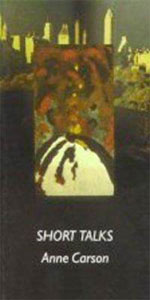
I think of Anne Carson as a model of literary exploration, my older poetic sister. She is eclectic and daring, willing to try anything to explore the limits of her craft, and I respect that, aspire to it for my own writing. Not to mention that she didn’t have her first book published until she was 42 when Brick Books published Short Talks, probably the most treasured of her books on my shelves. While I’m past 42 by many years, Carson demonstrates that there is hope for the spineless.
Starting August 1, 2012, I posted a line from the most recent collection of her work I own, Nox. I don’t have Antigonick yet, Carson’s update of Antigone in a form similar to that of a graphic novel.
My poetry shelves are arranged for the most part alphabetically, and for the most part, according to the order that the work was published, but books have a tendency to unsort themselves for the avid reader. I posted lines from Carson’s work in approximately publishing order with most recent first.
August 1: “The phoenix mourns by shaping, weighing, testing, hollowing, plugging and carrying towards the light.” Nox (New Directions, 2010)
I am intrigued by Carson’s focus on the retelling of myth and the reanimation of Greek and Latin literature to present day. I wasn’t educated in the classics, alas. Carson’s writing is a way to learn about them, a way in.
I love Carson’s wit and sense of humour:
August 8, 2012: “Always planning ahead that’s me, practical as purgatory my mom used to say.” Decreation: Poetry, Essays, Opera (Knopf, 2005)
Am astounded by the beauty of her lines, which aren’t sentimental, but visual and memorable, often with an edge:
August 12, 2012: “A fell dark pink February heaven/Was/Pulling the clouds home, balancing massacre/On the rips.” Men in the Off Hours (Knopf, 2001)
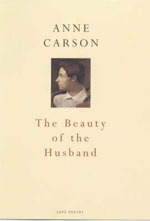
August 18, 2012: “Hotel gardens at dusk are a place where the laws governing matter/get pulled inside out,/like the black keys and the white keys on Mozart’s piano.” The Beauty of the Husband (Knopf, 2001)
Carson deals with concerns such as death, anger, youth, beauty in ways that resonate and strike a universal chord.
August 23, 2012: “Youth is a dream where I go every night/and wake up with just this little jumping bunch of arteries/in my hand.” Plainwater (Knopf, 1995)
For a very good overview of Carson’s work and insightful interviews, I heartily recommend:
I have been gratified by the responses of others on Twitter and Pinterest. Carson’s lines from Today’s Poem have been retweeted and repinned by people from all over Canada and the UK, possibly from the States too. One of the goals of this exercise for me is to spread the good word about poets whose work excites me.
August 31: “Sappho begins with a sweet apple and ends in infinite hunger.” Eros the Bittersweet (Princeton University Press, 1986)
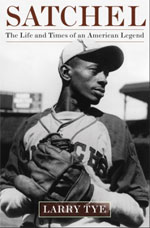
In one of the sports literature arenas that already boasts many seminal works of great storytelling and rhapsodic prose, Satchel: The Life and Times of an American Legend, by Larry Tye is a distinguished, inviting and elucidating addition. The book captures a pivotal time in the evolution of baseball and of North American society. As if there isn’t already a motherlode of stories and milestones to make that a captivating read, this book is rendered even livelier because it focuses on arguably the sport’s greatest practitioner and groundbreaker on numerous levels: athlete, entertainer, ambassador, philosopher clown prince and African American icon Leroy Robert “Satchel” Paige.
Close to the turn of the last century, Satchel Paige was born in Mobile, Alabama into the brimming, struggling but loving family of gardener Robert and domestic worker Lula Page – “close” because Satchel’s birthdate was long in dispute and frequently subject to scrutiny and confusion, some of it generated by Paige himself. And yes, even the spelling of Paige’s name changed as he embarked on a storied career as a virtually unstoppable baseball pitcher with raw talents evident at an early age that were honed starting with a teenaged stint in reform school.
Paige’s professional journey took him through the Negro leagues, an evolving amalgam of amateur, semi-professional and professional teams and leagues comprised chiefly of African Americans and some Latin Americans. The Negro leagues started in the late 1800s and lasted until the early 1950s, overlapping with Major League baseball for a few years after black players started to be integrated in that white-dominated sporting domain. Paige himself weighed in to the debate about who should have been the very first black player to break the baseball colour line, a role that fell famously to Jackie Robinson. Paige was still one of the first to cross that often treacherous barrier with signature aplomb, and certainly the one to leave the most indelible marks. Those marks were made and cemented before he departed after his last professional game in 1966, just shy of his 60th birthday (assuming we could, by then, trust his purported birth certificate).
If the range and longevity of Paige’s professional accomplishments against a backdrop of racial tension and societal change isn’t riveting enough, there’s also the diverting portrait of a singular man: charmer, trickster, and bon vivant (whether, at any given time, he could afford the cars, clothes, food, drink, companions, appurtenances et al that filled his lively and peripatetic life to overflowing). He was a life force exuding an ebullience that probably intentionally glossed over the pain he contended with maintaining a seemingly effortless physical prowess that was in play, quite literally, year round – from league play to barnstorming and other games and exhibitions across the United States, Canada, Mexico and the Caribbean. That pain surely extended to the emotional challenges of being separated from loved ones, not to mention being socially separated, even when that was supposedly a thing of the past. Paige’s almost unstoppable and at times inexplicable joie de vivre only seemed to fray around the edges in his final years, when he was out of the game and probably felt freer to give vent to some of the injustices with which he’d contended and had seemed to dance over, around and through at the time.
Author Larry Tye’s skills at distilling a complex story with layers of themes, towering mountains of data and gaping valleys of omissions in the data (for a sport deeply fascinated with and rich in statistics, recordkeeping in the early days and outside of the then exclusively white major leagues was sketchy at best) are breathtakingly impressive. That the themes and data are digestibly interwoven with infectious storytelling – true or tinted delightfully rose-coloured, all told with gusto – is more impressive still. That this daunting assignment was further complicated by a central figure who contributed as much to his own mystique as he did to his rightful legend makes the whole package, with astutely marshalled sources and research, extraordinary.
Some knowledge of baseball is useful to follow the terminology and have some frame of reference for the excellence of the accomplishments of Paige, his contemporaries and those who came after. Still, the reader will not be intimidated by an overly technical examination of the game. Tye frames well and accessibly where Paige stood in the context of the sport and its evolution, along with where he stood in the context of social changes external to but internalized by and affecting the sports world in which he operated and often but didn’t always thrive. Finally, Tye paints a vivid but also clear, honest picture of Paige, where there are wide and vibrant swaths of impressionistic versions of Paige out there (with some brushstrokes by Paige himself), but bringing the man into the sharpest focus possible to date, and possibly ever.
Satchel: The Life and Times of an American Legend is, by the way, a great read aloud book – that’s how my husband and I read this entire book. That’s tribute to Tye’s crisp, pleasant style which matches Paige’s argot in note perfect tandem … and of course, to the treasure trove of witticisms and repartee either on the record or legendarily associated with Paige and his contemporaries. (Yes, you can easily and abundantly google them.)