Two months and a bit into it, the #todayspoem inspiration is still going strong. Check the hashtag any day of the week – and at any time of the day, for that matter – and you’ll see that a core of regular contributors from around the world are starting, ending or pausing in their days to savour and contemplate a good poem, and then share it with others. There are more than 70 contributors sharing their #todayspoem selections daily or periodically – I’ve captured them in a Twitter list.
As I’ve mentioned before, I’m amazed every day at what #todayspoem contributors are reading and sharing. I faithfully bookmark/favourite the #todayspoem tweets and go back at every opportunity to explore the links, videos, pictures of pages taken straight from volumes, knowing that I’m going to be dazzled, amused and moved anew. I have this lovely feeling, too, that for every person sending out a thoughtful #todayspoem tweet every day or every week, there are even more people quietly reading, enjoying and reflecting on the poems we’re sending out into the ether.
I’m still experimenting with ways of archiving and showcasing all the #todayspoem selections, with links to texts and more information about the poets, poetry collections and publishers. Once I’ve got that figured out for my own selections, I’d also love to be able to find a way to aggregate all contributions in one place, if possible. Anyhow, this month, I started gathering and “pinning” my poems on Pinterest. What do you think?
How bunches of us bookish sorts on Twitter decided to start our day with some poetic inspiration – and share it with each other – is described here. You can always quickly tap into what we’re most recently sharing and discussing by simply checking out the #todayspoem hashtag on Twitter. You can check the hashtag and see new contributions at just about any moment of the day or night, as contributors are posting an astonishingly diverse and eclectic range of poetry selections around the clock and from around the world.
I’m amazed every day at what #todayspoem contributors share. I don’t have time to read them all on the spot, but I faithfully bookmark/favourite them in Twitter, and go back at every opportunity, knowing that I’m going to learn something new, be entertained, be moved, be surprised … and it’s all those great moments that keep the day rolling along, truth be told.
I’ve kept track of my own #todayspoem selections so far and just wanted to share them, just for fun and perhaps for enticement to more of you to follow and maybe join in. At very least, stop by, read and enjoy. If you’re tempted to pull a book of poetry off the shelf (even a virtual shelf, such as the great poetry resources online at sites such as The Scottish Poetry Library, The Academy of American Poets and the Griffin Poetry Prize, amongst others) and inspired to share what you’ve found, just add the #todayspoem tag to your tweet and a network of poetry lovers will get to enjoy it.
My #todayspoem selections so far …
December 25, 2011 Lorne Daniel (@LorneDaniel) Dog on Ice, from Drawing Back to Take a Running Jump Weedmark Publishing
December 26, 2011 Robert Graves The Cottage
Excerpt: “Now somehow it’s come to me To light the fire and hold the key”
December 27, 2011 Roo Borson The Garden, from Short Journey Upriver Toward Oishida McClelland and Stewart (@McClellandBooks)
Excerpt: “Eye of the lake half-closed with ice. Ducks at one end, sleeping.”
December 28, 2011 Charles Wright Little Landscape, from Scar Tissue Farrar Straus and Giroux (@FSG_Books)
Excerpt: “To lighten the language up, or to dark it back down Becomes the blade edge we totter on.”
December 29, 2011 Derek Mahon Homage to Gaia, from Life on Earth Gallery Press (@TheGalleryPress)
Excerpt: “Coleridge kept an Aeolian harp like a harmonica lodged in an open window to catch the slightest flicker”
Excerpt: “Just for today, if I were to pass myself in the street I wouldn’t even raise my hat, or say hello.”
January 20, 2012 Valerie Rouzeau (translated by Susan Wicks) Cold Spring in Winter Arc Publications (@ArcPoetry)
Excerpt: Mirror just let me see is this my head? But aren’t I grimacing, a new line too a bar across my forehead?
Miroir dis-moi voir c’est ma tête? N’ai je pas une grimace, une nouvelle ligne aussi à me barrer le front ? Valérie Rouzeau
January 21, 2012 Sina Queyras (@lemonhound) Acceptable Dissociations, from Expressway Coach House Books (@CoachHouseBooks)
Excerpt: “This poem resembles urban sprawl. This poem resembles the freedom to charge a fee. The fee occurs in the gaps.”
January 22, 2012 Dean Young Self Search, from Primitive Mentor University of Pittsburgh Press (@UPittPress)
Excerpt: “Some days you crash about raving how ignored you are then why the hell don’t people let you alone”
January 23, 2012 Lorne Daniel (@LorneDaniel) East to West, from Drawing Back to Take a Running Jump Weedmark Publishing
Excerpt: “We fly against the grain wash ourselves clean as wind and water clear”
January 24, 2012 AF Moritz Place, from The Sentinel House of Anansi Press (@HouseofAnansi)
Excerpt: “What if I’d never met my love and passed her now on this sidewalk – would I have the power to know her …”
January 25, 2012 Ann Scowcroft Phantom, from The Truth of Houses Brick Books (@BrickBooks)
Excerpt: “This is good-bye. This is your first step forward. This is your blood rattling with the new.”
January 26, 2012 Leslie Greentree (@LeslieGreentree) if I was a gate, from go-go dancing for Elvis Frontenac House (@FrontenacHouse)
Excerpt: “now I’m laughing aloud fiercely proud of the naked apertures racing across my kitchen like a banner”
January 27, 2012 Kate Hall Suspended in the Space of Reason: A Short Thesis, from The Certainty Dream Coach House Books (@CoachHouseBooks)
Excerpt: “The ground is still the same ground I paid for but the house is not in the same spot.”
January 28, 2012 Michael Ondaatje Driving with Dominic in the Southern Province We See Hints of the Circus, from Handwriting McClelland and Stewart (@McClellandBooks)
Excerpt: “Children in the trees, one falling into the grip of another”
January 31, 2012 Gwendolyn MacEwan Invocations, from The Broken Ark a book of beasts Oberon Press Excerpt: “In this zoo are beasts which like some truths, are far too true”
One daunting, harried morning, Heathcock paused to randomly draw a book of poetry from a shelf, and to just as randomly select and read a poem. Mary Oliver’s “Egrets” momentarily took him away from not enough sleep, from kids needing to get to school, from deadlines demanding to be met … and after that brief respite …
I closed the book, transformed, bolstered from the inside out.
From that day forward, each morning I read a poem.
A bunch of us book friends on Twitter – including Harvey Freedenberg, Jeanne Duperreault and Elizabeth Bastos – starting discussing the power of randomly selected and surprisingly resonant poetry to lift one’s spirits and put a new spin on the day. From that conversation, we agreed that we could all quite happily manage the New Year’s resolution of starting our day with a poem. We’d swiftly grab it from a bookshelf or online, as suited, and we would take the time to read, savour and contemplate, like a brief morning meditation. And then we’d share our choices with each other, using the #todayspoem Twitter hashtag.
Even before January 1st, several of us jumped in enthusiastically. The selections are diverse, whimsical, touching, haunting, prescient, eye-opening. Let me share a few of the tweets that have help to draw those of us who know about it (so far) into this exquisite shared experience:
As you can see, everyone is sharing their #todayspoem experience a little differently, with an image, a link, an excerpt, whatever fits in a tweet. Each tweet is enough to spur a moment of delight or recognition or, handily favorited in Twitter, is a lovely bookmark for future poetry explorations.
The #todayspoem experience is a dual delight. You treat yourself to an energizing moment of reflection in the morning, and then you have others’ shared #todayspoem gifts to enjoy just by going to the hashtag at any time. Care to join us?
Carolyn Smart’s Hooked uses a wickedly irresistible premise: a twisted chorus of famous/infamous female figures from history and letters expounding vividly on obsession. Smart has fascinatingly curated the stories of women who made misguided and horrific choices for their objects of desire, and determinedly saw that desire through to often tragic conclusions: Myra Hindley, serial killer partner to Ian Brady (for Canadians, the pairing is clearly Homolka-Bernardo); Unity Mitford, aristocratically born contrarian who became a confidante of Hitler; Zelda Fitzgerald, gifted, increasingly fragile spouse of F. Scott Fitzgerald; Dora Carrington, a painter associated with the Bloomsbury Group who carried a lifelong, unreciprocated passion for writer Lytton Strachey; Carson McCullers, a renowned writer who struggled with relationships, ill health and alcoholism; Jane Bowles, a talented, underrated writer who lived an unconventional and peripatetic life with husband Paul Bowles; and Elizabeth Smart, a poet whose work was overshadowed in her lifetime by the scandal of her enduring passion for poet George Barker, with whom she had and then singlehandedly raised four children.
As perversely and diversely interesting as the subject matter and cast of characters are, the voices from segment to segment in Hooked are somewhat disappointingly similar. Rhythm, cadence and pace are not so vividly distinguished as one might expect given the women’s different nationalities, social upbringings, mental states and time periods in which they lived, not to mention the varieties of types of charisma and inaccessible attractions with which each was enraptured. In some cases, there is too much admittedly clever direct quoting of sources (clear as such because it is italicized), but not enough true transmutation and alchemy to turn those sources into fresh perspectives and something of Smart’s own.
Hooked has inspired me to revisit or expand my reading on all of these figures, both in biographical and fictional realms. Less so, Hooked has impressed me with Smart’s inventiveness as a poet, but her resourcefulness with respect to exploring subject matter will still likely compel me to seek out more of her work.
Thank you to Brick Books for providing a review copy of Hooked, by Carolyn Smart.
Dionne Brand’s Griffin Poetry Prize-winning Ossuaries is an extended verse account of the wrenching, troubled life of Yasmine, who lives constantly on the move, assuming new identities to escape activities somewhat vague in their specific intents, but decidedly explosive and violent in their outcomes. Layered over and drifted artfully around the central story are meditations on cultural and historical shifts and evolution: what disappears in the process, what changes, and what bones and remnants are left behind for future generations to unearth and decipher.
Almost 10 years later, the events of September 11th are emerging in varying forms in literature and popular culture. It seems some of the most profound renderings are sufficiently particular in detail, but not so much so that they cannot resonate more broadly, taking in other cataclysmic historical events. Such is the case with Brand’s evocations, which not only echo what happened in New York City, but Oklahoma City, London, Mumbai and other scenes of urban terrorism shattering comfortable, mundane, day-to-day life: “the stumbling shattered dress for work … the seared handbags, the cooked briefcases … it was just past nine in any city …”
An ossuary is a container, building or location meant to house human skeletal remains in their final resting places. While suggesting peace and finality on one level, perhaps mystery and portent on another if those resting places are unearthed generations later, Brand’s ossuaries feel open, unresolved, anything but peaceful. Even the lack of punctuation at the end of each ossuary segment within the long poem gives literal lack of closure to each chapter in Yasmine’s edgily peripatetic existence.
Yasmine has suppressed love and tenderness in her own life, hardened (ossified, even) her heart, glossed and silted over her own personal trail. Still, occasional traces of wistfulness in her observations (“the children mattered, or so she told herself”), or at least acknowledgement that she has held herself too harshly and rigorously (“except it was always there / struck, harder, the lack of self-forgiveness, / aluminum, metallic, artic, blinding”) seem to betray that she would like to leave a trace, have someone care. Finally, that seems to be what Ossuaries encapsulates: the traces that people leave, intentionally or unintentionally, destructively or tenderly – in the world, on each other, and in a collective impact on the environment, culture and history.
here we lie in folds, collected stones in the museum of spectacles, our limbs displayed, fract and soluble
Dionne Brand’s readings from her work (even her readings from others’ works, such as PK Page) are never, ever to be missed. Until her entrancing reading from this year’s Griffin Poetry Prize readings is online, immerse yourself in this reading from thirsty, from her last Griffin Poetry Prize appearance.
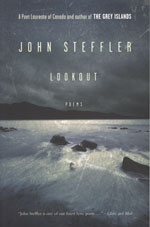
John Steffler’s latest collection, Lookout, is largely focused on and based in natural settings, paying tribute to nature, wrestling with both the enormity and the fragility of nature – nature unto itself and nature as it affects and is affected by human presence and interference. This is not your grandmother’s nature poetry, though – it dispenses with sanctimony and is not afraid of irreverence or even violence. Many poems in this collection sweep the reader through breathtaking transitions from rugged physicality and earthiness to emotional delicacy, frailty and ephemerality.
Former Canadian national poet laureate Steffler’s poems are not just acutely observant, but fully physically engaged. In fact, many of his poems quite literally meld body and landscape in startling, sometimes macabre, imaginative sequences.
Ironically, the most moving, central sequence in Lookout, Once, actually comes indoors to focus on a narrator’s wistful time with his ailing parents, which is simply and poignantly interspersed with memories from their youth and young adulthood.
Along with the recent past, the worries and duties that kept her fixing and pleasing are gone. Calmly she orders him to open the curtains, find her slippers, fetch her a small dish of strawberry ice cream. He jokes that he has to serve her smartly these days, and she answers flatly that she’s done a lot of serving over the years. Without apology she indulges her pleasures, and he is doting and patient, almost equally changed.
… and later …
As I leave, she hugs me and cries like a child. I have never seen her like this. I say I’ll be back in the early fall, and she nods as she goes on sobbing, not bothering to dry her face.
Upon that sad departure, it’s as if the same narrator immediately, cathartically leaps back into the natural world in the next sequence, Outside, as if that is where he personally and all of us can ultimately find solace.
Lookout is a worthy contender for the Griffin Poetry Prize, for which it is nominated this spring. Steffler offers a poetry clinic in his mastery of a range of voices and forms, with none of the sterility that a clinic or lessons or examples would suggest. From the rocks and elements to the creatures navigating them, Steffler’s poems are living, breathing, evocative beings.
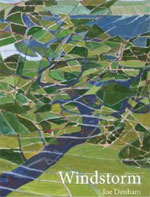
Joe Denham’s second collection of poetry is aptly titled. From the first line and page, Windstorm sweeps the reader in with powerful, all-encompassing imagery couched in rapid, muscular tercets. That unrelenting rhythm swoops from the broad – swirling cyclones, wild seas, wheeling flocks of birds – to the grimly specific: the pain, panic and bloodshed of an injury inflicted with a saw while mending a fence. The plunge from the immense natural world to the personal in spiritual and bodily senses, to the even microscopically analytical is often swift, breathtaking, dense and condensed:
the artery opened to a world now losing ocean life oceans wide (spirit of its soul) and through in time life renews
it is a world beyond weeping the exiting blood enters, it is perpetual shock, miasma, day upon day, it
is bees leaving the hive, then lost (little wonder, little wonders) it is the cost analysis, and the cost …
Even when a bit of comparative whimsy slips into the passionate barrage of what is essentially one poem in five sections marked with epigraphs, the momentum never lets up. When the reader encounters the rueful “Under a clusterfuck of stars (the names of which I’ve never / cared to learn …” one might think things are switching to a more contemplative pace. However, the next stanza ricochets from someone on cocaine screaming on a cellphone to that crazed cell signal bouncing off satellites, to the life of fish, to the poet’s brain radiating in that cell signal … and the interconnected images, vignettes and philosophizing blaze on, both exhilarating and verging on exhausting.
Admittedly, all that windswept swooping and the intense rhythms can produce some dizziness – albeit not unpleasant – in a reader. Perhaps some more modulation, more variety of form and tone, would then set the most powerful aspects in even stronger contrast. Some spare, succinct lines could have as much thematic and emotional impact as the onslaught that preceded it. After all, aren’t we often most in awe of the power of a storm once the world falls silent and then the small, modest sounds of life resume?
This is my first introduction to Denham’s work. He has a previous poetry collection, Flux, published in 2003, and a forthcoming novel, The Year of Broken Glass. Windstorm inspires this reader to look back and look forward to what Denham will do next.
Randall Maggs’ gritty poetry collection Night Work: The Sawchuk Poems casts a semi-biographical gaze on the life and times of legendary and troubled NHL goalie Terry Sawchuk. Arguably the standard by which hockey goaltenders are still measured today, with many records that have only recently been broken, Sawchuk played most of his 21 seasons in the NHL, spanning the 1950s and 60s, with little of the protective equipment in which modern goalies gird themselves. He also played in an era where backup goalies weren’t customary. This foreshadows and explains a lot.
How did Maggs formulate the balance of history, fact and imaginative interpretation to come up with his fierce and wrenching version of the Terry Sawchuk story? As he explains in the closing acknowledgements:
“What appears in the poems is based on stories told to me by those listed gratefully below or on what I have read or on what I brought to the book from my own life and playing days. As far as pure veracity is concerned, I don’t know which of the three would be the most unreliable.”
(Those listed gratefully include sports greats – players, officials and writers such as Johnny Bower, Carl Brewer, Ken Dryden, Ron Ellis, Trent Frayne, Dick Irvin, Red Storey and Stephen Brunt, as well as poetry greats Don McKay and Karen Solie.)
Maggs takes a varied approach to presenting Sawchuk the man, the figure and the legend, with different variations of dense but absorbing blank verse forms, and with a wide range of perspectives and colourful, often haunting voices. The tales, not just of action on the ice, but in the locker room, facing or avoiding the media, travelling, finding some quiet and solace on a frozen lake, run the gamut from rollicking and down to earth to dark and brooding to lyrical.
Sensitively researched and curated photographs are touchstones for several of the poems and fragments in this collection, and are arresting all on their own. In the mid-1960s, Life Magazine had a makeup artist superimpose scars and stitches on Sawchuk’s face to illustrate all of the injuries he’d incurred over his career. That picture concludes the collection, and is a wrenching poem unto itself.
The mounting inventory of Sawchuk’s mental and emotional suffering, including alcoholism and depression, is perhaps even longer than the physical injuries that either sparked or exacerbated his ongoing woes. But arching over it all and captured powerfully in Night Work: The Sawchuk Poems was the man’s unstinting determination to succeed and triumph and, in his way, transcend the harsh, grinding vocation he’d made his own and in the process, transcend time, even if only one game, one period or one play at a time.
Talk’s over at the glass, the captains waved away. The referee holds four fingers up and folds his arms, four seconds he wants put back on the clock. Son of a bitch, an old defender sags against the boards. Still, imagine the power, to kick time’s arse like that.
The following is a dramatic short film based on Night Work: The Sawchuk Poems.
The following is an audio excerpt, courtesy of Brick Books, of Randall Maggs reading the poem “No Country for Old Men” from this fine collection.
Eilean Ni Chuilleanain has apparently been accused by one past reviewer of lacking “killer instinct”, whatever that is supposed to mean when one is crafting poetry. (At any rate, Ni Chuilleanain turns that phrase to striking advantage in one of the most vibrant pieces in this collection.) The poems in The Sun-fish are dense, demand undivided attention and are often understated, sometimes to a fault. However, Ni Chuilleanain’s simultaneously grounded and transcendent verse pays off with fresh, sometimes pointed insights into human resilience.
Deserving winner of the 2010 International Griffin Poetry Prize, The Sun-fish even shades into the acerbic with selections such as the delightfully sly “Vertigo” (“How did such smart women acquire such a mother?”). “The Sister” is a haunting selection, which Ni Chuilleanain read at the Griffin Poetry Prize readings in the spring of 2010:
Reflective reading will reward the patient reader of this deceptively slim but surprisingly rich and deep collection.
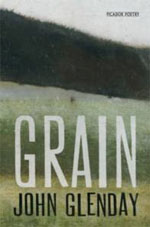
The poems in John Glenday’s Grain are unassumingly stoic and plainspoken, ranging from wistful and tender to self-deprecating to harrowing (“Song” and “Grain” have, unfortunately, particularly unforgettable images). Even when he jolts the reader, though, all of the work in this succinct volume has a strong underpinning of humanity and wry compassion.
Grain was recently shortlisted for the 2010 International Griffin Poetry Prize. The judges’ citation captures well the essence of this deservingly nominated work:
“[Glenday] listens carefully to the language he works in. [His poems are] also playful: a tin can, a peculiar fish, invented translations, made-up saints all can suggest poems. It’s refreshing to discover a poet whose work is earthly, full of rivers and hills and islands, but where old ideas like ‘love’ and ‘soul’ have not been banished. Grain is the work of an unhurried craftsman; John Glenday has made poems of understated integrity and humanity.”