Author Archives: bookgaga

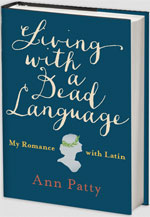
Living with a Dead Language – My Romance with Latin, by Ann Patty

I’m delighted and honoured to welcome novelist and essayist Pauline Holdstock to the bookgaga blog. She offers a thoughtful examination of Ann Patty’s interesting memoir, both an exploration of Latin and celebration of learning and literature. Before we plunge into the review, allow me to introduce our esteemed reviewer:

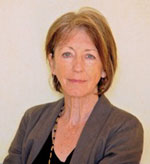
pauline-holdstockPauline Holdstock is an award winning Canadian author, originally from the UK. She writes literary fiction, essays and poetry. Her novels have been published in the UK, the US, Brazil, Portugal, Australia and Germany. In Canada her work has been nominated for, and won, a number of awards.

Of her eight books, the most well-known are Into the Heart of the Country, longlisted for the Giller Prize, and Beyond Measure, short listed for a number of awards, including the Commonwealth Writers’ Prize and the Scotiabank Giller Prize. It was the winner of the BC Book Prize Ethel Wilson Award. Pauline’s essays and book reviews have appeared in Canada’s national newspapers and have been broadcast on CBC radio. Her essay Ship of Fools was the winner of the Prairie Fire Personal Journalism Prize. Learn more about Pauline and her work at www.paulineholdstock.com.

bookcover-patty-dead-language

A New York editor, laid off from her high-powered job and forced into early retirement, moves to the country and sets out to learn Latin as a way to keep her mind engaged.

It’s an interesting and unlikely concept: a journey into a dead language as a way forward into a rewarding new life. At the outset of her memoir, Ann Patty paints a convincing picture of the new life she doesn’t want — a future bereft of purpose, prey to the inherent dangers of boredom, not least of which might be the alcoholism that destroyed her mother’s later years. And indeed in the course of the book a new life does slowly take form, one where Patty finds a new community to replace her vanished world of publishing, as well as an absorbing new pursuit.

Living With a Dead Language is more than an account of the intellectual challenges Ann Patty faced in her self-imposed undertaking. It’s also a memoir that gives glimpses of her career in New York, reflections on her parents and sketches of her friends and partners. Ambitiously, Patty has attempted to marry personal memoir with the Latin topics covered in her college courses. Sometimes it works. The poetry of Catullus, for instance, is the perfect launchpad for the wicked ways of decadent and driven New York, and Lucretius’ philosophy the perfect entry to her forays into Buddhism and the personal crises that prompted them. At other times the connections felt contrived, superimposed.

Often, I found myself wanting to be reading a different book. Her scheme, I felt, was doing the book a disservice. It was limiting. She was glancing off too many interesting questions while squandering precious time laying out the grammar topics covered in her various academic courses and meticulously illustrating their complexity.

Although the Latin language was what drew me to her book in the first place — I still consider it the single most useful subject of my high school education and daily reap the benefits of being forced to learn it — I had no particular wish for a refresher course in the basics of grammar and syntax or an advanced course in their intricacies. A chapter would have been all Patty required to demonstrate the syntactical elements of the language and convince us that its mastery presented a daunting challenge — especially for an older student who hadn’t, as she confesses, had to memorize anything in close to thirty-five years. The linguistic passages felt to me like the author revising her subject, making sure it had stuck, perhaps, too, simply wanting to impress us. I’d have welcomed more pages devoted to the wealth of coincidental knowledge — like those she offers on Roman calendars, or marriages, or burial practices, for example — that the study of Latin inevitably confers.

The book would have benefited, too, from a more rigorous treatment of some of the connections Patty tentatively introduces. Observations on the subordinate role of Roman women, for instance, are linked too loosely to an evocation of the limited version of feminism that flourished in the 1970s and followed by a sketch of the kind of pervasive passive aggression that her mother’s generation suffered earlier.

The book’s very title prompted many questions and connections that were never fully addressed. What does it mean to learn any language, for example? How does that open the mind? Or alter one’s perception of one’s own culture? And what about recent research on the plasticity of the brain and the effects of language learning. And how might the experience of learning Latin in particular enhance the brain’s abilities, working as it must with the new word orders possible in an inflected language? And what effect did it have for Patty in her own recognition of Italian when finally she goes to Rome.

“Don’t tell me Latin isn’t alive and well in literature” she says after making an amusing but feeble link between Ovid’s and romantic (small R) novelists’ predilection for sexy tresses. But what of popular culture’s apparently ineradicable interest in myth and supernatural influence? An afterlife? And what of the persistence of certain literary forms right across our culture — the epic, the elegy? Of certain figures of speech in literature? Much later in the book she does edge closer to examining those questions in a moving recollection of the death of a dear friend when in an “elegiac funk” she buys a copy of Anne Carson’s Nox. But enquiry and argument are not her modus operandi. Her writing is governed by emotion and enthusiasm, much, I imagine, as were her editorial decisions.

Most of all I’d hoped to see some discussion or even acknowledgement of the connection between syntax and thought or on the role of grammar as vital link between intuition/inspiration/idea and expression. It’s a vast and boggy philosophical field and perhaps it’s obvious why Patty wouldn’t want to venture there, but not offer even an observation on its effects on her own critical thinking …?

Finally, and most frustratingly, she only brushes against the whole question of elitism implicit in the study of a dead language. Her fellow students are a privileged lot as she remarks early in the book. But she doesn’t emphasize the liberating potential of studying for study’s sake, surely the true privilege. That becomes clear, to this reader at least, when, later, Patty visits Still Waters. Still Waters is Stephen Haff’s after school sanctuary for decidedly un-privileged children. Patty visits and works with two nine year-olds carefully translating a Latin picture book. Latin is on offer Haff’s after school program, along with yoga and violin — three subjects to exercise the mind, the body, the spirit. There’s a Buddhist “purposelessness” to all of those pursuits, an escape from what Haff sees as the “soul destroying and deadening” core curriculum.

Clearly Patty recognized the value of what she witnessed at Still Waters and it’s to her credit that she went on to volunteer both her time and newfound expertise there and to facilitate a connection with a wider community. It’s interesting but not surprising that she derived a true sense of purpose and reward from the experience, something she doesn’t mention in relation to her entry to the elitist academia of the Latinists.

The chapter on this visit was, for me, the most intriguing and sent me straight to Google. Here’s a quote I found online — a testimonial, to use the Latin — from one of the children at Still Waters. It could well express the feelings too of Ann Patty — ever enthusiastic, ever up for a challenge, ever ambitious.

“I love Latin! Latin is a big, beautiful puzzle. It is a mystery to be solved. I feel brilliant here.”
Still Waters in a Storm

Friends reading aloud / #sundaysentence for July 24, 2016

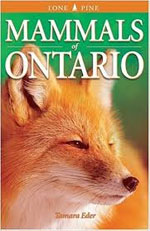
bookcover-mammals-ontario“Although most of us will never see a Wolverine, the knowledge that it maintains a hold in remote forests may reassure us that expanses of wilderness still exist.”

from Mammals of Ontario by Tamara Eder
(2002 Lone Pine Publishing)

My Sunday sentence comes from one of many vibrant sentences read aloud on Saturday night. Four longtime friends gathered at a cottage by a lake, comfortably tired after a sunny day of swimming, dogwalking, birdwatching and more, comfortably full after a delicious and lovingly prepared meal, to read aloud to each other. The reading selections came from a charmingly eclectic range of sources:

Such a wonderful way to knit together a special weekend spent with beloved friends …

Enjoy more #sundaysentence selections here.

#sundaysentence for July 3, 2016

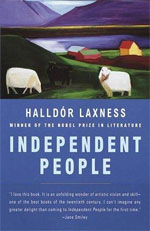
bookcover-independent-people“She blushed furiously in the darkness and had not the remotest idea what to do or say, especially as it was after midnight; for poetry was meant to be read aloud in the daytime, but understood in silence during the night.”

from Independent People by Halldór Laxness
(1934-1935)

Enjoy #sundaysentence selections here.

See also: Of sheep, lungworm, coffee, and poetry, and God, and a lot, lot more

Saying thanks to The Poetry Extension and other hard-working poetry purveyors

I was recently asked to offer a testimonial for an arts initiative called The Poetry Extension. I was happy to do so, as I’d very much enjoyed their first (I hope of many) productions:

Here’s what I had to say:

I’m both a poetry reader and attendee, where possible, of poetry readings. I enjoy both the word on the page and the word brought to life. I’m blessed to live in a city that has much to offer in the way of literary events most days of the week. The majority of those events happen because of hard work by organizers, performers, venues and contributors.

If you can’t get out and/or you aren’t blessed to live somewhere that has lots of live literary events, the next best thing are virtual events. What’s wonderful about virtual events – in addition to being able to enjoy them in your pyjamas – is that they can bring together artists and performers for whom it might be difficult to be together in the same city or on the same continent, much less the same venue. That’s where initiatives such as The Poetry Extension are so brilliant, and why I was so effusive about the first of their events in March, 2016:

Amazingly, this virtual event established a balance of both professionalism and intimacy that you might not think possible in a bunch of colliding video screens in different countries. All of the readings introduced unique poetry voices in a warm, friendly, accessible format. I look forward to more such productions, and hope that The Poetry Extension can get the support it needs to make more of them possible in future.

Live or virtual, not only is it wonderful to attend such events, but it’s really rather easy to say thank you for the time and effort that goes into these vibrant offerings. Even a tweet, a Facebook comment, a quick email message are all gratifying ways to let our artists, poets, writers, performers and organizers know they are appreciated, and to let others know about the eye-opening works and events that might just be a click away. (Note, for example, that the next Poetry Extension online gathering will be livestreamed on Wednesday, August 31, 2016.)

Let’s go to the FOLD!

I’m thrilled to welcome Margrit Talpalaru, who is going to share some terrific observations and enthusiatic praise for the recent inaugural Festival of Literary Diversity (FOLD), which took place in Brampton, Ontario over the first weekend of May, 2016.

I regret missing the fest, but am grateful for the next best thing, seeing it through Margrit’s eyes. She brings a unique combination of the erudite and the fan girl to her observations, which I think you’re really going to enjoy. First, here’s an introduction to our literary festival guide:

Margrit has been going to school for many years, in spite of repeated decisions to stop. During those many years, Margrit changed schools, changed countries, changed roles, changed diapers, and tried hard to change the world.

Mostly, Margrit’s attempts to change the world have taken a written form. Here’s a list. Lately, Margrit has been hard at work trying to change genres, too, and make her foray into fiction.

Margrit blogs at www.creativecritique.ca, and tweets @MeMargrit.

fold-logo

“When queer / trans / poc writers are treated as artists as opposed to just spokespersons of our identities, it’s very liberating.”
(Vivek Shraya, 7 May 2016)

“So many wonderful things about @TheFOLD_ but esp. loved sharing space with diverse writers and not being forced to talk about diversity.” (Vivek Shraya, 7 May 2016)

Vivek Shraya’s tweeted contention emerged as the leitmotif running through the sessions of the inaugural Festival of Literary Diversity (FOLD), which took place May 6-8 in the remarkable venue of the Peel Art Gallery Museum and Archives (PAMA) in Brampton. Panelist after panelist echoed Shraya in remarking how crucial it is for diversity to become the assumption, rather than the subject of advocacy. In a panel about diversity in publishing, Bianca Spence said she had always been the one person of colour on staff, “but it’s not my job to teach my boss diversity.” What happens when the burden of proof and the need for validation are removed is a true celebration of diversity in literature, as the FOLD had set out as its mission in the first place. By this measure alone, the inaugural FOLD was a resounding success. But the Festival went far beyond merely fulfilling its mission statement, and the excitement around it can be easily gauged by the plethora of tweets under its hashtag #FOLD2016. (Go ahead and take a peek; I won’t tell anyone if you join the chorus.)

Isn’t this the point of diversity, that we can only achieve it collectively, rather than by token representation? That its value is intrinsic, rather than didactic or instrumental? That we, as a society should do everything to achieve it in all aspects not because it’s the concept du jour, but #becauseits2016?

The panelists’ consensus made me realize where the Festival drew so much of its energy from. The FOLD’s foundation on celebrating diversity leaves room to discuss the richness of all aspects of writing and publishing, as well as seek solutions to the disproportionate representation of people of different backgrounds, sexualities, abilities, and ages in literature and publishing. The choir needed no preaching to, so it just sang. In multiple harmonies.

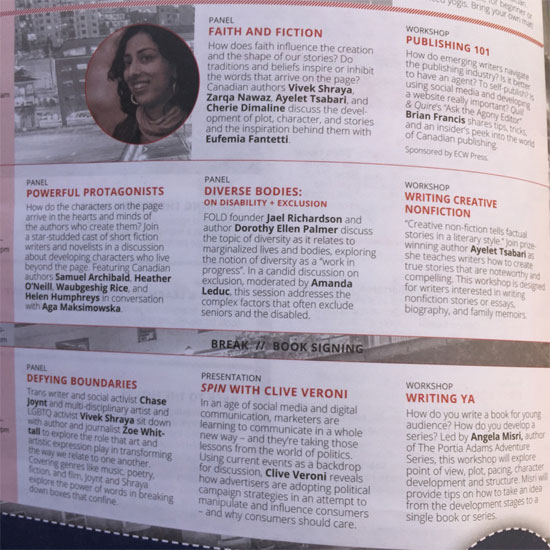
fold-program

The richness of topics and viewpoints carried through to the panel options: whether interested in craft, publishing, self-promotion, or genre, there was always a brilliant choice among the concurrent panels. The only problem I had was I wanted to attend them all, but since this was no fantasy, I had to pick, and not once did I feel short-changed, both because of the in-depth discussions in the panel themselves, as well as because of the cross-pollinating conversations among them during the breaks or through social media.

I was greedy in my attendance, and went to all types of panels on offer. I started out the day listening to a conversation on “Faith and Fiction,” between Vivek Shraya, Zarqa Nawaz, Ayelet Tsabari, Cherie Dimaline, moderated by Eufemia Fantetti. I am not even a little bit shy about fan-girling over the depth of the discussion, which emphasized cultural influences in the participants’ writing through the lens of faith or spirituality. Fantetti’s questions were both prodding and generous, and the panelists’ answers revealed their personal connections to their background, and their own interpretations of it in their writing.

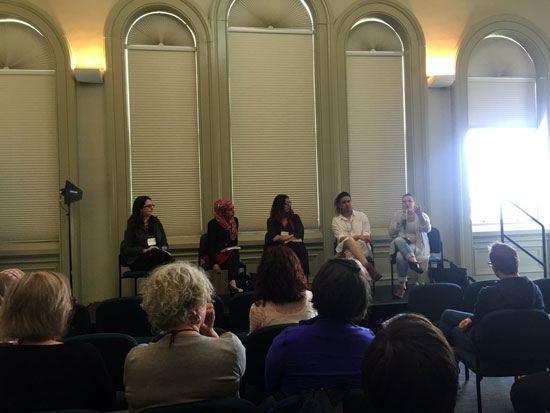
fold-session

Tsabari joked that “Growing up Jewish in Israel, we didn’t have to practice Judaism; we were just naturally good at it.” Shraya emphasized the crucial importance of representation, noting that “Queer kids had to be creative about where they found role models, so I found it in Hindu iconography,” with its more fluid gender boundaries. Nawaz spoke about the politicization of Islam, and how that creates generic expectations for her writing. Because of the portrayal of Muslims in the media—especially in the US—Nawaz suggested that writing a domestic novel about a Muslim woman can be transgressive. Dimaline shared the story of her upbringing in the Georgian Bay Métis Community, and the honour and responsibility of becoming a storyteller: “It’s the job of community’s story-keepers to provide a blanket of safety and spirituality and to uphold the duty to the seven generations.”

Next up, Aga Maksimowska moderated the panel on “Publishing (More) Diverse Canadian Stories,” which gathered publishing professionals from different branches of the industry. The panel description was

“From acquisition to acquired reading, industry professionals Anita Chong (Penguin-Random House), Barbara Howson (House of Anansi), Rachel Thompson (ROOM Magazine), Bianca Spence (OMDC), and Susan Travis (Scholastic Books) discuss ways to improve access to diverse, Canadian stories at home and beyond Canadian borders. Animated by Leonicka Valcius, this session is designed for industry professionals.”

However, the popularity (standing-room only) of the panel demonstrated that festival participants from all aspects of the book universe were hungry for answers and solutions.

We were not disappointed, as the panelists all focused on solutions, and how to proceed in the future, rather than on rehashing the obstacles. Thompson, for example, explained how the Room Editorial Collective restructured itself with an eye on including editors from different backgrounds before the “Women of Colour” issue was published. Chong echoed the notion of inclusion cautioning decision-makers to “be cognizant of who gets a voice at the table, because inclusiveness and quality are not mutually exclusive.” The unanimous conclusion pointed to the interconnection between the different aspects of the publishing industry: Spence emphasized the need for arts funding for the stories to be written in the first place; Howson challenged publishers to look for voices from around the world; Travis urged marketing and sales departments to ask book sellers why they’d think they would not sell diverse books, as well as push them not to insulate different voices in boxes, but put them on their genre shelves instead.

These are only three of the five panels I’ve attended. And I’ve only gone to one day of the Festival, so I hope this quick glimpse convinces you that my title was not a cheap pun, but genuine advice: the FOLD has only just begun, but it is sure to become a touchstone for literary and publishing conferences, so I know I’ll get my day passes as soon as they appear next year, and I hope you will, too.

The Brief Reincarnation of a Girl, by Sue Goyette

bookcover-brief-reincarnationSue Goyette’s The Brief Reincarnation of a Girl has left me breathless and heartbroken by a tragic story uniquely depicted. Goyette’s series of linked poems has also left me awestruck once again at her singular gifts for evoking emotion and revelations through startling juxtapositions of animate and inanimate, real and imagined, quick and dead, soulless and spiritual.

Those gifts were on fine display in her 2014 Griffin Poetry Prize shortlisted collection Ocean. In those poems, she brought the ocean to life as a full character, brimming with capriciousness, mischief and even menace as it interacts with the community that relies on, reveres it, cherishes it and fears it.

Goyette’s startlingly unique takes on the many people who failed an abused child might seem inexplicably frivolous and irreverent at first glance.

“Her prescription pad was important to the doctor.”

“The girl’s father had been prescribed aluminum foil.”

“The lawyer prayed for a parking space.”

“The girl’s mother, without telling the doctor, had taken
double her dose of television and had neglected
to take any of her patience.”

In fact, the tone of muted whimsy serves cumulatively powerful purposes over the course of the collection. In its way, it enables the reader to not turn away, as a more baldly stated account of the child’s fate would likely do. It defuses the power of the selfishness, perversity, cruelty and neglect visited on an innocent, and reduces pointedly to ridiculousness the factors and the pathetic figures that contributed to her death. At the same time, that fairy tale-like tone captures a child’s spirit and ultimately offers hints of hope and redemption, felt in this unconventional eulogy’s final lines:

“… several seasons later,
the tree surprised the bear by flowering; its fruits a succulence
that chimed with her loss a new kind of nourishment.”

The tactile warmth of another finely crafted Gaspereau book, emblazoned with a specially commissioned woodcut by George Walker of a bear – the child’s one protector – add to this singular collection’s approachability on a subject typically of despair.

The Brief Reincarnation of a Girl
Sue Goyette
Published by Gaspereau Press
2015 / Poetry / $19.95
9781554471461 / Trade paper / 64 pp

A Slim Green Silence, by Beverly Rycroft

With literary life force Kimmy Beach at the guest reviewer controls, we’re not only in for a treat, but we’re going to learn a lot. First, let’s meet our bookish guide:

Kimmy Beach’s fifth book, The Last Temptation of Bond (The University of Alberta Press, 2013), was chosen as one of the best five poetry books of the year on Quill & Quire’s 2013 Readers’ Poll. The book was longlisted for the 2013 Alberta Readers’ Choice Award, and was featured on CBC Radio One’s The Next Chapter with Shelagh Rogers.

Kimmy’s poetry, fiction, articles, and reviews have appeared in journals across the country and in the UK, and she has read across Canada. Her second book, Alarum Within: theatre poems, has been adapted as a full-length stage play by both the University of Toronto and the Red Deer College Theatre and Film Studies Programme. She’s working on a novella about a giant puppet, and a novel featuring 1970s romance comics and This is Tom Jones (1969-1971). Kimmy holds a First Class Honours Degree in English from the University of Alberta, and lives in Red Deer, Alberta with her husband, Stu.

bookcover-a-slim-green-silence
Constance (Connie) West is the narrator of Beverly Rycroft’s first novel, A Slim Green Silence. Connie has died, but she’s not yet left Scheepersdorp—her small South African town. Don’t worry; I’m not giving anything away. We know this within a few sentences as Connie herself tells us. Rycroft gives us this fairly familiar premise in which to place her narrative and its central character. Connie says, “Below this cluster of roofs are all the people I ever loved.” But A Slim Green Silence is far more than the story of an earth-bound soul peering in on her loved ones’ lives going on without her, and trying to decipher why she’s still here. It is also an allegory for a country on the verge of redefining itself.

Rycroft’s drawing of Connie is sharp and unflinching. Despite her declaration of love for the people she’s left behind, Connie makes no bones about her ambivalence when her daughter Marianne is born. She actively ignores the child, and is happy to let everyone else raise her. Everyone else includes her sister Sheila, her “uncle” Harry, and their domestic worker, Princess, who rules the place with an iron fist.

From her vantage point outside the windows of her former home, Connie’s spirit watches life carry on without her. She grows more affectionate toward those she took for granted: particularly Marianne. A boatman accompanies her, waiting to take her to the other side. The image of the boatman (or ferryman) is a common figure in narratives of this kind, in which a dead character is tied to the place he or she lived and needs to be ferried to the other side. Rycroft’s boatman, however, differs in that he himself has been wounded. Rycroft writes that he “doesn’t seem to notice the red-black stain seeping through the blue fabric on the left side of his chest.” The boatman stays by Connie’s side and gives her until half past six that evening to find what she needs to set herself free.

The idea of this time limit appeals to me, and I like that Connie (and perhaps the boatman as well) is on the clock and yet powerless to make her former friends and family move more quickly to help her discover what will release her. As the family prepares for Connie’s memorial, Rycroft gives us flashbacks to when Connie was alive. Now, she searches for meaning and for the missing puzzle piece that will set her soul free.

~

The image of an unruly, almost unbearably loud pandemonium of parrots runs through the book, humorous and lyrical at turns. The parrots roost in an ancient yellowwood tree on Connie’s property, on an untended plot of ground that is a point of contention between Connie and her neighbours. The parrots fly out of the yellowwood at 6:30am every day to strip Harry’s pecan trees bare: “immediately, the sky will cloud over and a rippling orange-green carpet of parrots will tear through the valley to drop to the plot below.”

Wild parrots are largely unfamiliar to a North American reading audience, but the image of noisy birds in organized packs is nothing we haven’t seen. On any July morning in a tree-filled suburb in Alberta, the families of baby magpies would try the patience of Saint Monica. Rycroft speaks to the universal with images like this, and reminds us that birds are birds and people are people, no matter where they are. Connie remembers her mother, who “didn’t seem to care what [we] did, so long as we did it outside.” I had an instant flash of recognition remembering my own mother’s admonition when we claimed—dramatically—that we were dying. “Die quietly,” she’d say. “And do it outside.”

These touches—and the strength of the story itself—do not alienate the reader from the South African setting. Rather, they draw us in with their reminders of our shared experience. Beverly and I connected via social media and briefly discussed my reading of her book. I point to the wide-reaching accessibility of her narrative as during our conversation, she had expressed a touch of worry that the Afrikaans and Xhosa phrases might be off-putting for a North American reader. Because there is no glossary in the book, she offered to translate the phrases for me if I stumbled on anything I didn’t understand. I told her I felt confident that because I’d read a good number of South African books, I was sure I’d be able to read the expressions in context.

As a great believer in meeting an author halfway and not wanting to have anything spoon-fed to me, I went into the book with my Afrikaans dictionary nearby. But I didn’t need it. That’s not a commentary on how many words I know; rather, it shows Rycroft’s tremendous skill in giving us a little of the language without the need for a glossary. Her sentences are seamless and incorporate other languages without the narrative losing pace or drive. Even if a reader knew not one word of Afrikaans, I don’t know a reader anywhere who would not understand this: “As they reach the back step of the stoep, the dogs inside the house start to tjank.”

~

A Slim Green Silence is set in 1994: the year of South Africa’s first democratic election following the end of apartheid. I think it’s no accident that Connie dies that year. The transformation she undergoes as she tries to understand why she cannot leave seems to parallel the great changes 1994 brought to South Africa.

Constance’s name is in itself a metaphor, I believe. The elections of 1994 brought about an end to the troubled but constant rule of apartheid. Constance’s death coincides with the death of the oppressive structures that had been holding South Africa and its peoples hostage for decades.

Connie is able to stay near her family long enough to know that they will be preserving the overgrown plot of land, including her beloved yellowwood tree. If the plot of land represents South Africa itself (as I think, on one level, it does), then she is earthbound until she knows that her loved ones and her home—her country—are safe.

As the ferryman rows her away:

For the first time, he smiles.

      It’s like the sun coming out. It’s more like a flash of lightning in a midnight storm. For those few dazzling seconds, the landscape ignites and everything is clear and comprehensible: the lake, the murky sky, the last pinpricks of light from Scheepersdorp. Even the darkness crawling towards us from the nearby shore. […]

      The Boatman can see all this, too. His sloe eyes are larger than the moon. They see everything. They contain everything. I want to lean forward and brush my fingertips against the skin of his hand, but already the edges are starting to dissolve.

If Connie’s plot of land represents South Africa, I like to think of the ferryman as the wounded heart of that country setting Connie and itself free at the same time.

In 1994, there will be challenges and difficulties for the family in the preservation of Connie’s plot of land, just as there will be challenges and upheaval as the edges start to dissolve in her post-apartheid country. Without being heavy-handed, Beverly Rycroft parallels Connie’s personal search for meaning and eventual freedom with the birth of a new South Africa.

A Slim Green Silence by Beverly Rycroft (Umuzi/Random House, South Africa, 2015)

My thanks to Helen Moffett for her editorial eye on this piece.

~~

See also:

Guides, Drinks and Stacks of Books: My Journey into South African Literature
By Kimmy Beach
(first published in WestWord: Magazine of the Writers’ Guild of Alberta, 35:6)

Heaven sent
Samantha Gibb is enthralled by A Slim Green Silence, Beverly Rycroft’s beautifully crafted debut

A Little Life, by Hanya Yanagihara

bookcover-alittlelifeThe term “fairy tale” describes circumstances or things notably blessed with great happiness and good fortune, such as a fairy tale ending or a fairy tale wedding or romance.

In the centuries-old form of oral and written storytelling, those unjustly harmed, downtrodden and beleaguered are rescued and showered with rewards and love. The compensation arrives by various forms of magic and divine intervention. Modern fairy tales focus almost exclusively on the glorious rewards and glosses over the cruelties that precede them. Before fairy tales evolved into children’s entertainment (and further, were cinematically Disney-fied), they were actually as macabre and violent as anything Quentin Tarantino could wickedly concoct.

And that’s where I arrive at a way of encapsulating and working my way to some kind of recovery from the reading experience that is A Little Life by Hanya Yanagihara. Days since my eyes slipped from the end of what did not feel like page 720 because it went so swiftly, I’m still digesting and reeling from what is essentially a fairy tale, with an intense concentration of abuse and sorrow thrown up against an equally dense compression of transcendent joy, accomplishment and love encompassed in this book.

Four young men graduate from a small Massachusetts college and remain friends as they pursue their lives and careers in New York. The book traces the relationships of actor Willem, artist JB, architect Malcolm and lawyer Jude from post adolescence to late adulthood. The era in which their story unfolds is not specific, but is contemporary. As the friends move from youth to maturity and to notable measures of success, theirs is literally and figuratively a rich universe, strangely cloistered from or devoid of financial considerations or the influence of technological change or world events. (Set in New York City and environs, a notable historical event is almost startlingly absent.)

The relationships of the four young men intertwine and at times unravel, then spool back, in believable and organic fashion over the years. Increasingly implausible, however, is the tolerated mystery around the horrific traumas in Jude’s early life, which inform and affect his savagely self-abusive behaviour as an adult. As readers, we learn more than Jude’s friends, adoptive family and ostensibly close circle about the nature and extent of these traumas, making his behaviour and secrecy perversely understandable, but as frustrating for knowing it as not.

Simultaneously frustrating and awe-inspiring is Jude’s contemplation later in life, when it would be fair to say that life has continued to test with rollercoaster alternations of happiness and grief:

“It had always seemed to him a very plush kind of problem, a privilege, really, to consider whether life was meaningful or not. He didn’t think his was. But this didn’t bother him so much.

“And although he hadn’t fretted over whether his life was worthwhile, he had always wondered why he, why so many others went on living at all; it had been difficult to convince himself at times, and yet so many people, so many millions, billions of people, lived in misery he couldn’t fathom, with deprivations and illnesses that were obscene in their extremity. And yet on and on and on they went.”

Even frustrated and repeatedly pummelled along the way, the reader is drawn so inexorably into this extended, grim fairy tale of a story. A Little Life (the title itself is many-layered, and appears as a phrase in one of the book’s most wrenching scenes) is dream-like, but like the most haunting dreams, it is pervasive, puzzling, tormenting and deeply moving when one wakes … or when one closes the book. It is a sprawling, horrendous, heartwrenching, uplifting Cinderella story – where, fortunately and marvellously, the evil step-parent trope is upended.

There is much one can clinically criticize or dissect about A Little Life, but so very much one cannot emotionally or even spiritually dismiss.

What I read (and where I read it) in 2015

bookcover-closetohugh

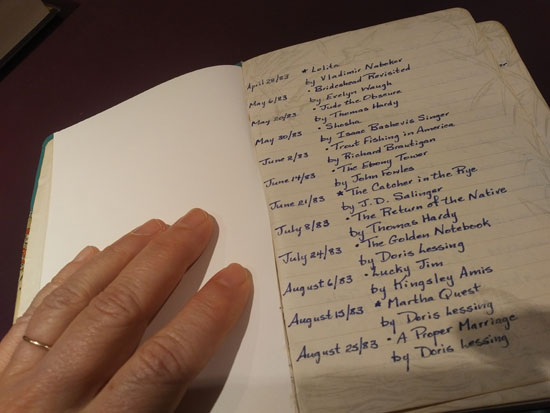
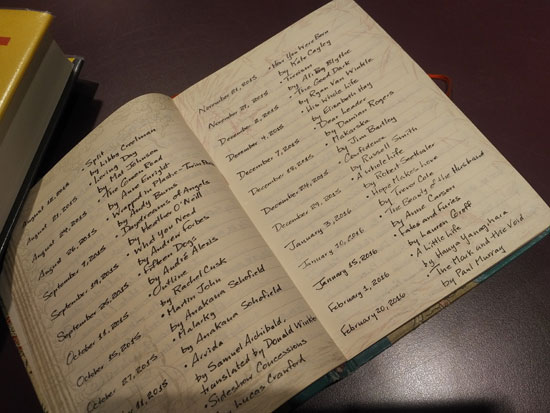
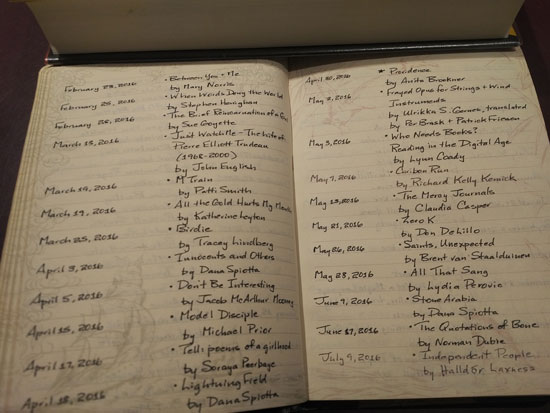
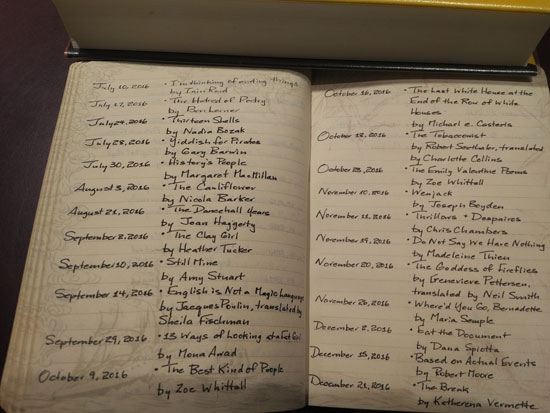
Here are the books I read in 2015, with links to reviews (here on this blog or on Goodreads) where I have them. (I confess that I didn’t get many books fully reviewed this past year. I’ll try to improve in that department in the upcoming year.) As I’ve done in previous years, this is an exhaustive, “all of” list, not a “best of” list.

I continued my commitment in 2015 to a daily devotion to at least one poem … and usually more, as friends on Twitter continued to generously share their poem choices and reflections via the #todayspoem hashtag. Now four years in, I haven’t missed a day, both contributing and enjoying selections from others in this edifying and vital communal experience. I’ve now pondered the works of well over 800 unique poets, writers, songsmiths and wordsmiths I’ve revisited or unearthed myself, and countless more via others wielding that often revelatory hashtag. On into its fifth year, I’m continuing with my #todayspoem habit every day heading into 2016, and I hope many will continue or join anew.

I also celebrated some uniquely beautiful books in 2015, including:

Here are the books I read, reread and read aloud in 2015. Wherever I go, I try to carry a book with me, so for each book, I’m also going to try to recall where I was when I was reading it.

  1. The Gallery of Lost Species
    by Nina Berkhout
    (reread)

    I read this book at my desk in my home office, as I prepared the readers’ guide / book club questions for this book, offered by House of Anansi Press.

  2. Mrs Killick’s Luck
    by Christina Fitzgerald

    As this book is in somewhat delicate condition, I never took it out of the house. I read this book at my desk in my home office and at the dining room table.

  3. Hard Light
    by Michael Crummey
    (reread)

    I toted this book everywhere – on the subway, on the streetcar, in coffee shops while waiting to meet up with friends.

  4. Fire and Air
    by Erik Vlamincky, translated by Paul Vincent

    This is another book I recall reading on transit.

  5. The First Bad Man
    by Miranda July

    Not only did I take this book with me on transit, but I was finishing the last few pages as I took the subway to see Miranda July at an Appel Salon event at the Toronto Reference Library.

  6. 10:04
    by Ben Lerner

    I was so wrapped up in this book that I had it with me when we went to see The New Pornographers at the Danforth Music Hall in early February, and I was reading it before the show started.

  7. Life is About Losing Everything
    by Lynn Crosbie

    I was definitely reading this book on the subway.

  8. The Devil You Know
    by Elisabeth de Mariaffi

    I read this book several times on the subway, including when I went to the Rowers Reading Series to hear Elisabeth de Mariaffi read from it. (She read a section I’d already read, if I recall correctly …)

  9. Into the Blizzard
    by Michael Winter
    (read aloud)

    This book was our (my husband and I) read aloud book over winter 2015. Typically, I read aloud while my husband concocts wonderful dinners for us – he’s an amazing chef. So, most read aloud time is in our cozy kitchen, around the cooktop island, accompanied by a glass or two of wine.

  10. Breathing Lessons
    by Andy Sinclair

    Both the engrossing story and the neon book cover brightened up a few subway rides.

  11. Backup Singers
    by Sommer Browning

    I remember reading this poetry collection in the kitchen and at the dining room table.

  12. Her Red Hair Rises With the Wings of Insects
    by Catherine Graham

    I took this poetry collection with me on a few errands, and I recall dipping into it while in the vet clinic waiting area, for example.

  13. Safely Home Pacific Western
    by Jeff Latosik

    This poetry collection accompanied me on several subway rides.

  14. The Amazing Adventures of Kavalier & Clay
    by Michael Chabon

    I read this book in my home office as I followed along online as part of the One Book, One Chicago reading sprints. The Amazing Adventures of Kavalier & Clay is a lively, addictive read perfectly suited to that participatory format. Our dog Fionn was often my company during reading sprints.

  15. My October
    by Claire Holden Rothman

    I recall reading this book on a restaurant patio on a surprisingly warm spring evening while waiting for a friend.

  16. The Road In Is Not The Same Road Out
    by Karen Solie

    I won a copy of this at the Anansi Poetry Bash, and started reading it on the subway ride home that very evening.

  17. Human Voices
    by Penelope Fitzgerald
    (reread)

    This is another delicate book not allowed out of the house. I recall reading it snuggled in my favourite reading chair and in bed.

  18. A Serious Call
    by Don Coles

    I recall that this poetry collection was my calming companion when I got stuck on the subway for a protracted delay one evening.

  19. One Night in Mississippi
    by Craig Shreve

    I distinctly remember reading this book at the cottage in early spring.

  20. Close to Hugh
    by Marina Endicott

    I got in some late spring/early summer porch reading with this wonderful book.

  21. Daddy Lenin and Other Stories
    by Guy Vanderhaeghe

    I remember reading this book in the comfy reading chair in our loft bedroom at the cottage.

  22. I Shall Not Hate / A Gaza Doctor’s Journey
    by Izzeldin Abuelaish

    I recall the bright sunshine at the cottage contrasting sharply with this somber but ultimately inspiring book.

  23. Something Crosses My Mind
    by Wang Xiaoni, translated by Eleanor Goodman

    I remember reading this poetry collection both at the cottage and at home.

  24. Tell
    by Frances Itani

    I definitely remember reading this book while relaxing on the dock at the cottage. In fact, I was so engrossed in it at one point that when I glanced up, a loon was swimming very close to the dock.

  25. Just Kids
    by Patti Smith

    This is another book I gobbled up while relaxing on the dock at the cottage.

  26. Where Did You Sleep Last Night
    by Lynn Crosbie

    I vividly recall reading a large chunk of this book on a long drive home from the cottage.

  27. Split
    by Libby Creelman

    I read this book at the cottage, on the dock, on a sunny rock, and indoors when the bugs were fierce.

  28. Loving Day
    by Mat Johnson

    When I’m alone at the cottage, I read while I’m eating. I recall reading this book at the cottage dining room table, with sunlight trickling in through the trees at the front of the cottage, with the pages of the book propped open with a chunk of quartz that I keep expressly for book-propping-open purposes.

  29. The Green Road
    by Anne Enright

    Not only did I savour this book while alone at the cottage, but I had a wonderful discussion about it with one of my cottage neighbours while walking the dogs one morning.

  30. Wrapped in Plastic – Twin Peaks
    by Andy Burns

    I have very fond and vivid memories of reading this book, accompanied by a mini binge watch of Twin Peaks on DVD, over a few rainy days alone at the cottage. I set up a portable DVD player in the loft bedroom, curled up in a comfy chair with book, popcorn and bourbon, and had myself a wonderful, spooky time with Agent Cooper et al.

  31. Daydreams of Angels
    by Heather O’Neill

    I remember reading this book in the waiting room at the doctor’s office. I’m always very glad to bring my own reading material to waiting rooms …

  32. What You Need
    by Andrew Forbes

    I definitely recall reading this book on a number of subway and streetcar rides.

  33. Fifteen Dogs
    by Andre Alexis

    This book was another much appreciated transit companion … although the book rendered me verklempt more than one in public.

  34. Outline
    by Rachel Cusk

    This book was my travel companion on a sunny autumn day when I took the subway to Harbourfront for Word on the Street, then took the Spadina streetcar and subway to the High Park Reading Festival, and then took the subway home in the evening when the High Park poetry readings were over.

  35. Martin John
    by Anakana Schofield

    Is it kind of ironic that I read this book on the subway?

  36. Malarky
    by Anakana Schofield

    This book was another constant transit companion.

  37. Arvida
    by Samuel Archibald, translated by Donald Winkler

    I carried this book with me to and fro on the subway to International Festival of Authors (IFOA) events, and often read it between events, too.

  38. Sideshow Concessions
    by Lucas Crawford

    In addition to Arvida, I also had this poetry collection with me during IFOA visits. Before a reading, I recall sitting upstairs in the Queens Quay building, gazing out at Lake Ontario, reading a few poems from this collection, alternating with stories from Arvida.

  39. How You Were Born
    by Kate Cayley

    I remember purchasing this very fine short story collection at IFOA. I remember reading it during a wintry visit to the cottage.

  40. Twoism
    by Ali Blythe

    I distinctly recall reading this poetry collection on the subway, and getting a look from a young woman across from me of that special recognition that readers give each other.

  41. The Good Dark
    by Ryan Van Winkle

    This poetry collection was another fine transit companion.

  42. His Whole Life
    by Elizabeth Hay

    I tend to drift off after just a few pages when I read in bed, but this book held my attention and often kept me awake, but in a good way.

  43. Dear Leader
    by Damian Rogers

    I distinctly recall reading this poetry collection while sitting in a pub, having a beer and waiting to meet my husband for dinner. I was especially grateful to have those poems for company, as all the screens in the pub, which normally showed sporting events, were all tuned to some infuriating and violent breaking news about which I’d had enough.

  44. Makarska
    by Jim Bartley

    This novel was an excellent and absorbing subway companion during a week when I had a lot of appointments, meetings and errands to run.

  45. Confidence
    by Russell Smith

    I was reading (and being charmed by) this book at a restaurant while waiting to meet a friend for dinner, followed by the Tafelmusik rendition of Handel’s Messiah at Koerner Hall.

  46. A Whole Life
    by Robert Seethaler

    I was reading this book as we drove from Toronto to Kitchener on Christmas morning to visit with family.

In 2015, I read 31 works of fiction (novels and short story collections), 11 poetry collections and 4 works of non-fiction.

Currently in progress, heading into 2016:

  • Hope Makes Love
    by Trevor Cole

  • Just Watch Me – The Life of Pierre Elliott Trudeau: 1968-2000
    by John English
    (read aloud)

    This book was particularly comforting and almost talismanic to read during the interminable 2015 federal election campaign.

Looking back fondly on my 2015 reading, looking forward eagerly and with anticipation to my 2016 reading, I’ll simply conclude (as I’ve done in previous years) …

It’s not how many you read that counts. It’s that you read that counts.